
"AI hiring tools" is one of the most confused phrases in recruiting software.
Vendors attach the label to everything from a transcription bot to an enterprise talent platform.
The useful ones each do one job well: capture interviews and draft the scorecard, find passive candidates through sourcing and outreach, screen applicants by chat, phone, or video, schedule panels, or test skills. The table below names the job, who each tool fits, and what it costs.
Here are 13 AI hiring tools recruiting teams use in 2026. For each one we cover what it does, where it falls short, and who it fits, then close with a guide to choosing by bottleneck.
All 13 tools at a glance.
| Tool | Category | Best for | Pricing |
|---|---|---|---|
| Metaview | AI interview intelligence | Structured candidate reports with ATS write-back | Free with work email |
| HireEZ | AI sourcing | Passive-candidate sourcing at scale | Quote-based |
| Paradox (Olivia) | Conversational AI | High-volume hourly and frontline hiring | Quote-based |
| Puck | AI phone screening | High-volume, inbound-heavy hiring | From $300/month |
| Gem | AI sourcing + outreach | In-house teams running outbound campaigns | Quote-based |
| InterviewFlowAI | AI interviewing and screening | Automating first-round phone and video interviews | From $59/month, credit based |
| GoodTime | AI interview scheduling | Coordinating multi-stakeholder interview panels | Quote-based |
| Eightfold | AI talent intelligence | Enterprise talent management at scale | Quote-based |
| SeekOut | AI talent intelligence | Specialized and cleared talent sourcing | From $833/seat/month |
| Manatal | AI agency software | Cost-conscious agencies and recruiters | From $15/user/month |
| HireVue | AI video assessment | High-volume video screening and assessment | Quote-based |
| Hirevire | Async video screening | Screening high volumes without scheduling | From $39/month billed yearly |
| Xobin | AI talent acquisition and assessment | Staffing agencies and TA teams running technical interviews | Published starting prices |
1. Metaview.
Best for: recruiting and TA teams where interview signal drives hiring decisions.
Metaview is the AI interview intelligence platform built for recruiters and hiring managers.
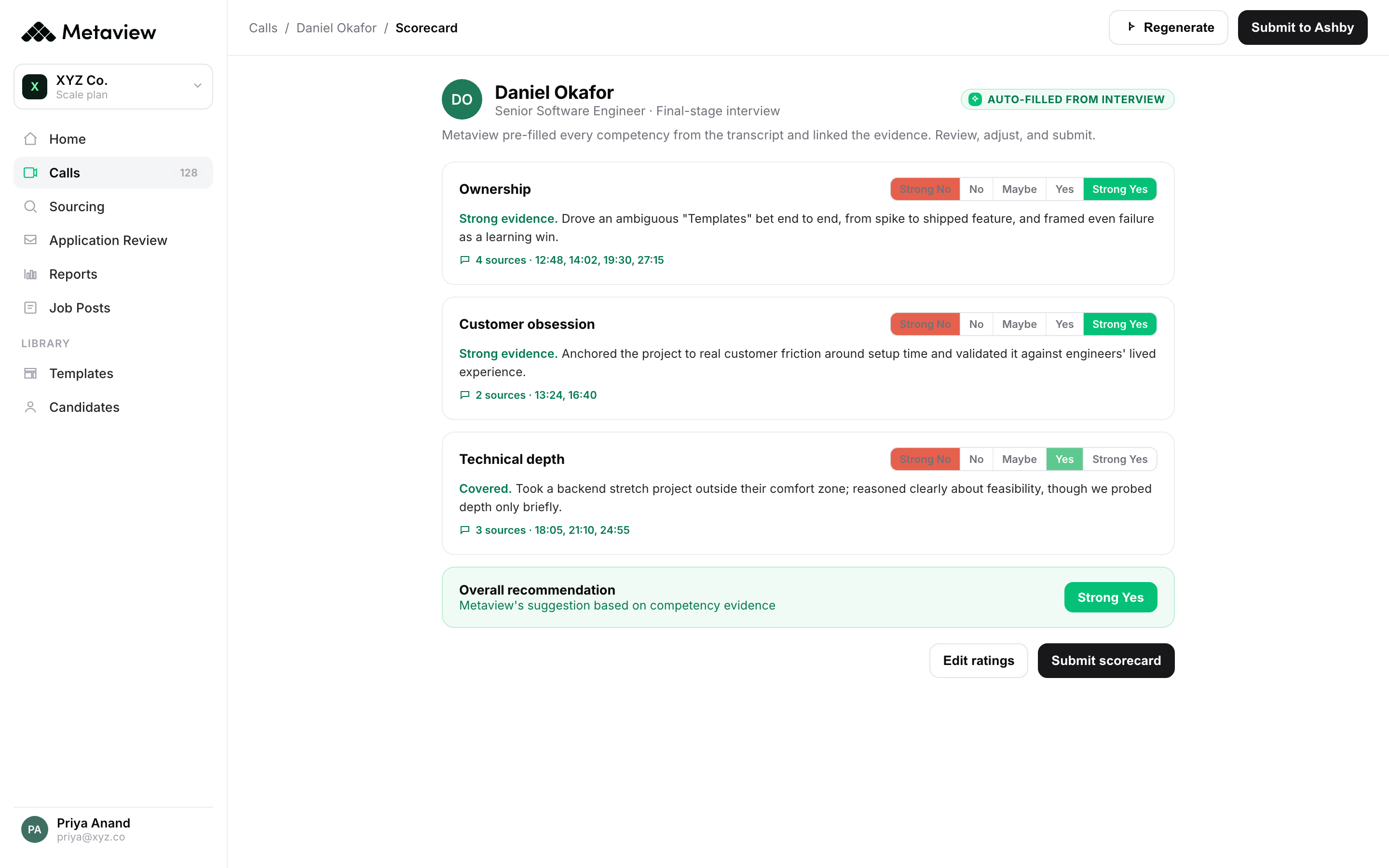
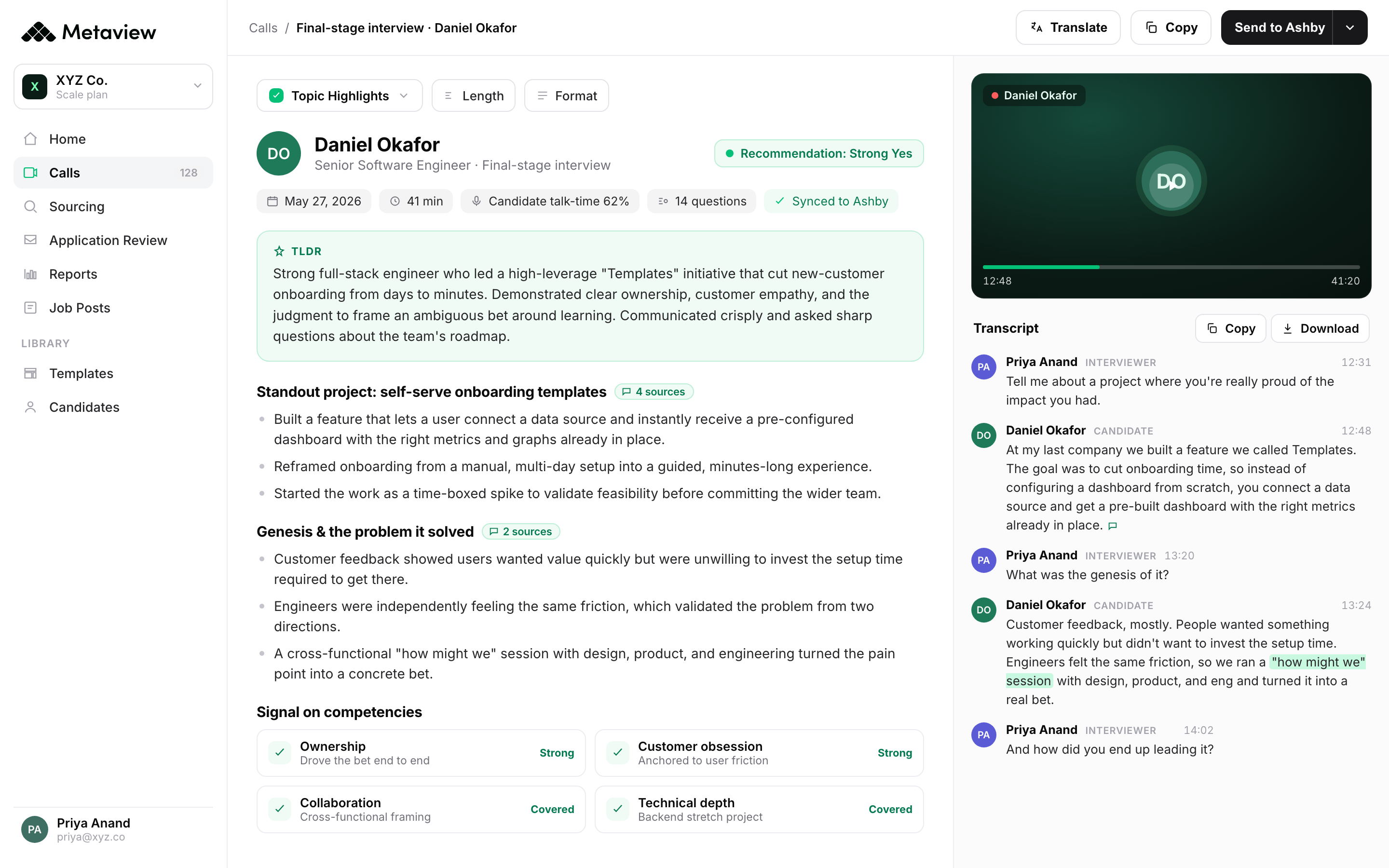
The recruiter takes the call. Metaview joins as a visible participant, transcribes it, maps the candidate's answers against the role's rubric, and drafts the scorecard for the recruiter to review and submit.
Each point in the report links back to the moment in the transcript. Interview capture is one agent among several: Metaview's others cover sourcing, application review, screening, and reporting.
What you get on day one:
- Structured candidate reports mapped to your interview rubric.
- Scorecard submission straight into Ashby and Lever, and browser-extension autofill of the objective scorecard fields in Ashby and Greenhouse.
- ATS integrations with 114 applicant tracking systems across the platform, and capture on Zoom, Google Meet, Microsoft Teams, and Webex.
- AI Sourcing with its own free tier, covered below.
- SOC 2 Type II, GDPR, and CCPA compliance.
- Free tier for the Notetaker with a work email; paid plans are priced per agent (see metaview.ai/pricing).

I've fallen in love with features like Candidate Comparison which allows me to compare candidates based on our interview structure, and also with having an AI assistant that deep dives on the scorecard. It's just next level.”
Our pick: recruiting teams that want the scorecard drafted before the debrief. The Notetaker has a free tier, so you can pilot it without a budget line.
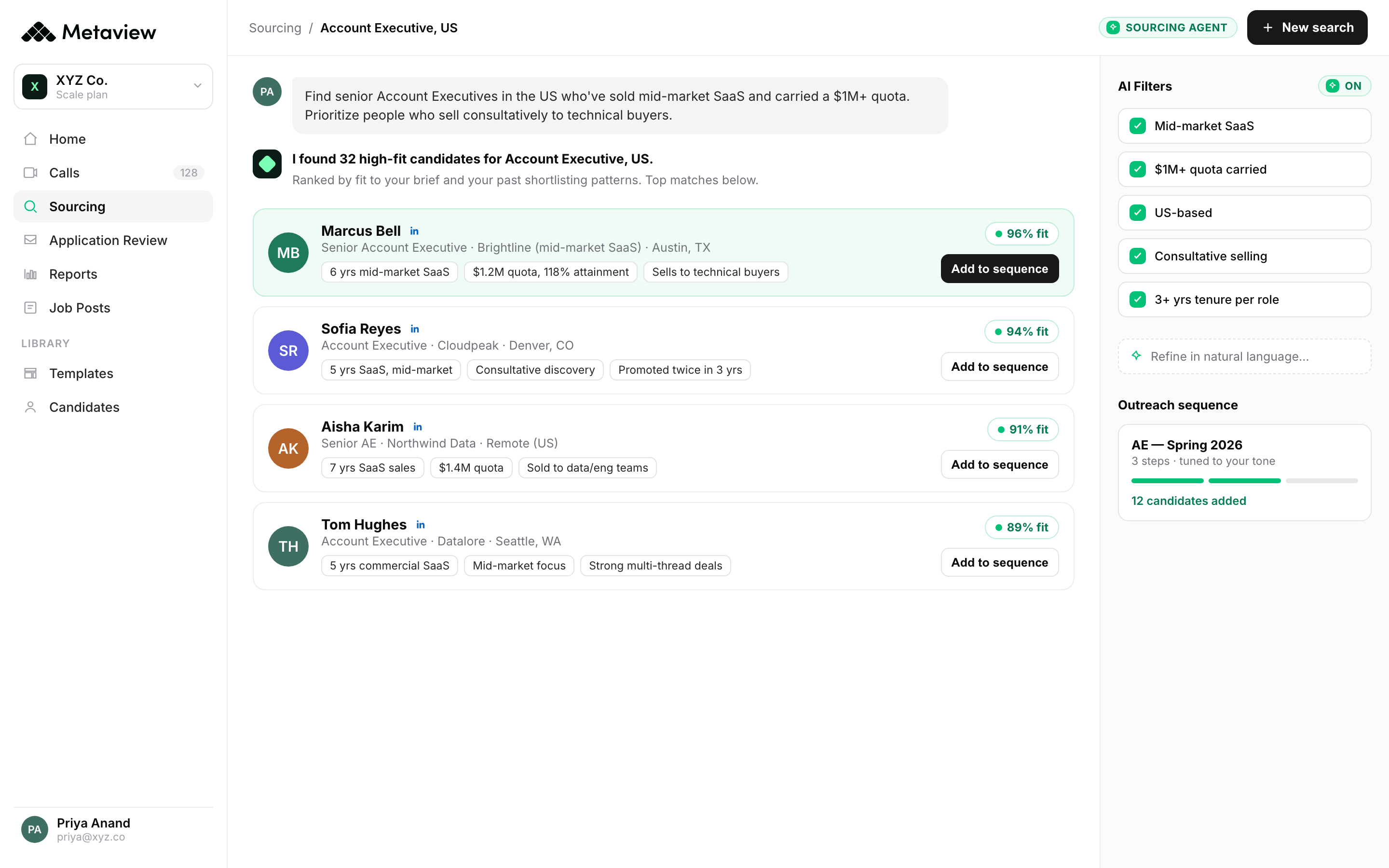
The same platform runs sourcing from a short role brief. The agent searches the web, your connected ATS, and your past Metaview conversations, and returns a ranked shortlist with the reasons shown:
2. HireEZ.
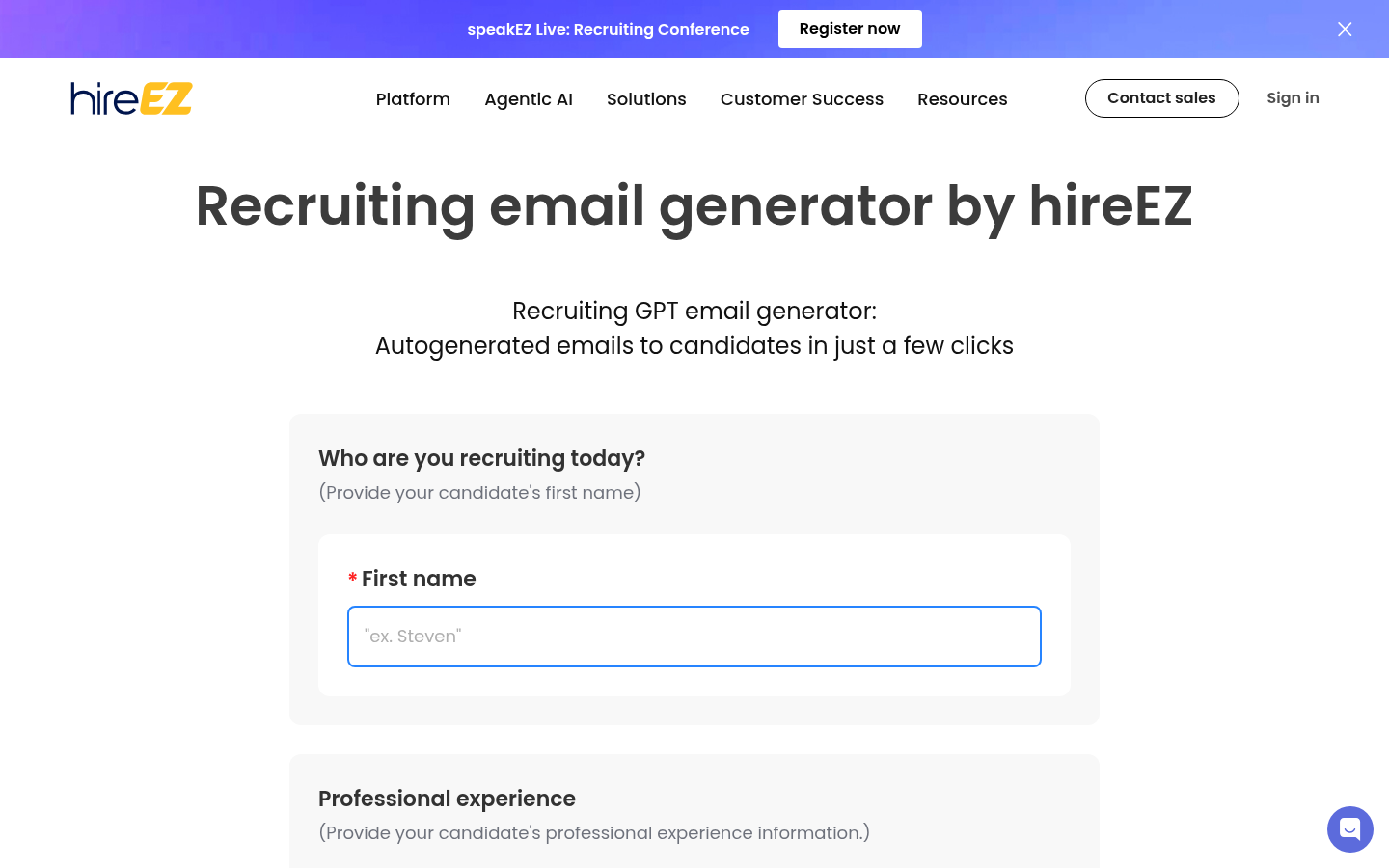
Best for: mid to large teams running active outbound sourcing at scale.
HireEZ is the leading AI sourcing platform for candidate discovery. 750M+ profiles indexed from 45+ platforms, with AI matching across all of them.
What you get:
- Cross-platform sourcing engine (LinkedIn, GitHub, Stack Overflow, Behance).
- AI candidate matching against your role brief.
- Automated email outreach sequences with personalization tokens.
- Native ATS integrations for Greenhouse, Lever, Workday, Bullhorn.
Where it falls short: Contact information accuracy is uneven. G2 reviewers consistently flag bounce rates as high as 30% on some segments. Verify contact data before sending high-volume sequences.
Our pick: mid to large in-house teams where outbound sourcing drives the pipeline. For budget-conscious teams, see our HireEZ alternatives guide.
3. Paradox (Olivia).
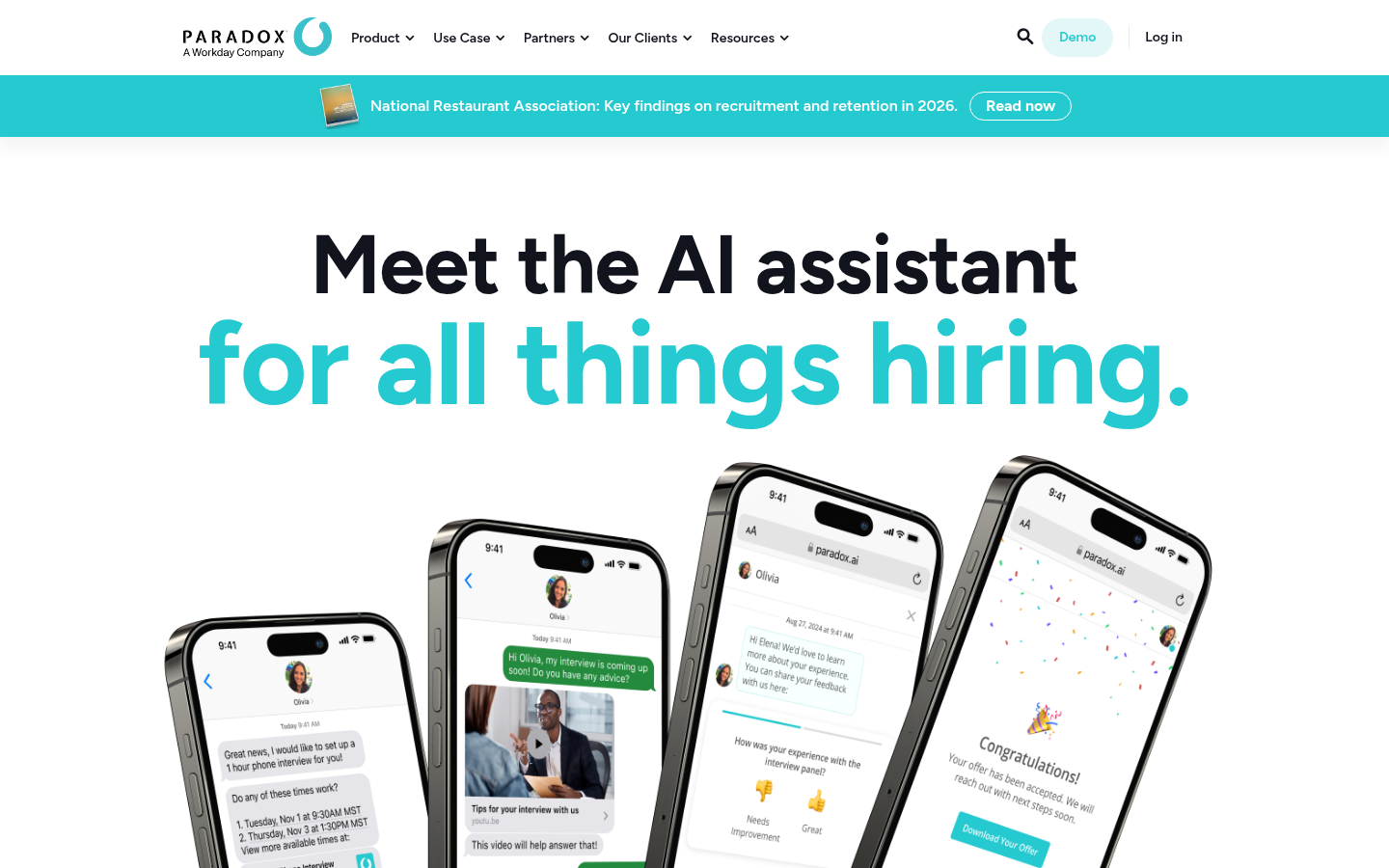
Best for: high-volume frontline and hourly hiring.
Paradox, powered by its AI assistant Olivia, is a conversational recruiting platform. It automates the high-volume side of hiring: screening, scheduling, FAQs, and onboarding.
What you get:
- Conversational AI for candidate screening and engagement.
- Automated interview scheduling and reminders.
- Multi-language support across SMS, WhatsApp, and web chat.
- Native integrations with major ATS platforms.
Where it falls short: Primarily built for high-volume and frontline roles. Not the right tool for partner-led search or six-figure exec mandates.
Our pick: retail, hospitality, and frontline employers where the funnel volume is too large for human screening.
4. Puck.
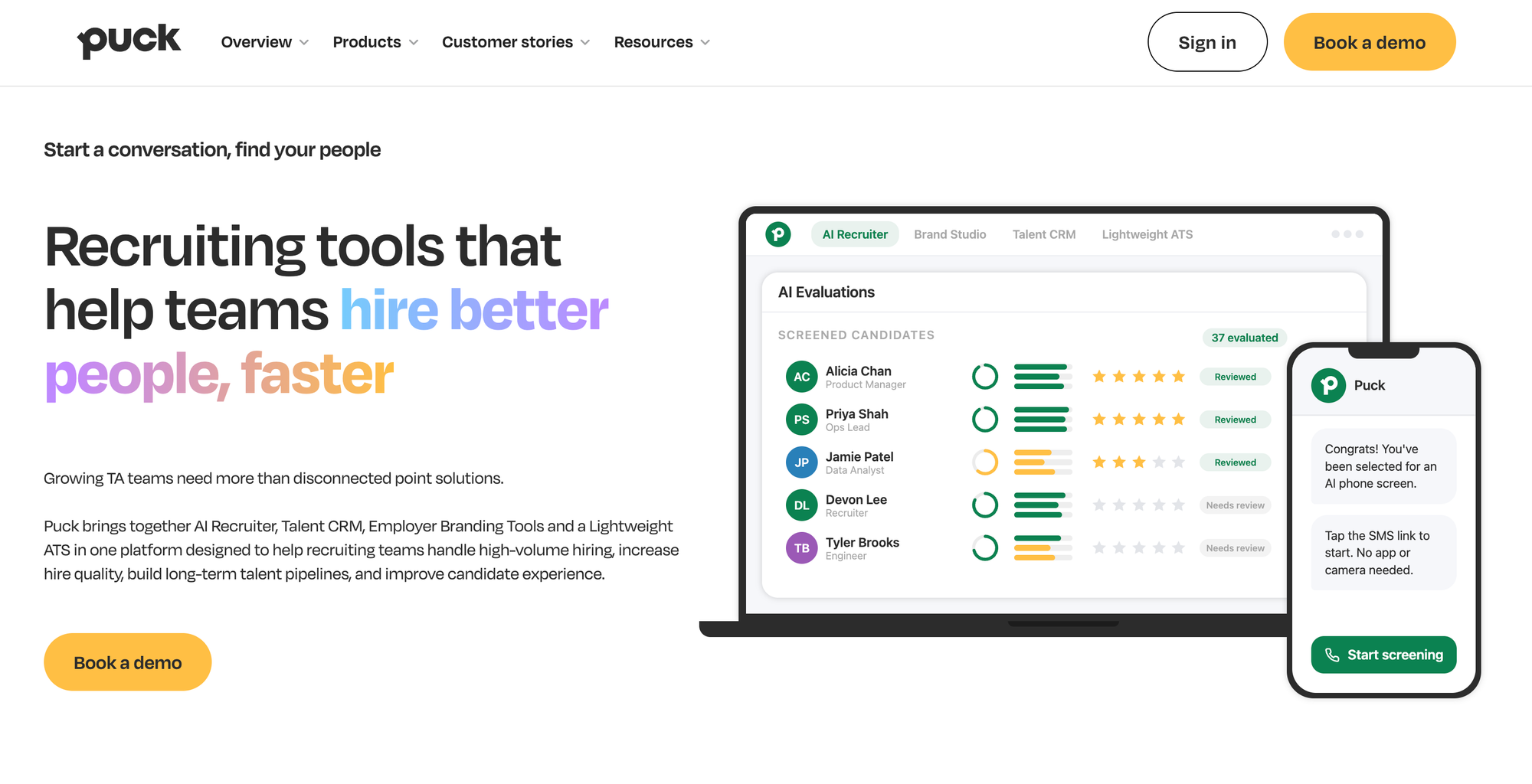
Best for: high-volume and inbound-heavy teams that need phone screening without calendar coordination.
Puck is talent acquisition software built around faster candidate screening and assessment, with an employer branding focus.
Candidates open an SMS or email link and complete a two-way conversational audio screen on their own time. The process takes about 10 minutes, requires no camera or app, and supports multiple languages.
What you get:
- Custom questions for structured phone screens.
- On-demand candidate screening launched through an SMS or email invite.
- Interviews scored against a standardized skills list, with recordings and transcripts, followed by recruiter review and a human decision.
- Employer-branded podcasts with real employee stories embedded into job pages and outreach.
- AI resume review, candidate matching, and automated follow-up.
- A Talent CRM, lightweight ATS, branded career pages, and job board distribution.
- Greenhouse, Ashby, Lever, and other native ATS integrations.
Where it falls short: Puck's center of gravity is high-volume, inbound-heavy hiring. Teams focused on bespoke search or low-volume executive recruiting may prefer a process centered on sourcing and relationship management.
Our pick: teams with more inbound applicants than recruiters can phone-screen, especially when employer brand matters.
5. Gem.
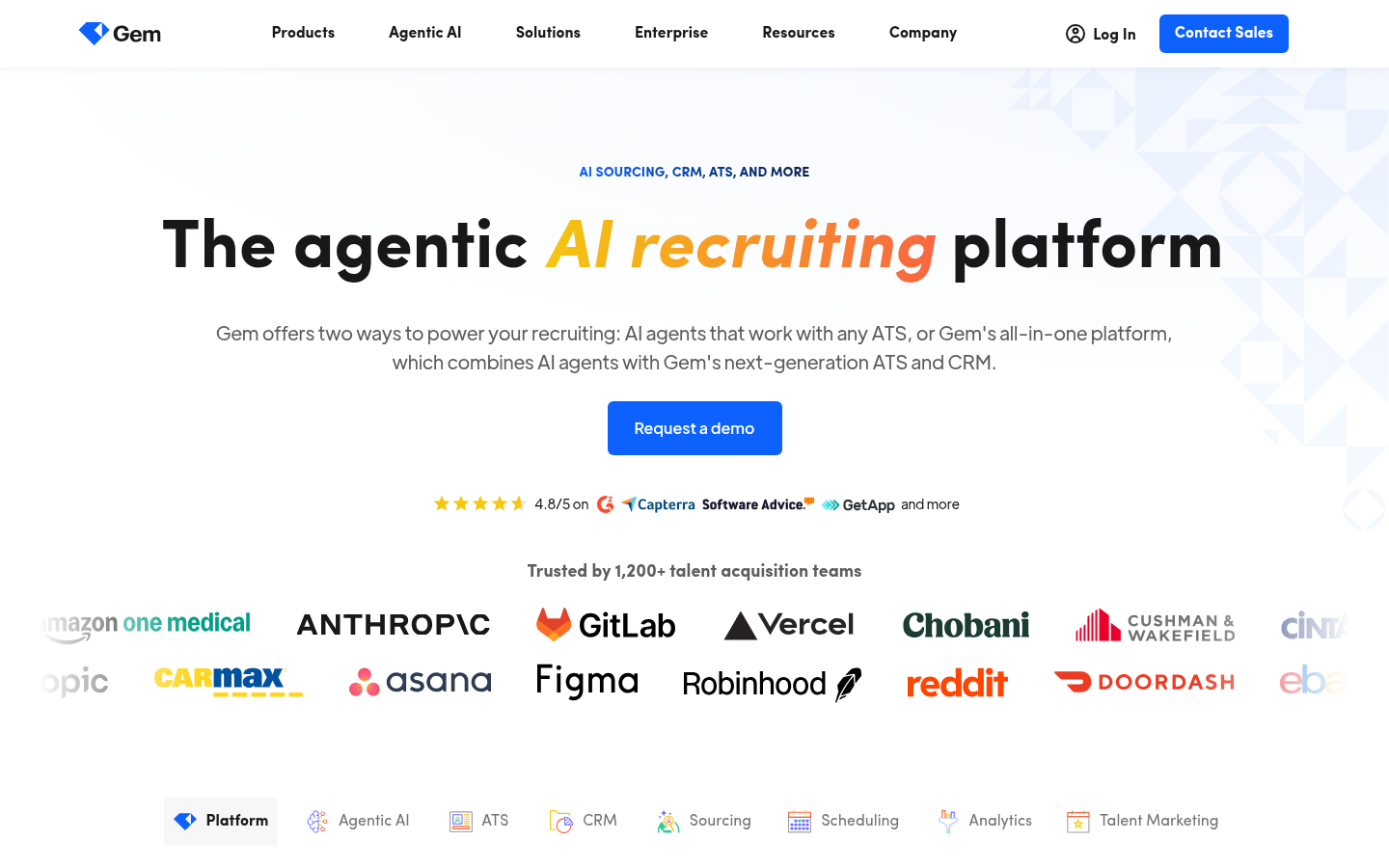
Best for: in-house teams running outbound campaigns where reply rates drive the pipeline.
Gem is the sourcing and outreach platform that has expanded into a full ATS+CRM since acquiring ModernLoop. For teams running heavy outbound, Gem is the center of the campaign workflow.
What you get:
- 800M+ profile sourcing engine.
- Email outreach with sequence analytics across reply rates and conversion.
- ATS and CRM unified, with native scheduling via ModernLoop.
- AI-led talent CRM with the Taylor AI assistant layer.
Where it falls short: Enterprise-only pricing. Originally built for in-house teams; the agency fit is workable but the data model wasn't designed mandate-first.
Our pick: in-house GTM and engineering recruiting teams where outbound volume drives the placements.
6. InterviewFlowAI.
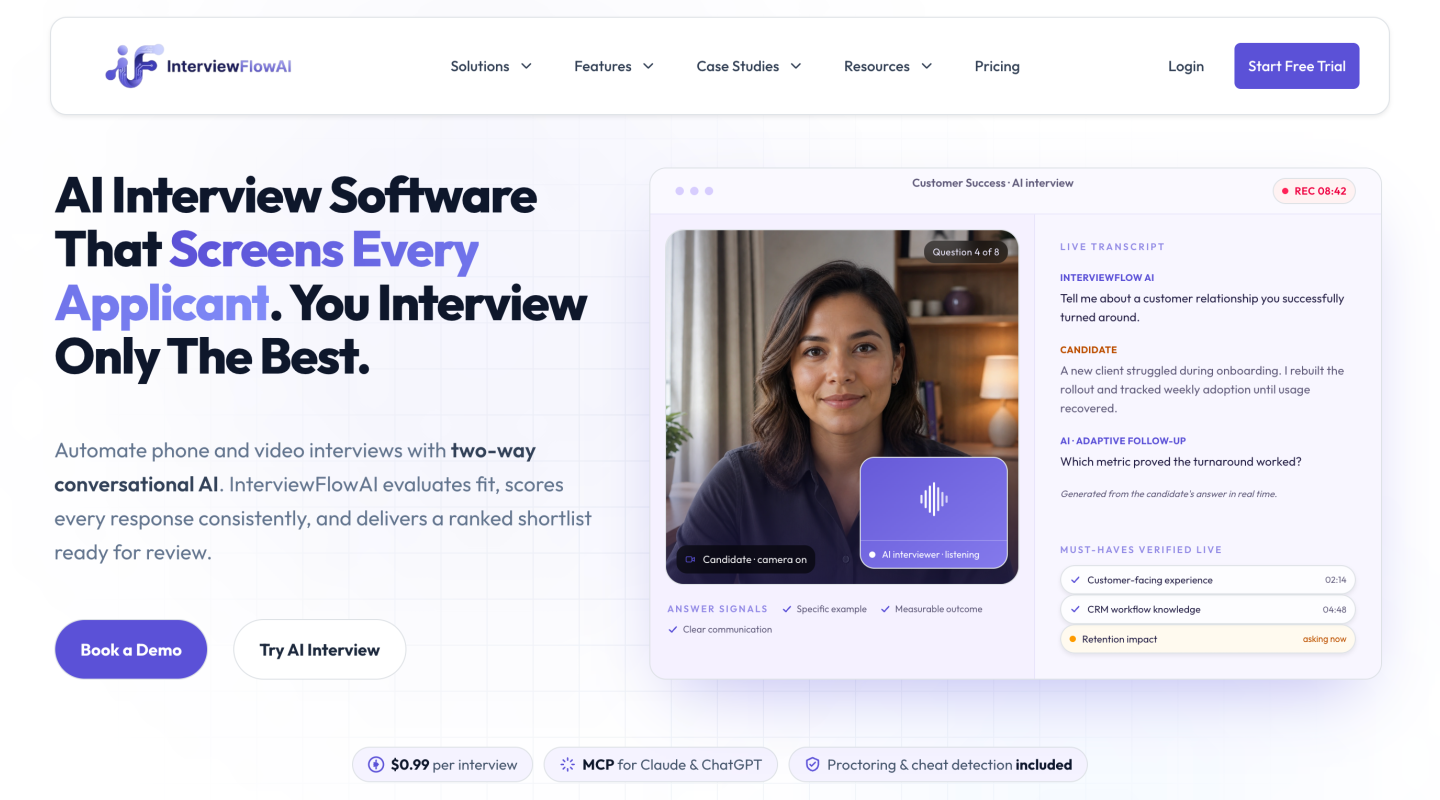
Best for: teams automating first-round candidate interviews with conversational AI.
InterviewFlowAI is an AI interviewing and screening platform that conducts two-way conversational video and phone interviews without requiring a recruiter to join. The AI asks role-specific questions, dynamically follows up on candidate responses, and turns each interview into a structured evaluation recruiters can review before deciding who moves forward.
What you get:
- Conversational AI video and phone interviews with dynamic follow-up questions.
- Resume-based, skill-based, and custom interview questions.
- Recordings, transcripts, per-question scoring, and structured candidate reports.
- Resume screening, knockout questions, assessments, and interview proctoring.
- Multilingual interviews for global hiring.
- ATS integrations with Greenhouse, Ashby, Teamtailor, and Workable, plus Zapier.
- API, webhooks, and MCP connectivity for custom recruiting workflows.
- Usage-based pricing: on monthly Growth and Scale plans, $0.99 buys one interview credit, with Pilot at $2.95 per credit and Growth and Scale at $0.83 per credit billed yearly, making it practical for high-volume hiring teams.
Where it falls short: InterviewFlowAI is primarily designed for screening and interviewing candidates once they enter the hiring funnel. Teams looking primarily for outbound candidate sourcing may need to pair it with a dedicated sourcing platform.
Our pick: recruiting teams with more applicants than recruiters can realistically interview, especially when they want to automate first-round interviews while still giving candidates a two-way conversational experience.
7. GoodTime.
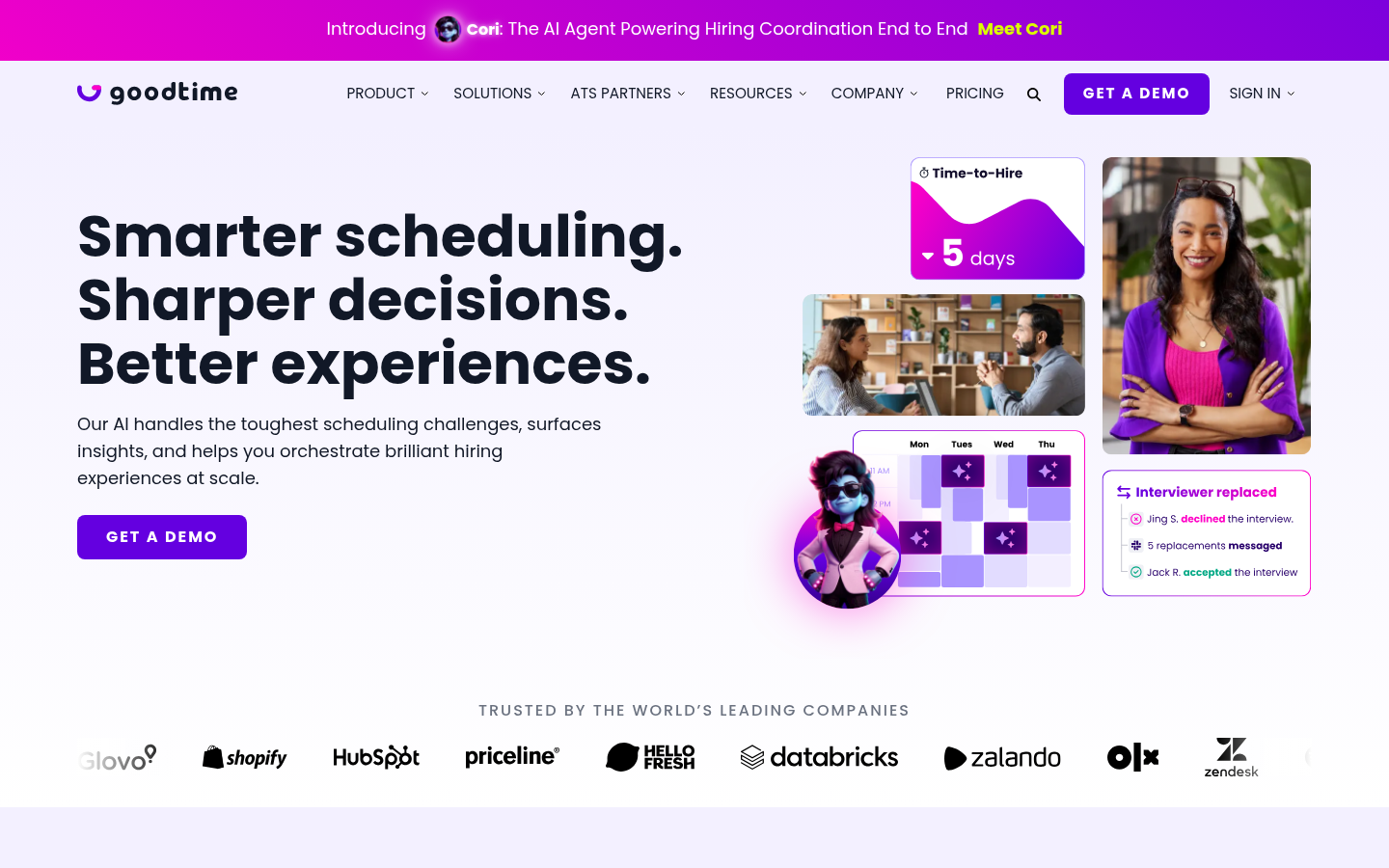
Best for: teams running multi-stakeholder interview panels at scale.
GoodTime is the AI scheduling platform built for hiring teams juggling complex panel coordination. It eliminates the back-and-forth of finding times across candidate, recruiter, and interviewer calendars.
What you get:
- AI interviewer matching across multiple roles and panels.
- Candidate self-scheduling links.
- Calendar syncing across recruiters, interviewers, and external stakeholders.
- Interviewer load balancing to prevent overbooking.
Where it falls short: Built for in-house TA, not agencies. Best fit when scheduling friction is a real bottleneck in your hiring loop.
Our pick: high-growth tech companies where 4-5 round on-site interviews need to coordinate across senior interviewers. See our automated interview scheduling tools roundup for the wider category.
8. Eightfold.
Best for: enterprise talent management at scale, including internal mobility.
Eightfold is the enterprise AI talent intelligence platform. The pitch is one AI brain that runs across recruiting, internal mobility, workforce planning, and skills development.
What you get:
- AI talent intelligence layer across hiring and internal mobility.
- Skills-based candidate matching and sourcing.
- Career-site personalization and candidate experience tools.
- Workforce-planning and reskilling analytics.
Where it falls short: Enterprise-only pricing and implementation complexity. Best suited to 5,000+ person organizations with mature HR functions, not high-growth scaleups.
Our pick: Fortune 500 talent functions where AI needs to run across recruiting plus the broader talent lifecycle.
9. SeekOut.
Best for: teams hiring for specialized, cleared, or technical roles.
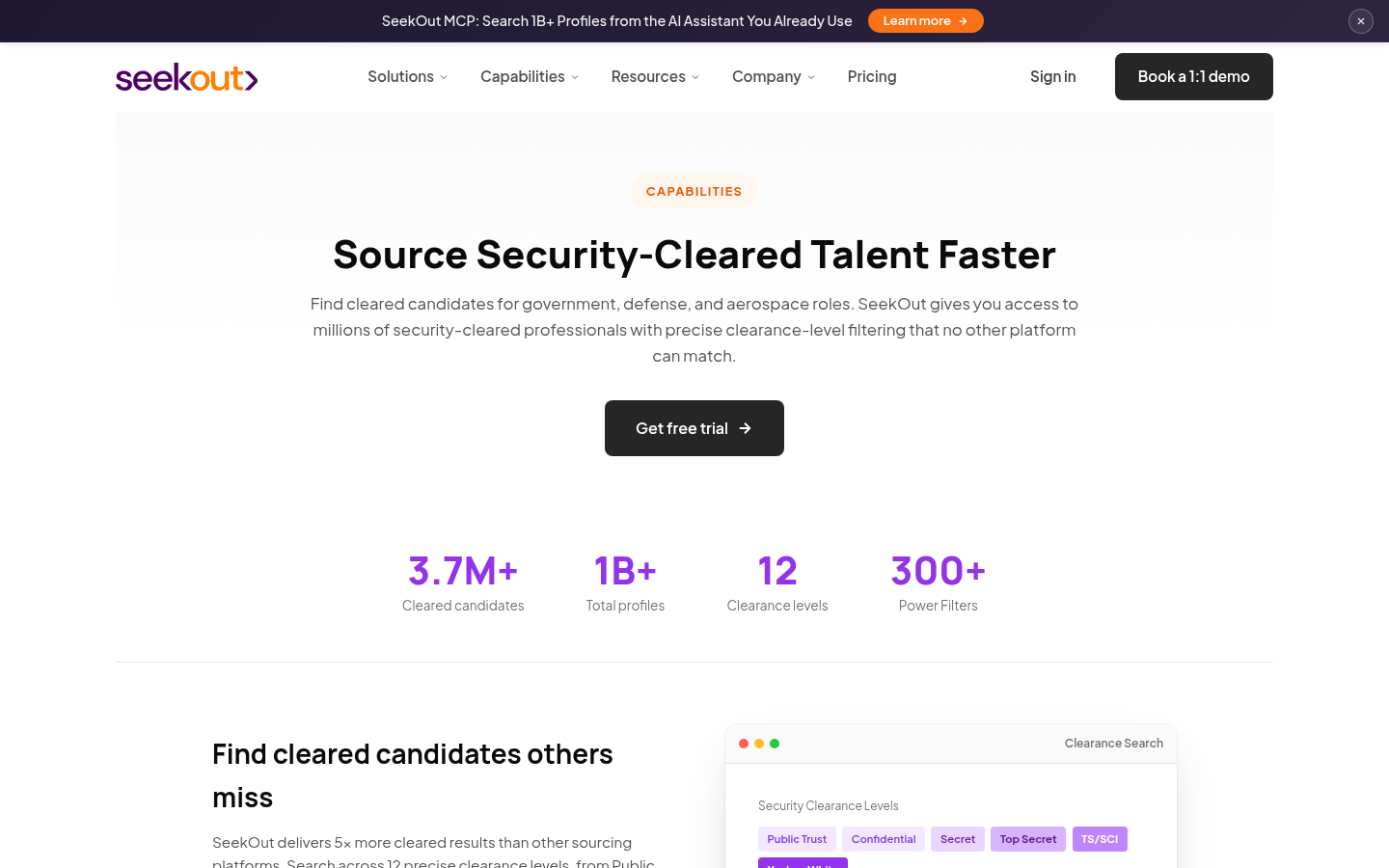
SeekOut is an enterprise talent intelligence platform with unusually deep specialized filters. 1B+ profiles, 3.7M+ security-cleared profiles, plus rich diversity and veteran data.
What you get:
- Full-graph sourcing with specialized filters (clearance, diversity, technical skills, GitHub activity).
- SeekOut Assist: paste a JD, get auto-built Boolean and filter strings.
- ATS rediscovery on Greenhouse, Lever, Workday.
- 14-day trial available.
Where it falls short: No perpetual free SKU. After the trial, paid seats run at $833 per seat per month or more.
Our pick: defense-adjacent, cleared-civilian, or specialized technical recruiting. See our SeekOut alternatives roundup for the wider landscape.
10. Manatal.
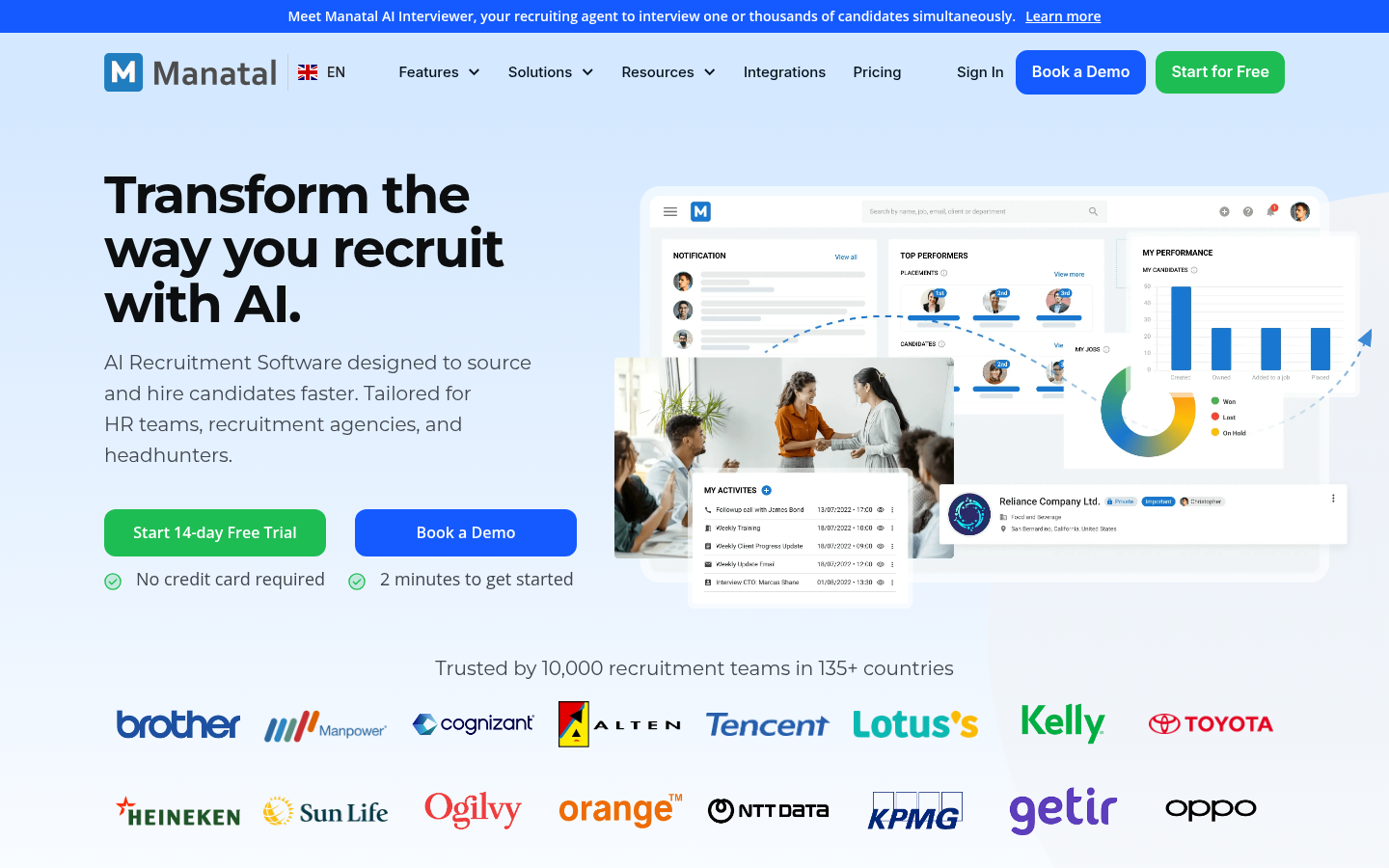
Best for: cost-conscious agencies and recruiting teams.
Manatal is an AI-driven recruitment platform built for teams that want capable AI features without the enterprise price tag. Strong on social-media enrichment, candidate scoring, and AI matching.
What you get:
- AI candidate recommendations and scoring.
- Social-media enrichment to flesh out thin candidate profiles.
- Advanced search and filtering.
- Client and candidate portals for collaboration.
- Pricing from $15/user/month on the Professional plan.
Where it falls short: Less depth on enterprise reporting and contract back-office than Bullhorn or Vincere. Best for desks that don't need full mid-office handling.
Our pick: small to mid-sized agencies that want serious AI features without a six-figure CRM line item.
11. HireVue.
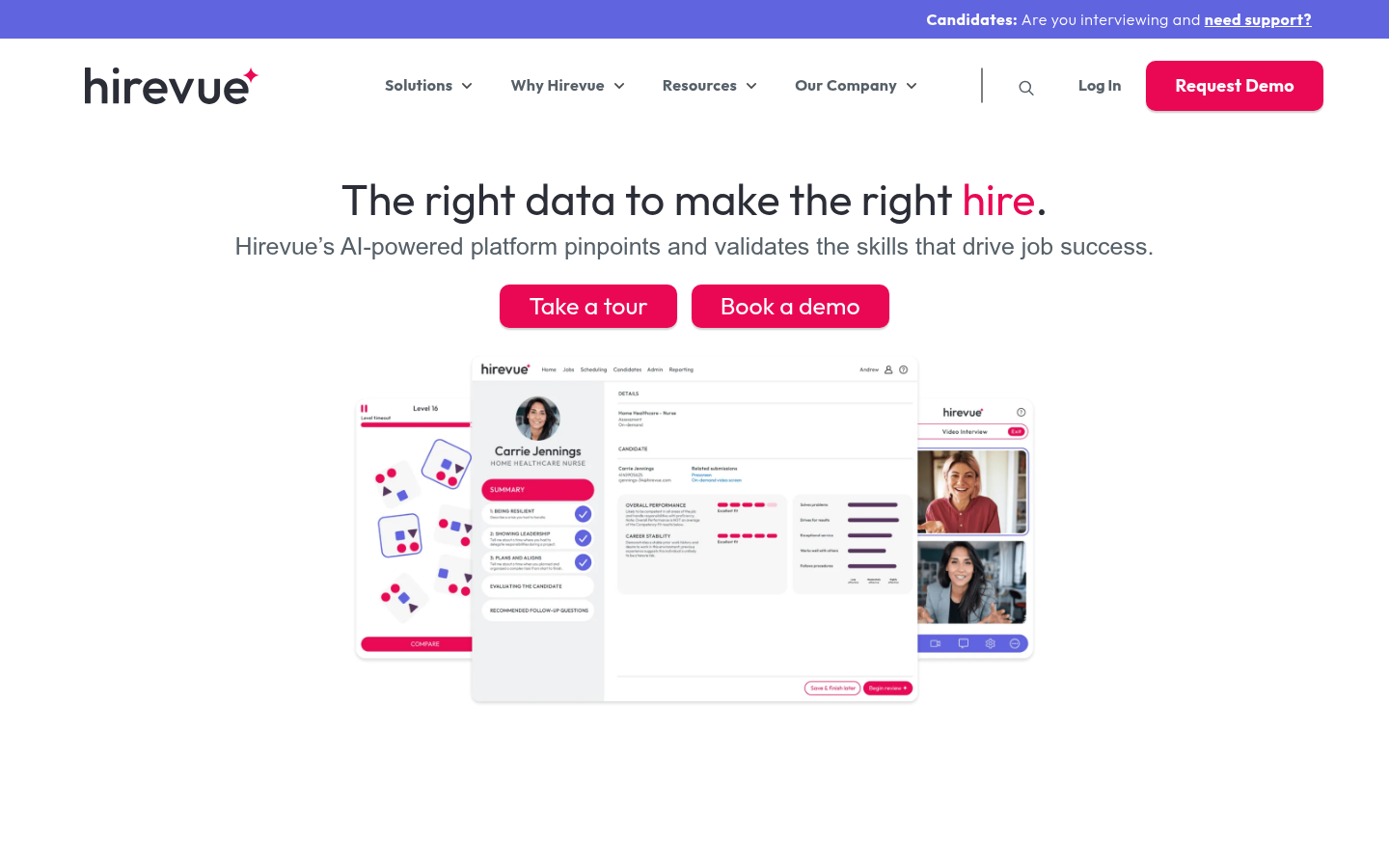
Best for: high-volume video screening, assessment, and skill validation at scale.
HireVue is the AI video interviewing and assessment platform. The pitch is structured, fair, and consistent screening at the top of a high-volume funnel.
What you get:
- Pre-recorded video interview workflows with structured questions.
- AI skill validation and competency scoring.
- Game-based assessments for cognitive and behavioral traits.
- Enterprise-grade compliance and bias-detection tooling.
Where it falls short: Pre-recorded video interviews can feel impersonal to candidates. The product is strongest at the top of the funnel, less so for the partner-led conversations that decide a senior hire.
Our pick: enterprise TA functions and high-volume hiring teams running thousands of screening assessments per quarter. Teams hiring across several languages can also look at KitaHQ, whose AI video interviews let candidates answer in their preferred language and give recruiters the report in English.
12. Hirevire.
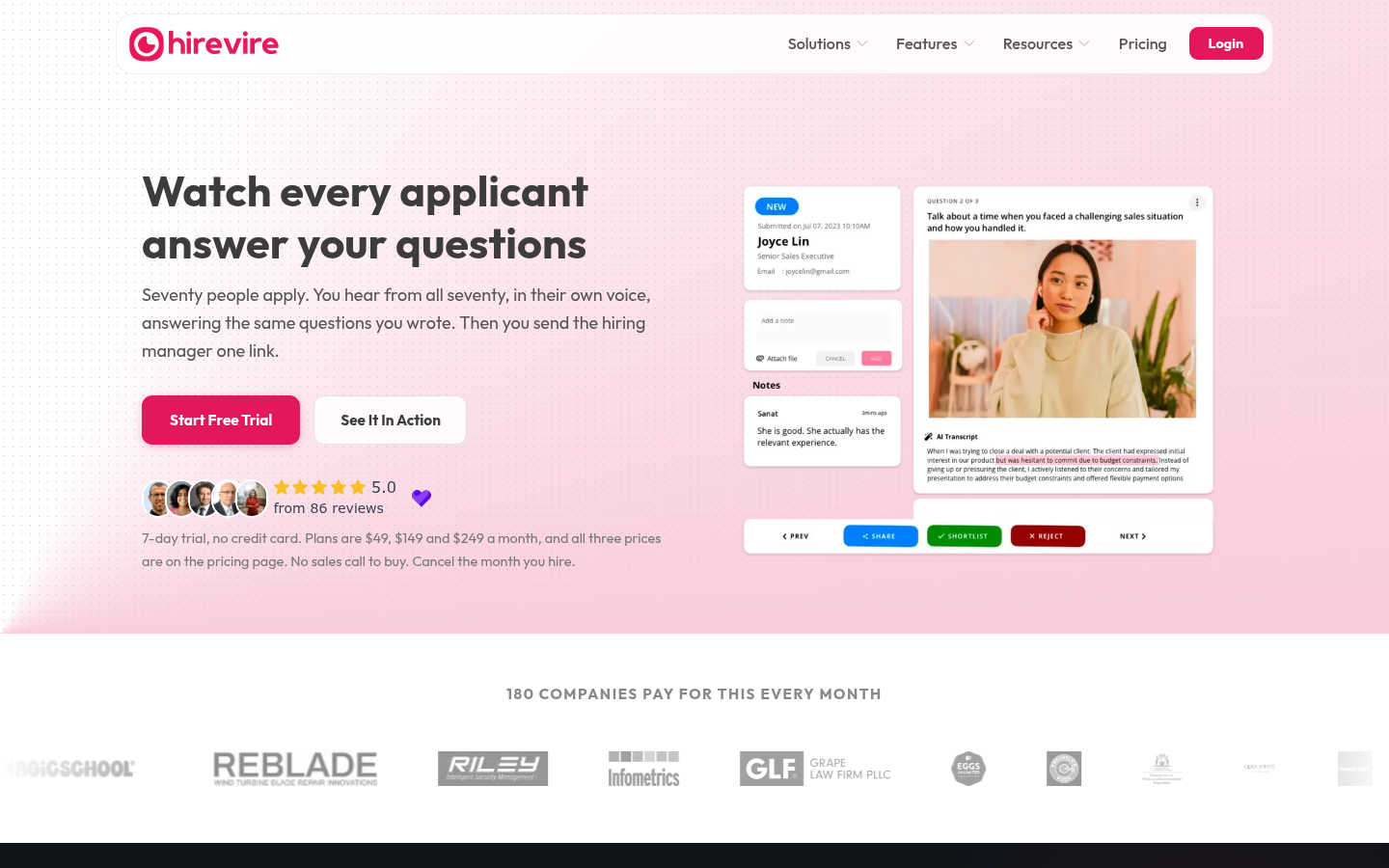
Best for: async screening when scheduling is the bottleneck.
Hirevire is video screening software built around one-way interviews. Candidates record answers whenever it suits them, from any device, so the first round never touches a calendar.
What you get:
- Screening questions set up once and reused, answered by video, audio, or screen recording.
- AI scorecards and AI match, with what Hirevire describes as transparent reasoning behind each score.
- Auto-disqualification that filters applicants who miss must-have criteria before they record, so those responses do not count against the plan quota.
- Transcripts in more than 90 languages, plus your own logo, colors, and fonts on every interview.
Where it falls short: Hirevire positions itself squarely at the screening stage, so sourcing, scheduling, and the rest of the pipeline sit in other tools. Each plan includes a fixed interview allowance per billing period. Once that allowance and a 10% grace buffer are used up, the job pauses until the next cycle or until you upgrade.
Our pick: lean teams and agencies that screen high volumes and want the first round off the calendar entirely.
13. Xobin.
Best for: talent teams bringing skills evaluation, interviews, and applicant tracking into one connected system.
Xobin applies AI to resume review and skills evaluation, then connects shortlisting with video interviews and coding rounds. A job description becomes a role-matched assessment through its Copilot. AI Evaluate scores open-ended answers, flags anomalies, and surfaces ranked shortlists.
What you get:
- Role-matched assessments generated from a job description
- Psychometric and coding tests, including real-time coding environments
- Automated grading of spoken, recorded, and written answers by LLM-powered AI
- Proctoring with eye tracking, browser monitoring, and behavior analytics
Where it falls short: Across AI hiring, Xobin covers applicant tracking through Tracks, plus assessments, proctoring, and live or automated interviews.
Our pick: Staffing agencies and corporate TA teams coordinating assessment, technical interviews, and candidate communications.
How to choose the right AI tool.
You want interview signal that drives hiring decisions. Metaview. The output is a structured candidate evaluation tied to your rubric, not a generic meeting summary.
You want passive candidates surfaced at scale. HireEZ, Gem, or SeekOut. HireEZ for breadth, Gem for outbound campaigns, SeekOut for specialized filters.
You want to fill the high-volume funnel. Paradox for conversational screening at scale, InterviewFlowAI for two-way AI phone and video interviews, Hirevire for one-way video screening, HireVue for structured video assessments, and Xobin when the screen needs a skills test or coding round.
You want on-demand phone screening without calendar coordination. Puck. Candidates can start an audio-only screen from an SMS or email link whenever it suits them.
You want scheduling automated. GoodTime for complex panel coordination.
You're an enterprise running talent management broadly. Eightfold for the AI brain across recruiting, mobility, and skills.
You're a small to mid agency. Manatal for accessible AI features. See our recruitment agency software roundup for the full agency stack.
For more on what to put alongside these AI tools, see our interview quality tools and best applicant tracking software roundups.
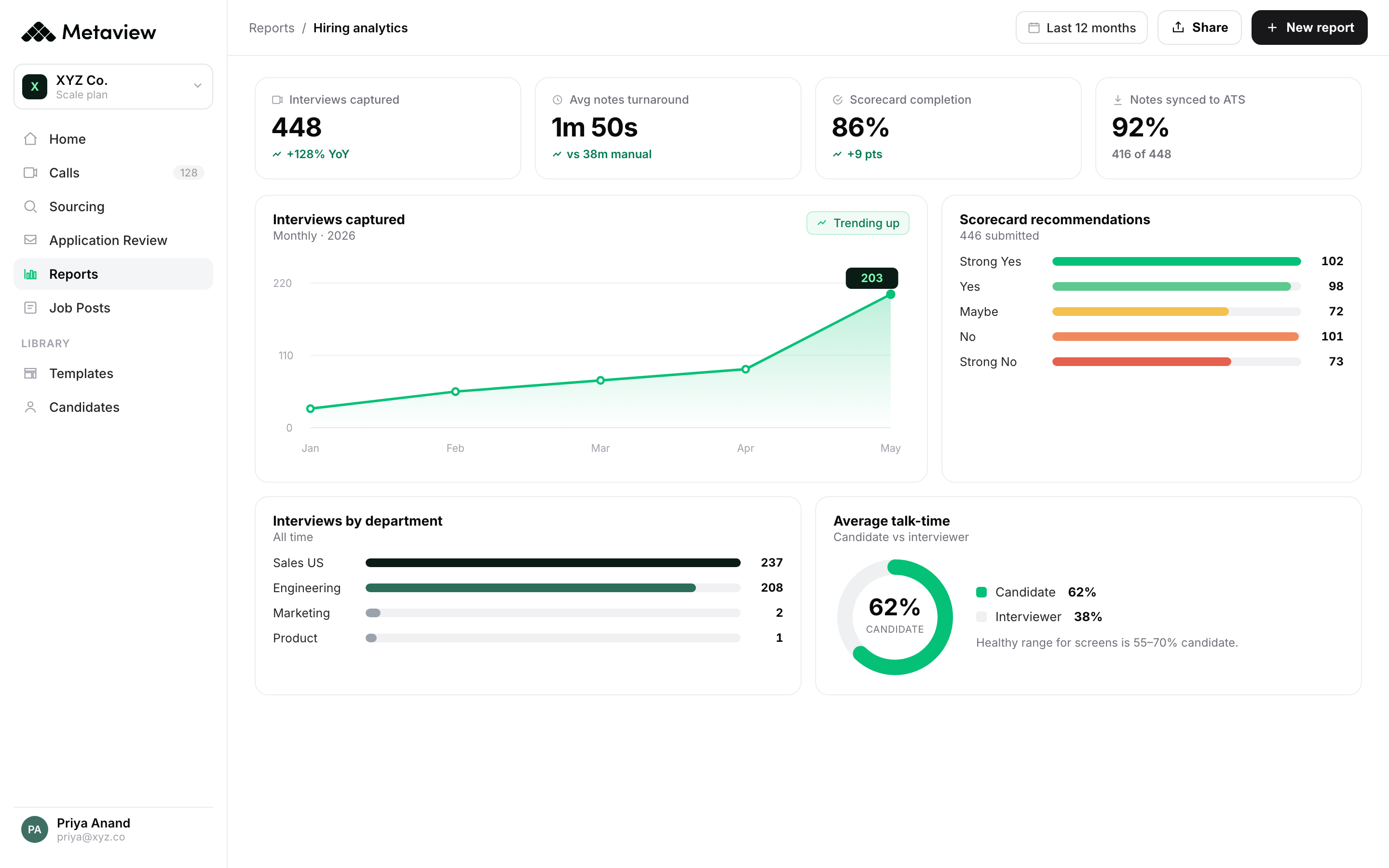
Whichever tools you pick, the signal they generate only counts if you can see it across the pipeline, which is where Metaview Reports comes in:
Bring Metaview into your hiring stack.
Live notes, structured scorecards, and ATS sync - set up in under 10 minutes.
Frequently asked.
What are AI hiring tools?
AI hiring tools use artificial intelligence to automate or augment specific parts of the recruiting workflow: sourcing passive candidates, screening applicants, scheduling interviews, capturing interview conversations, scoring assessments, and matching candidates to roles. The best stacks combine 2-3 specialized AI tools, each targeting a specific bottleneck in the hiring loop.
Which AI hiring tool gives the biggest ROI?
It depends on where recruiter hours leak. If interviews happen and the scorecard still gets written afterward from memory, interview intelligence removes work on every call. Manual scorecards were submitted 28.6% of the time; when Metaview drafted the first version, that rose to 50.3% (a capped sample of 120,000 scorecards). If the funnel is too big to phone-screen, conversational or async screening pays back first. Scheduling tools only pay off when panel coordination is the bottleneck.
Do AI hiring tools replace recruiters?
No. The right AI tools remove repetitive admin (note-taking, scheduling coordination, scorecard data entry, outreach drafting) so recruiters spend their hours on candidate relationships, hiring-manager alignment, and the judgment calls that drive hire quality.
Are AI hiring tools fair and bias-free?
No automated system is bias-free, but well-designed AI hiring tools reduce specific biases that humans introduce, such as inconsistent note-taking, recency bias in debriefs, and uneven scoring across panels. Always evaluate the vendor's bias audits, data sources, and human-review controls before rolling a tool out at scale.
Can AI hiring tools integrate with my ATS?
Most of the tools here list native ATS integrations, but check the direction and depth of the sync for your ATS before you buy. Metaview integrates with 114 applicant tracking systems across the platform; scorecard submission is direct for Ashby and Lever, and its browser extension autofills the objective scorecard fields in Ashby and Greenhouse. Ask every vendor which fields sync, in which direction, and whether a recruiter reviews the result before it lands in the ATS.
How much do AI hiring tools cost?
Pricing varies widely. At the low end, Manatal starts at $15 per user per month and Hirevire at $39 per month billed yearly, and InterviewFlowAI sells interview credits from $0.83 each on annual plans. Metaview's Notetaker has a free tier, and paid plans are priced per agent; current rates are on metaview.ai/pricing. HireEZ, Gem, GoodTime, Eightfold, HireVue, and Paradox are quote-based, so budget time for a sales conversation.
