
Most recruiters know AI is no longer optional. Far fewer have figured out how to use it well.
Last year we surveyed 380+ recruiters and recruiting leaders globally to measure the gap between the two. The adopters and the rest.
The numbers were lopsided. Recruiters who'd already moved on AI were speaking to a quarter more candidates per week and spending almost half as much time on admin. Their teams were getting through two-thirds more screens. And nine out of ten of them said they'd lose serious productivity if the AI were turned off tomorrow.
What we measured.
The survey ran across 380+ recruiters and recruiting leaders globally. It covered AI adoption (who's using it, who isn't), use cases (what they're asking AI to do), productivity impact (how much time it saves), and the skills outlook (whether AI fluency is becoming part of the job).
We also pulled aggregated, anonymized data from how Metaview customers interact with our AI assistant. That gave us a behavioral read alongside the self-reported one.
The full PDF can be found here.
Why teams adopt AI.
92% of TA pros we surveyed said they started using AI to save time and increase productivity. Not for novelty, not for the headlines, not because someone bought a tool. Because the workload had outgrown the hours in the week.
The use cases bear that out. Looking at how recruiters interact with Metaview's AI assistant, the most common ask is summarizing unstructured conversational data.
That's the recruiter coming back to a candidate four weeks after the screen and asking "what did they actually say about their team size at their last role." Or pulling up six candidates for a debrief and needing a one-line summary of each one's strongest moment.
The pattern: recruiters reach for AI when memory and admin time are the bottleneck. Which is most of the time.
Where adopters pull ahead.
AI-enabled recruiters speak to 25% more candidates per week than their counterparts who aren't using AI. They spend 41% less time on admin tasks like writing up notes. That's several hours per week back, for work AI can't do.
89% of AI-enabled recruiters said time savings is the main benefit they get from AI. And 42% said they'd lose "massive" amounts of productivity if the AI were turned off tomorrow.
Team-wide adoption beats individual copilots.
The biggest finding in the survey was that solo AI adoption doesn't compound. Team-wide AI adoption does.
Recruiters whose teams centrally implemented AI across the hiring process got through 66% more screens per week than recruiters using AI in their individual work only. Two-thirds more screens, from the same headcount.
The 2026 AI & Hiring Alignment Report (505 respondents across North America and EMEA) backed this up: 85% of companies exceeding their hiring goals use AI in hiring.
The real competitive advantage is effective AI adoption vs. everyone else. The teams doing this well are building alignment at every stage. AI earns its keep when it both strips out the mechanical work and surfaces the signal that helps recruiters actually close. Alignment isn't just a kickoff, it's infrastructure."

The skills shift: AI is becoming table stakes.
93% of the recruiters and recruiting leaders we surveyed said AI skills are necessary for the job. Not nice-to-have. Necessary.
74% said AI has already had, or will have, a positive impact on their career. That's the inverse of the narrative the trade press has been running. Recruiters who actually use AI like it. They're not worried about being replaced by it.
The recruiters not yet using AI are the ones at risk. Not from AI itself, but from being outpaced by the colleague three desks over who's getting through 25% more candidates a week.
How Metaview captures and coaches AI adoption.
Knowing the survey numbers is useful. Acting on them is harder.
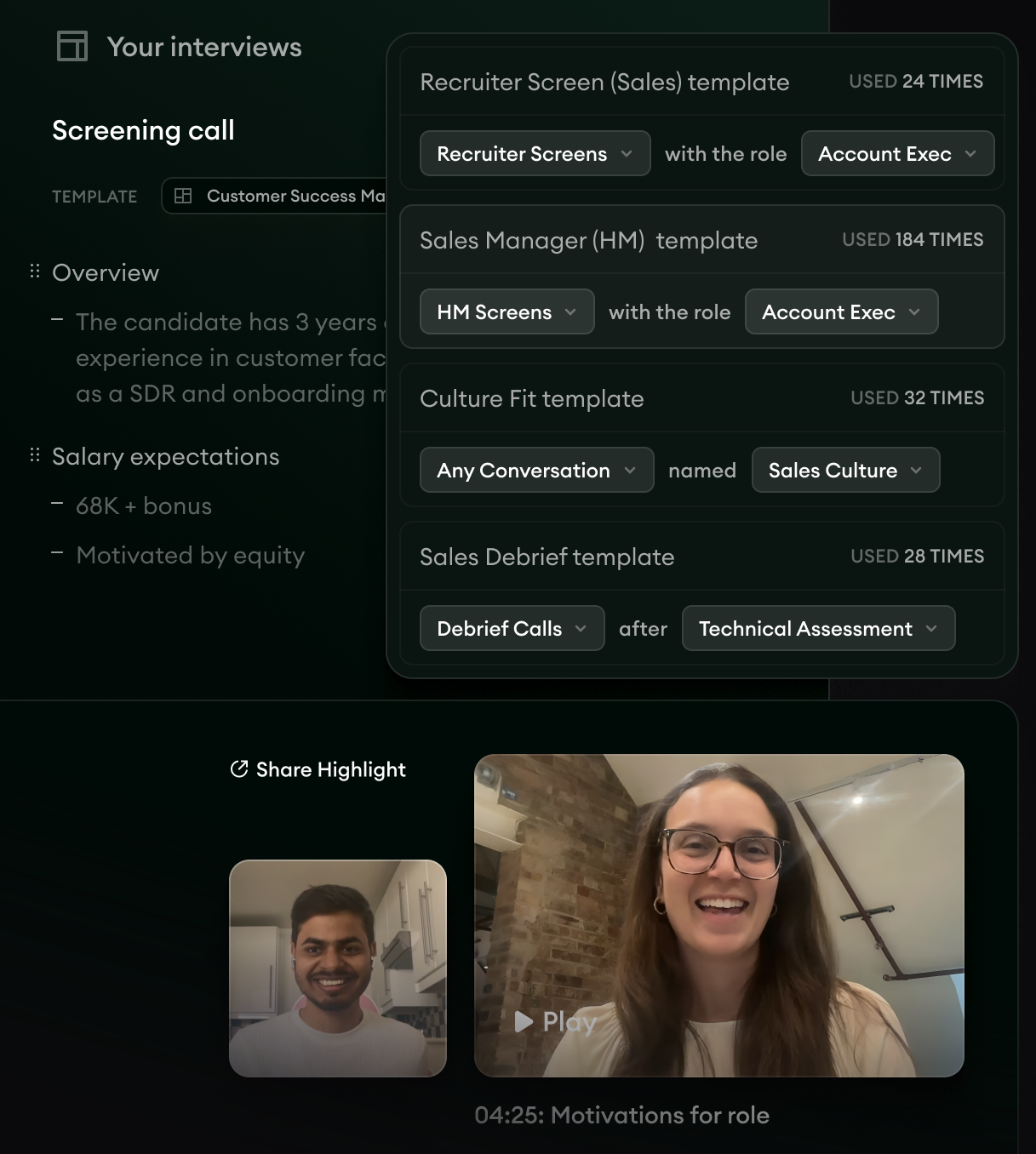
Metaview's Notetaker captures every interview automatically. AI Notes generates the summary in the format your team uses. AI Filters lets you ask, in plain language, which interviewers are getting through the most candidates, which loops are running long, which interviewers haven't adopted the structured-note workflow.
The same coaching loop that surfaces the three most common mistakes new interviewers make also surfaces who on your team is and isn't using AI well.
Teams like Raines International use this to standardize across every interviewer, so the gap between adopters and non-adopters never opens inside one team.
What this means for your team.
Three things to do this quarter.
First, audit who on the team is and isn't using AI. The survey gap is structural; it shows up the same way inside individual teams. Identify the recruiters in the 41%-less-admin bucket and the ones still typing notes from memory.
Second, move to centralized infrastructure. Solo copilots don't compound. The 66% team-wide lift is only available to teams that adopt AI as a shared workflow, not as individual side tools.
Third, make AI fluency part of recruiter onboarding. 93% of the surveyed pros said AI skills are necessary. Treat them like any other necessary skill: train for them, measure them, hire for them.
Frequently asked.
How are recruiters using AI in 2026?
Mostly to handle the things that used to eat the day. Summarizing candidate conversations, recalling what someone said three weeks ago, writing up notes after a screen, and pulling context across multiple interviews on the same req. 92% of TA pros in our 380-recruiter survey said they adopted AI to save time and increase productivity, and summarizing unstructured conversational data is the most common single ask.
What does AI actually do for recruiters?
The measurable outcomes from the survey: AI-enabled recruiters speak to 25% more candidates per week, spend 41% less time on admin like writing up notes, and 89% say time savings is the main benefit they get. Teams with centralized AI adoption get through 66% more screens per week than teams using AI only in individual work. The pattern: AI removes the parts of the job that don't require recruiter judgment, leaving more time for the parts that do.
Do recruiters need AI skills?
93% of the recruiters and recruiting leaders we surveyed said yes. AI fluency is becoming a baseline expectation for the role, the way ATS proficiency was a decade ago. Practical starting point: get comfortable with one note-taking AI, one summarization workflow, and one search-by-natural-language tool. Pattern-matching across those three covers most of the day-to-day use cases.
How much time can AI save recruiters?
For a recruiter doing 20 screens a week, the 41% admin-time reduction works out to roughly five hours back. For a team of ten, that's a fifty-hour weekly swing. Across a quarter, it's the equivalent of an extra recruiter. The savings show up most cleanly when AI is implemented team-wide rather than picked up individually: those teams get through 66% more screens per week.
Bring Metaview into your hiring stack.
Live notes, structured scorecards, and ATS sync - set up in under 10 minutes.
