
Most AI buying decisions in recruiting get made backwards. Buyers start by mapping the categories (sourcing, screening, scheduling, ATS, CRM, talent intelligence), then narrow on feature checklists. That ordering produces stacks where the single most valuable thing in the entire hiring process, the signal generated during interviews, leaks between every layer.
According to Metaview's 2026 AI & Hiring Alignment Report - surveying 505 recruiting leaders and hiring managers across North America and EMEA, fielded with Cint - 85% of companies exceeding their hiring goals use AI in hiring. The number isn't surprising. What's surprising is what happens when you ask which AI: teams where AI is core to hiring are 3.8x more likely to rate their cross-functional relationship as excellent. The teams that bought broadly didn't get there. The teams that bought for signal did.
This guide is for that second group. Not what categories exist. Not what features to checklist. Which layer of the stack actually deserves the budget, and how to evaluate vendors against the signal they capture rather than the demos they polish.
It's set up the way one of our customers, Carolann Vance, ran her own evaluation when she picked Metaview (“one of the best investments” was her phrasing in a LinkedIn post). The same matrix, the same vendor questions, and a 30-day evaluation plan you can run before you commit.
Key takeaways.
- The interview signal layer is the only buy that compounds. Every other tool in the recruiting stack consumes signal that was generated in a conversation; if that capture is brittle, everything downstream is brittle.
- Evaluate vendors by where their signal lives after the interview ends, not by feature checklists. Manual capture, generic AI screeners, and an interview-first AI platform produce very different downstream behavior even when the demo looks similar.
- Run a 30-day evaluation, not a 30-minute demo. Audit five real interviews, walk every recap through your matrix, and confirm the ATS round-trip works before you commit.
Why the category list is the wrong starting point.
Open any AI-recruiting buyer's guide (this one's old version included) and you'll find the same opening move: a list of categories. Sourcing tools. Notetakers. Screening tools. ATS. CRM. Talent intelligence. The implication is that a complete stack means owning one of each. The reality, after two years of watching teams roll these out, is that owning one of each rarely produces a working hiring system. It produces six dashboards and a recruiter who is now also a copy-paste operator.
Here's what the category framing hides. Every layer of the recruiting stack is downstream of one thing: what was actually said in a hiring conversation. The ATS records the outcome of that conversation. The CRM nurtures candidates based on context from those conversations. The talent-intelligence dashboard rolls up patterns extracted from those conversations. The screening rubric is only as good as the structured signal it's calibrated against. If the capture layer is brittle, every dashboard above it is a confident chart drawn on top of bad data.
That's why buyers who start with the category list end up with stacks that feel busy and produce ambiguous decisions. The fix isn't a bigger stack. It's a different starting question: which layer, if I bought it right, would make every other tool in this stack worth running?
Read that row left to right and the buying question rewrites itself. The question isn't whether to buy AI. It's whether to buy something that becomes core. That requires picking the layer where AI compounds rather than the layer where it bolts on.
What the interview signal layer actually does (and what depends on it).
The interview is where the highest-density information in your entire hiring process is produced. A 45-minute conversation generates a thousand signals: how a candidate frames trade-offs, where they hesitate, which examples they reach for under pressure, what they ask the interviewer in the last 10 minutes. Almost none of that lands in a structured form by default. It ends up as a paragraph of bullet points in someone's notebook or, worse, a single overall rating in a scorecard hours later.
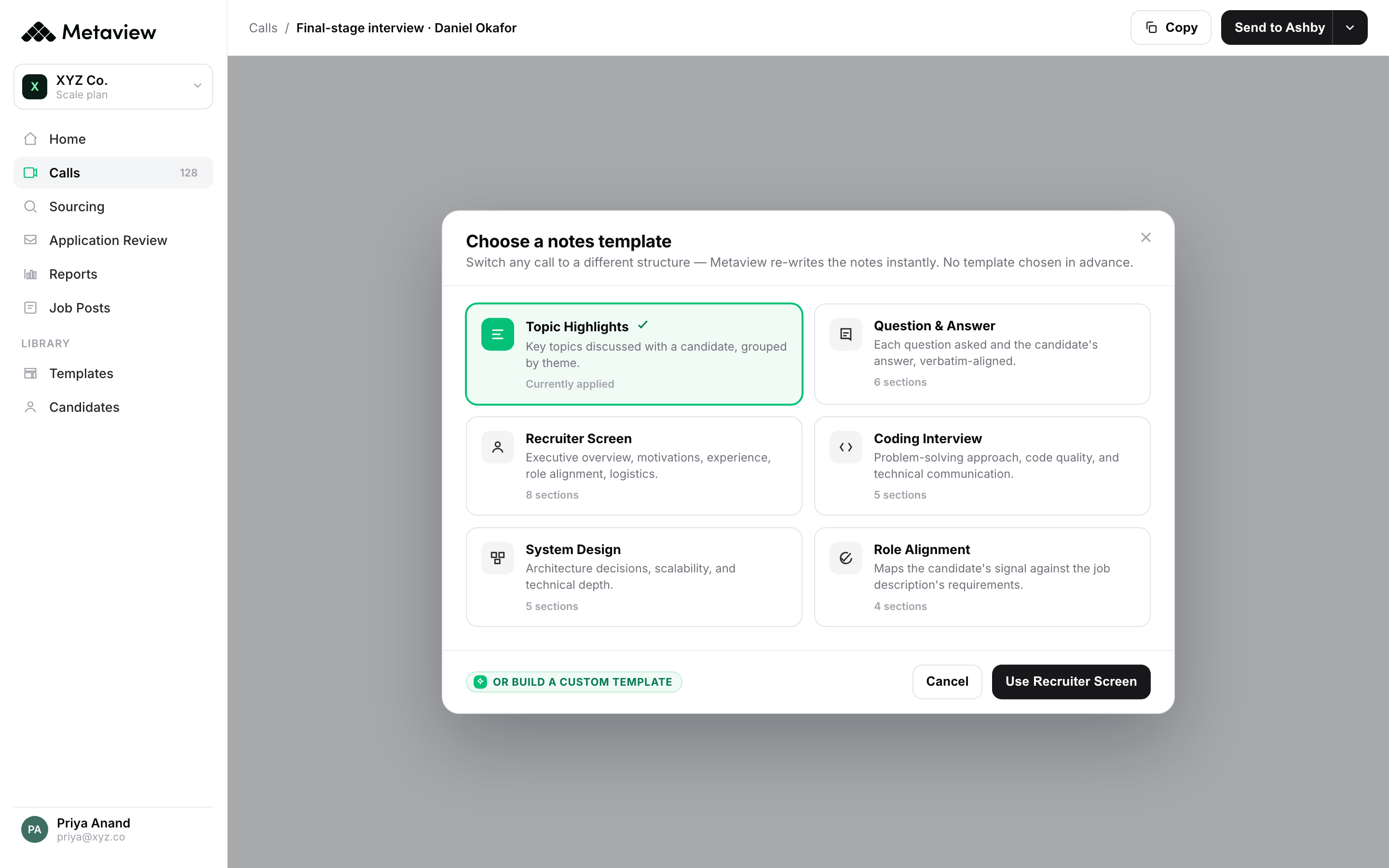
The interview signal layer is the AI category that fixes that. Done well, it does five things at once: it joins the call automatically based on the calendar event, it captures the verbatim conversation, it structures the signal against the role's scorecard while the interview is still in progress, it writes the recap back into the ATS in the right shape, and it keeps the original transcript searchable for the next time a hiring manager wants to verify what was actually said. None of that is post-processing. It's the capture moment itself.
Every layer above that consumes its output. The ATS holds the structured recap. The CRM warms candidates with context the interview surfaced. Reports roll up structured signal across roles and competencies. Sourcing rubrics get tightened by the patterns the recaps reveal. When a buyer spends real evaluation time on the signal layer, the rest of the stack gets sharper without a separate purchase. When a buyer skips it, every downstream tool spends its own AI budget reconstructing context that should have been captured cleanly the first time.
I get more signal off of work trials than I do just about anything else. You give them a situation, they have to solve it, and they come back and present it to the team. The team jams on it with them. In that exercise alone I see problem solving, writing skills, presentation skills, and how they collaborate with the team.”

Garrison is making a hiring point, but it's also a buying point. The unit you're really purchasing isn't a tool, it's signal. Whatever vendor captures the most reusable signal per hiring conversation wins, regardless of what category their site puts them in.
The 7 evaluation criteria (and the 3 that actually compound).
Below is the criteria list every buyer's guide uses, reordered by what compounds. The first three are the ones that, if you buy them right, make the next four cheaper to acquire later. The last four are still important (skipping security would be reckless) but they don't change which vendor wins on signal.
1. Structured signal capture (compounds).
Structured capture is the difference between every interview producing a reusable artifact and every interview producing a paragraph that dies in an email thread. The vendor question is whether their AI maps the conversation against the scorecard you actually use, or whether it produces a generic three-paragraph summary that recruiters and hiring managers then have to manually relate back to the role's criteria.
Ask to see a recap from a real interview, not a marketing screenshot. If the recap reads like an essay, it's content. If it reads like an evaluation, it's signal.
2. AI-powered insights tied to that capture (compounds).
AI insights only compound when they sit on top of structured capture. AI running over unstructured notes produces summaries. AI running over scorecard-mapped conversations produces patterns: which competencies your team consistently under-probes, where candidates drop off in specific stages, which hiring managers ask leading questions. That's the AI worth buying. Everything else is a summarizer.
3. ATS and HRIS integrations that move structured signal (compounds).
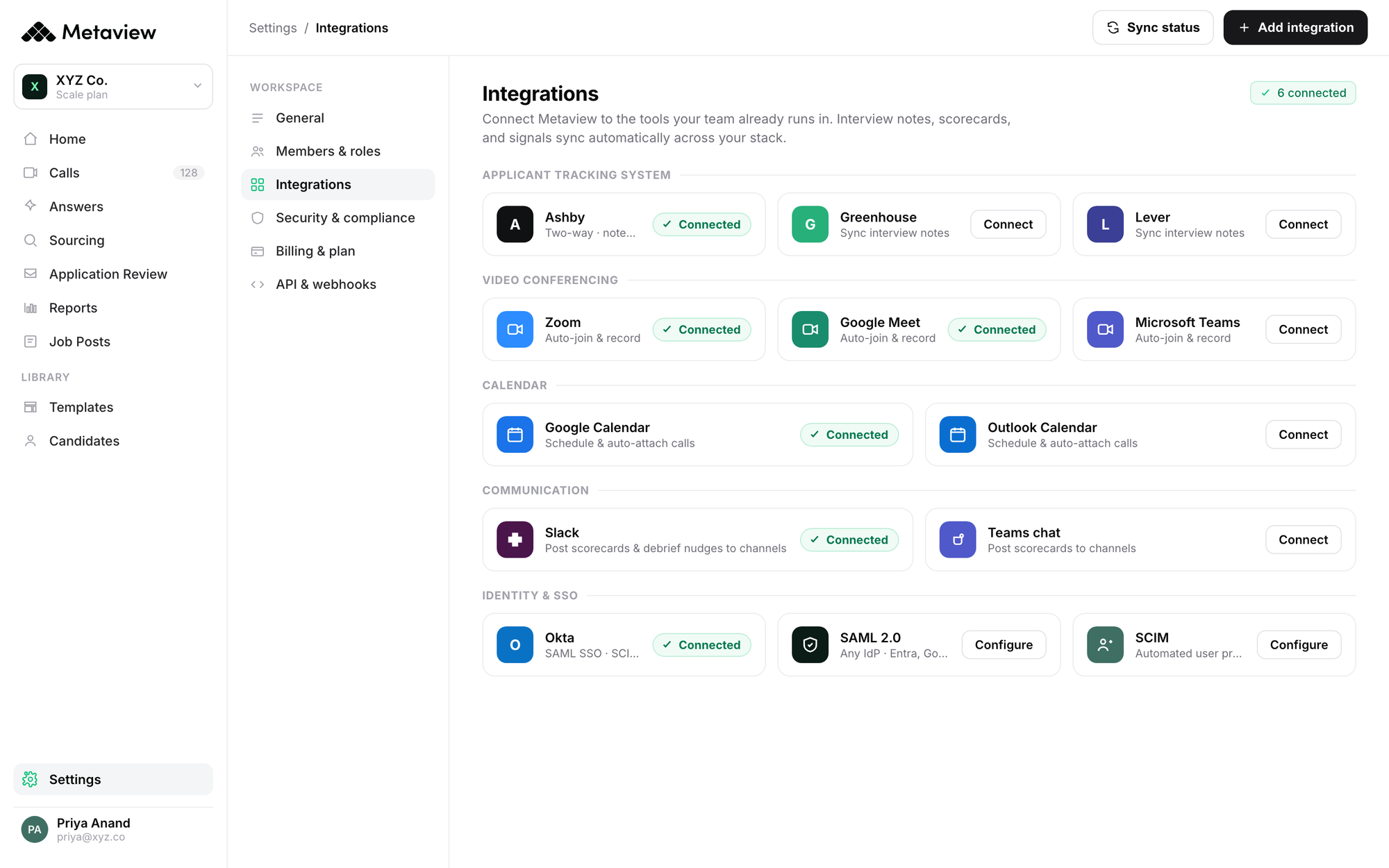
Most buyers ask if a vendor has an ATS integration. The better question is what shape the signal arrives in. Native integrations should write a structured recap into the right scorecard fields in your ATS without a recruiter copy-pasting anything. If the integration is one-way (calendar in) and the recruiter is still typing into the ATS at the end of the day, the integration is decorative.
Per the changelog as of April 2026, an interview-first AI platform should be able to write feedback into Ashby, Gem, Greenhouse, Lever, SmartRecruiters, Teamtailor, and Workable on a published-and-live basis. Anything narrower is a 2024-grade integration story.
4. Process automation (table stakes).
Scheduling, follow-ups, stage transitions, candidate communications. Every modern platform automates these to some degree. Treat them as a yes/no filter, not a differentiator. A vendor that automates everything except the capture moment is still selling you a faster way to produce the same ambiguous decisions.
5. Real-time collaboration on captured signal.
Multiple interviewers should be able to leave context on the same captured moment, debrief should reference verbatim conversation rather than memory, and a hiring manager who missed the call should be able to read the actual signal in under five minutes. Score this on whether the team can act on captured signal, not on how many comment threads the product supports.
6. Data visibility and reporting.
Reports should answer questions like which competencies are getting under-probed, which interviewers consistently produce decisive signal, and where the team's decisions don't match the structured evidence captured during the interview. Generic funnel reports (applied to screened to onsite) are an ATS concern, not a signal-layer concern.
7. Security and compliance.
SOC 2 Type II, GDPR posture, role-based access, candidate-side notice and consent flows, audit trails for who accessed which recording. These are non-negotiable for any vendor handling interview content. Confirm them early so they don't become a procurement-stage surprise that resets the evaluation timeline.
If you want to hear what evaluating-by-signal looks like from a buyer's seat, Cassie Chao Leemans (Talent Partner at Craft Ventures) describes how she went from non-technical to wiring her own AI workflows on top of Metaview, Claude, and Supabase. The lesson she keeps returning to: the best AI outputs in recruiting don't come from a single magical prompt, they come from feeding signal into a system that already understands your scorecards.
What a buyer’s demo should actually look like.
Most vendor demos are story demos. The salesperson clicks through a polished test interview, hits a recap button, and shows you the perfectly formatted summary. That's a content demo, not a signal demo. The signal demo runs against your interview footage with your scorecard, in a working session, with you as the evaluator.
Pin three moments to look for. First, can the AI surface the verbatim moment behind a specific signal (not paraphrase, not summary)? Second, does the recap tie signals across the panel, so the next interviewer starts informed? Third, can a recruiter walk into a debrief and have an action recommendation that's specific enough to coach a hiring manager with, rather than 'continue to next round'?
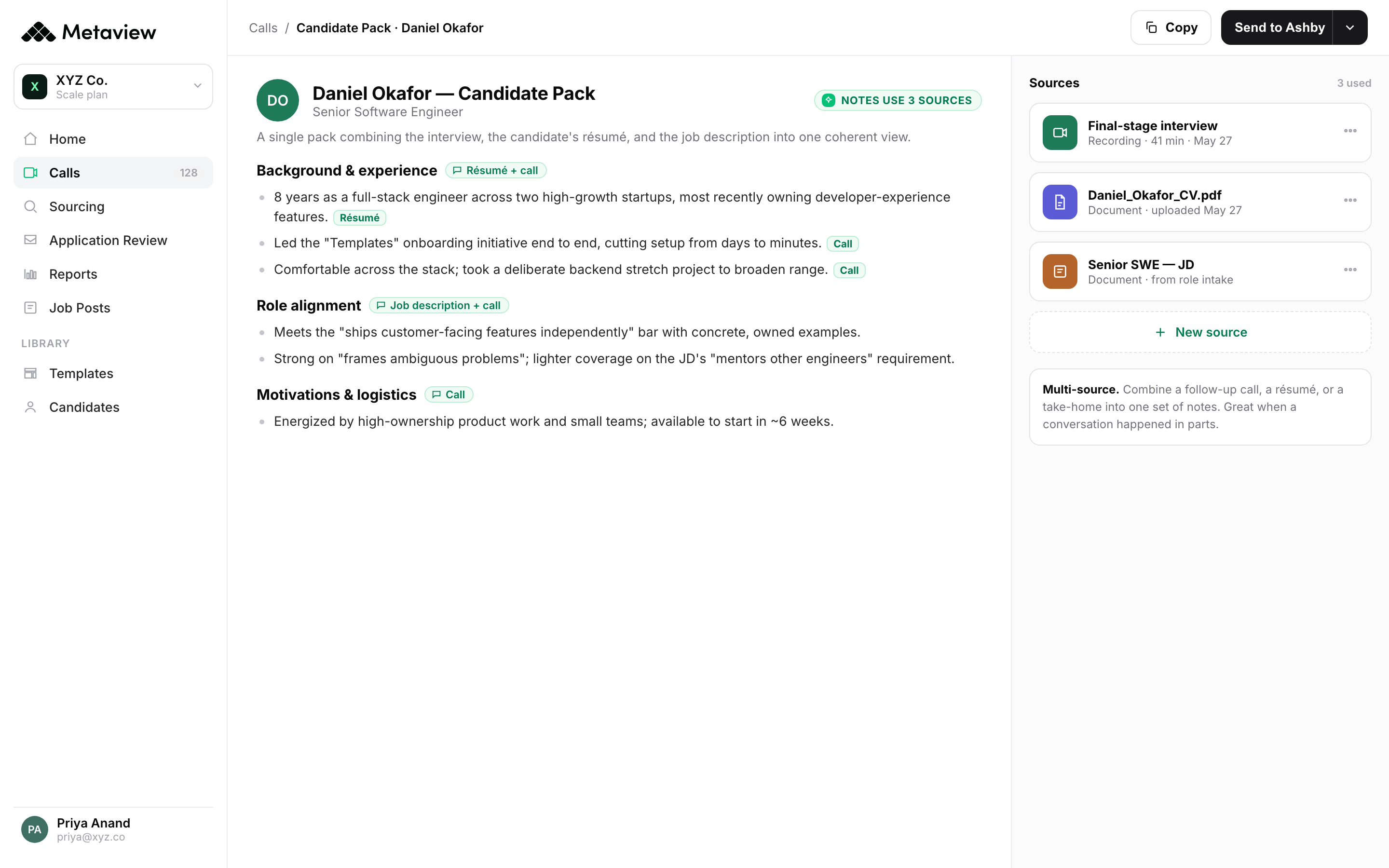
- Verbatim moment, not a paraphrase. If the vendor can't take you back to the exact sentence behind a signal, it isn't signal yet.
- Cross-panel summary tying multiple interviews together. This is what makes the next interviewer start informed instead of from zero.
- An action a recruiter can use in the debrief, not a generic recommendation. Demand this in the demo or assume it won't exist after the demo.
Manual vs Generic AI vs Metaview: a 6-row buyer’s matrix.
Three configurations cover the working population of buyers. Manual: humans typing notes into Google Docs or directly into the ATS. Generic AI screener: an ambient notetaker built for sales calls or general meetings, repurposed for interviews. Metaview: an AI built specifically for hiring conversations, with scorecards, ATS write-back, and structured capture as first-class concerns. The matrix below is six dimensions where these three diverge, even when their feature pages read similarly.
| Buyer dimension | Manual notes | Generic AI notetaker | Metaview (interview-first AI) |
|---|---|---|---|
| Where the signal lives after the interview | A paragraph in someone’s notebook or scorecard field | A generic transcript and a 3-paragraph summary | A structured recap mapped to your scorecard, with verbatim grounding |
| Re-use 6 months later | Whoever wrote the note is the only person who can re-read it | Searchable by keyword, not by competency | Searchable by competency, candidate, role, or interviewer |
| Bias surfaces | Invisible until a pattern review meeting nobody actually runs | Buried in transcript text; needs a separate report layer | Surfaced as patterns across interviews and interviewers |
| Speed to debrief consensus | A meeting where everyone’s reading different notes | A meeting where everyone’s reading the same summary | A debrief where everyone is comparing the same verbatim moments to the same scorecard |
| ATS coupling | Recruiter types feedback into the ATS later (or doesn’t) | Copy and paste, with formatting that breaks the scorecard fields | Native write-back to Ashby, Greenhouse, Lever, SmartRecruiters, Teamtailor, Workable, and Gem |
| Compliance trail | Whoever still has the notebook | A retention policy not designed for hiring data | SOC 2 Type II, role-based access, candidate consent flows built for hiring specifically |
The cost of buying for features over signal shows up downstream. Teams without excellent recruiter and hiring-manager partnerships are 60% more likely to lose qualified candidates to faster-moving competitors, per the Metaview 2026 AI & Hiring Alignment Report (p.12). The partnership quality is downstream of how cleanly the team can act on what was said in interviews. Two recruiters and two hiring managers operating on the same captured evidence reach consensus faster than the same four people operating on four versions of their own memory.
The 4 questions to ask every vendor.
Skip the feature checklist on a discovery call. These four questions, asked in this order, will separate signal vendors from content vendors in under 20 minutes.
1. Where does the signal live after the interview ends?
Listen for one of two answers. The strong answer names a structured object (the scorecard, the candidate record, a per-competency rating tied to verbatim evidence). The weak answer names a content artifact (a transcript, a PDF, an email summary). Content artifacts decay. Structured objects compound.
2. Can a hiring manager who missed the call read the signal in under five minutes?
Ask the vendor to send you a real recap from one of their customers' interviews (anonymized). Set a five-minute timer. If you can come out the other side knowing what the candidate said about a specific competency, the capture works. If you come out the other side with a vague positive feeling, the capture is theater.
3. What writes back to the ATS automatically, and what does the recruiter still type?
The honest answer is rarely 100% automatic. The honest answer is also rarely 0%. Ask for the exact list of ATS systems where the integration is native (not via Zapier, not via CSV) and the exact fields that write back. Anything vague at this stage gets worse, not better, in production.
4. How does the data trail satisfy your compliance team?
Loop in security and legal before the demo, not after. The vendor should be able to walk a non-recruiter through SOC 2 Type II posture, candidate consent flows, retention defaults, and the audit trail for who accessed which recording. If procurement is the first time security hears about the tool, the evaluation will reset by 4 to 8 weeks.
It’s not just the hours saved, but also the time you can use to focus on what really matters: getting the signal we need to make the best hiring decisions.”
A 30-day evaluation plan.
A 30-minute demo cannot answer the questions above. A 30-day evaluation can. Run it in four one-week phases against your real interviews, not against a sales-engineered test environment. By week 4 you will know more about whether to buy than any G2 review will tell you.
- Week 1 - capture audit. Run the vendor on 5 real interviews across at least 2 roles. At the end of the week, score whether each recap is structured against your scorecard or a generic summary. Reject if more than one of the five reads as content rather than signal.
- Week 2 - signal review. Walk each recap through the 6-row matrix above with the panel that ran the interview. If you cannot agree, in 5 minutes, on what the candidate said about a specific competency, the capture isn't working yet.
- Week 3 - ATS round-trip. Have a recruiter trigger the integration end to end on a live req. Confirm what fields are populated, which ones still require typing, and whether the structured recap survives the ATS write-back without manual cleanup.
- Week 4 - hiring-team consensus check. Run a debrief on a real candidate using only the captured signal as evidence. If hiring manager and recruiter reach the same call faster than before, you have your answer. If they don't, the vendor isn't your signal layer.
 Carolann Vance
Bring Metaview into your hiring stack.
Live notes, structured scorecards, and ATS sync - set up in under 10 minutes.
Frequently asked questions.
Do I need multiple recruiting tools or one platform?
Most teams use multiple tools, but the question that matters is which layer captures the signal that every other tool depends on. Buy the signal layer right first; the rest of the stack gets sharper without separate AI purchases.
What's the difference between an AI notetaker and an interview-first AI platform?
An ambient AI notetaker captures generic meeting transcripts. An interview-first AI platform maps the conversation against your role-specific scorecard, writes structured signal back to the ATS, and exposes patterns across roles and interviewers. Both technically transcribe; only one compounds.
How do I evaluate AI recruitment tools without getting trapped in feature checklists?
Run the four-question script in this guide (where does the signal live, can a missed hiring manager read it in 5 minutes, what writes back to the ATS automatically, how does the data trail hold up). Then run the 30-day evaluation on real interviews. Feature pages can't lie that long under real conditions.
Is interview-intelligence software only for large enterprise teams?
No. Smaller TA teams often get more leverage from it because every interview matters more. The decision isn't headcount, it's how many hiring decisions per quarter are made on memory rather than structured evidence.
How do customer quotes and proprietary data fit into evaluating AI vendors?
Customer quotes tell you what's worked in production. Proprietary data (like the 2026 Alignment Report's 55% / 35% / 21% / 14% relationship-quality ladder by AI integration depth) tells you the population-level shape of the buying decision. Use both. A vendor with neither is selling a roadmap, not a product.
What does a Metaview pilot actually look like?
Connect to your calendar and ATS in under 10 minutes, run the platform on 5 to 10 real interviews across a couple of reqs, and walk every recap through your scorecard in week 2. By week 4 you'll know whether the signal layer is real for your team. Book a demo to start.
