

Engineering interviews are the longest thing most recruiting teams run.
Across the interviews captured on Metaview, the median engineering interview takes 42.6 minutes, and the technical stage on its own averaged 62.4 minutes last quarter.
So who does it better? Agencies or in-house tech recruiters? Let's find out.
Why technical roles are the hardest thing your process does
Engineering absorbs more interview time than any other function we see. It also absorbs the most expensive interview time, because the people doing the interviewing are the people you are hiring to free up.
The screening end is noisier too. Of engineering applications run through Metaview's fraud detection, 34.9% come back flagged as medium or high risk, the highest share of any function.
Reading a backend engineer off a resume is genuinely hard, which is why recruiting developers rewards people who know the domain and punishes people who are pattern matching on job titles.
So a technical req costs more per candidate than anything else in the pipeline, and it spends that cost in engineering hours.
Agency recruiters really are faster
Recruiting and staffing firms run the shortest median interview of the top five sectors by volume, at 34.1 minutes. Scientific and technical services, where most in-house engineering teams sit, runs 37.1.
The three minutes matter less than what sits behind the interview. A scorecard template is attached to 2.2% of the interviews agency orgs run, against 48.7% in scientific and technical services and 44.8% in professional services.
Agencies are running a lighter interview, and the length data lines up with that. Across the whole dataset, interviews with a template attached run about 7 minutes longer than those without, at 39.5 minutes against 34.7.
We cannot say from this that dropping the template is what makes agency interviews shorter. The two move together, and the workflow gives an obvious reason why they would: a template adds fields to cover, and covering them takes time.
One thing the data does not support is the idea that agency recruiters are rushing candidates. On speaking time they look like everyone else. Agency interviewers take a median 48.0% of the talking, against 46.1% in scientific and technical services, and across every company size band the interviewer's share sits within about two points of that.
The interview is shorter and lighter, but the candidate still gets a normal share of it.
What that speed costs on a technical loop
Minutes per interview is the wrong unit for an engineering hire. What decides how long the hire takes is how many loops it needs, and that turns on what survives the interview in writing.
About 42% of candidates who advance to the next round do so without a submitted scorecard behind the decision. Where an early round scorecard does exist, it agrees with the final verdict 54.4% of the time, barely better than a coin flip.
Technical interviews are already the most structured stage of the process. A scorecard template sits behind 68.8% of them, against 0.4% of intake and screening calls. The discipline concentrates exactly where the stakes are highest, and it is the discipline the agency model runs without.
A submitted scorecard is not automatically a useful one. Of the scorecards that get created, 25.6% are completely empty and another 27.5% carry a single field. Pushing a completion rate on a technical loop will produce more empty forms unless the writing itself gets easier, which is the finding underneath our scorecard completion study.
So who actually hires better
On getting a qualified engineer into a first conversation, agencies win. They run a shorter, lighter interview, and when the constraint is calendar time that is a real advantage.
On everything after that first conversation, in-house teams win, and the margin comes from the same thing that costs them the minutes. A scorecard template attached to the technical stage is what leaves the next interviewer something written to work from, and what stops the second loop from repeating the first.
So the fastest team on engineering roles is the one running the agency's lightness at the top of the funnel and the in-house team's evidence discipline at the technical stage. Both halves are available to both models. Neither one requires an agency contract or a headcount req.
For a niche or senior engineering search where your team holds no warm pool, an agency will get you candidates sooner. The trade is that you have to supply the structure, so make a scorecard template for the technical stage a condition of the engagement rather than a nice to have.
For the roles you hire over and over, like backend and platform, your own team should beat an agency's first req on its second. If it does not, the delay is sitting in your process, and adding a sourcer will not move it. That is usually a job for better structured interviews rather than more candidates.
How Metaview closes the gap
Metaview is built around the measurable part of this. Four surfaces matter on a technical loop, and they are worth more together than separately.
AI Sourcing searches the web, your connected ATS and your own past Metaview conversations from one natural-language prompt, and returns candidates with the reasoning for each. It can also take the brief straight from an intake call you recorded with Metaview. Across 26,356 of those searches, the median time from the end of the intake call to the first shortlist was 17.6 minutes. The agent surfaces candidates and explains why each one is there; it does not contact or assess them.
Application Review reads every application against an ideal candidate profile you approve, sorts candidates into fit buckets, and shows its reasoning. Candidates it rates a great fit go on to advance at 17.2%, against 5.6% for poor fit, so the ordering holds up against what recruiters do next. Fraud detection runs by default, which matters more on engineering than anywhere else. Every accept and reject stays with a person.
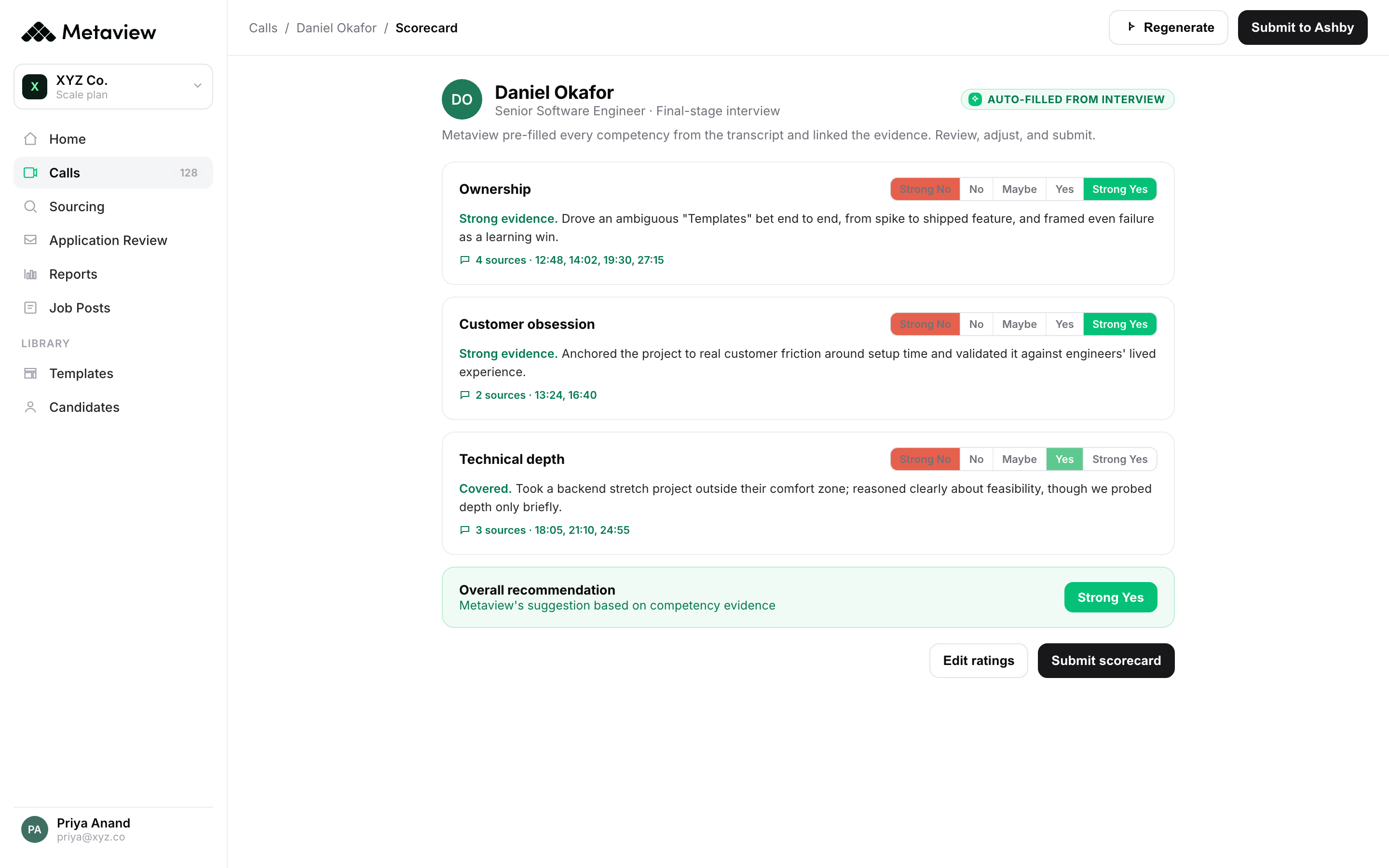
The Notetaker joins the interview as a visible participant, turns the conversation into structured notes, and drafts the scorecard from what was said. This is the piece that changes the economics of structure. When Metaview generated the first draft, 50.3% of those scorecards were submitted, against 28.6% of the ones interviewers started themselves, and they carried 7.85 filled fields on average against 2.61.
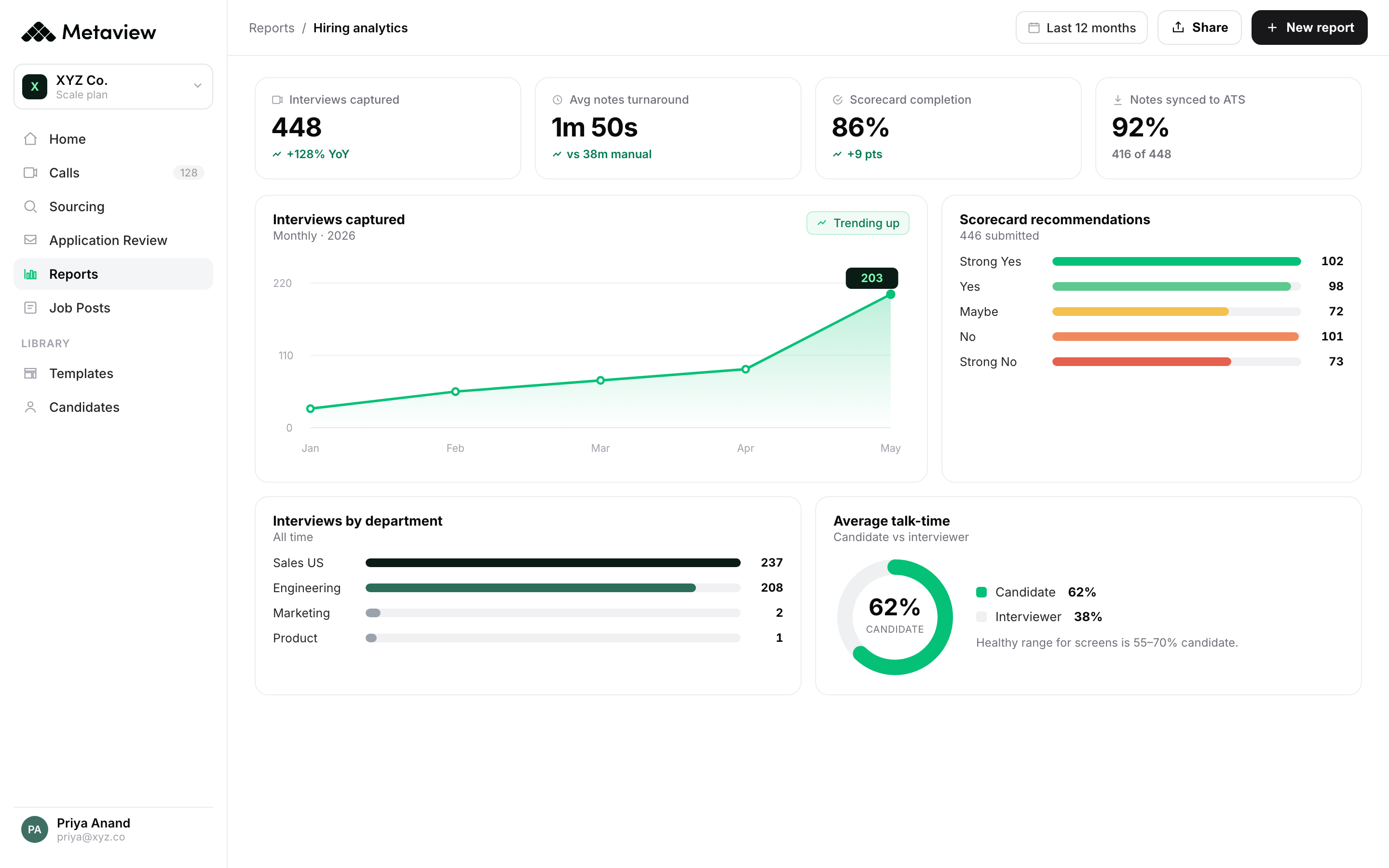
Reports runs over your own interview data, so the question stops being who hires faster in general and becomes where your own technical searches lose their days.
The integration detail matters if you are going to lean on this. Direct scorecard submission works for Ashby and Lever. The browser extension autofills the objective sections of Ashby and Greenhouse scorecards, and leaves the subjective fields and the hiring recommendation to the interviewer.
How to decide on the req in front of you
- Break your last three engineering hires down stage by stage and look at where the days actually sat. One number for the whole search will not tell you anything you can act on.
- If most of those days sit between opening the req and the first conversation, an agency will help. If they sit between the interview and the decision, an agency will not touch them.
- Whichever model you use, make the technical stage structured. It is the stage where written evidence changes the outcome, and the one your interviewers already take seriously.
- Make the scorecard cheaper to finish than to skip. Reminders and deadlines are the usual answer, and the completion figures above are what they produce.
Agencies are faster, and the data shows why rather than leaving it to argument: they run a lighter interview. On a backend role where a bad hire costs two quarters of engineering time, that lightness is the one part you should not copy. Take the reach, and keep the record.
Give your tech recruiters evidence from every interview.
Metaview records the interview and drafts the scorecard, and your interviewers review it and submit.
Frequently asked
Can you use an agency and an in-house recruiter on the same role?
Yes, and it is common on senior engineering searches. Agree upfront who owns the scorecard for the technical stage, so both sides score against the same criteria and the debrief has one record to argue from instead of two.
What should I ask an agency to provide on a technical req?
A written scorecard against your competencies for every candidate they put forward, submitted before the debrief rather than after it. Ask for the interview record too if their process captures one. Without that you are buying speed to the first conversation and nothing beyond it.
How do I tell whether my hiring delay is sourcing or process?
Split your recent engineering hires by stage. If most of the elapsed days sit before the first conversation, the constraint is reach and more sourcing will help. If they sit between interviews and decisions, the constraint is your process, and more candidates will make it worse.
Is an agency cheaper than an in-house recruiter for engineering roles?
For a handful of senior searches an agency is usually cheaper, and for sustained volume an in-house recruiter is. A placement fee is a one-off cost per hire while a recruiter is a fixed annual cost, so the crossover comes down to how many engineers you will hire in a year. Metaview holds no cost data, so treat that as standard arithmetic rather than a finding from our dataset.
Should the recruiter or the hiring manager own the technical scorecard?
The hiring manager should own the criteria and the engineer who ran the interview should own the rating. The recruiter's job is making sure the scorecard exists before the debrief starts.
