
Workday is one of the world's leading HCM platforms, and for good reason. It gives large organizations a single system for HR, recruiting, payroll, finance, and workforce planning.
But that's also why many teams start looking elsewhere. Workday is built to run the business, not necessarily to help recruiters hire faster.
As AI reshapes recruiting, many talent teams want better tools for sourcing, application review, interviewing, and hiring manager collaboration.
Some replace Workday with another HCM. Others keep it as their system of record, and invest in better recruiting software instead. This guide covers both approaches, comparing the best Workday alternatives to modernize your HR platform, your hiring technology, or both.
Best Workday alternatives at a glance
| Platform | Category | Best for |
|---|---|---|
| Metaview | AI recruiting platform | AI-powered sourcing, application review, interviewing, and recruiting workflows |
| Greenhouse | Applicant tracking system | Structured hiring and collaborative recruiting |
| Ashby | ATS and recruiting platform | Data-driven recruiting teams and talent operations |
| SmartRecruiters | Enterprise recruiting platform | Large organizations hiring globally |
| SAP SuccessFactors | Enterprise HCM | Global enterprises needing comprehensive HR and talent management |
| Oracle Fusion Cloud HCM | Enterprise HCM | Organizations already invested in Oracle's ecosystem |
| UKG Pro | HCM | Workforce management, payroll, and HR |
| Dayforce | HCM | Payroll, workforce management, and compliance-heavy organizations |
| Rippling | HRIS/HCM | Fast-growing companies wanting HR and IT in one platform |
| BambooHR | HRIS | Mid-sized organizations seeking a simpler HR solution |
Why teams look for Workday alternatives
Recruiting has moved faster than the enterprise HCM suites. Recruiters now expect AI to source candidates, sort hundreds of applications, and capture interview evidence, and those features tend to arrive in specialist recruiting platforms first. So many enterprise teams keep Workday as the system of record and add recruiting software built for hiring: HR keeps its governance and reporting, and recruiters get tools they’ll use.
What about Workday Recruiting?
Workday Recruiting is the recruiting module within Workday's HCM platform. It helps organizations manage hiring from job requisition through onboarding, while keeping recruiting, HR, payroll, and employee data in a single system.
Its biggest strength is that it works natively with the rest of Workday. But because it's part of a broader HCM, many recruiting teams pair it with specialist recruiting software to improve sourcing, interviewing, and recruiter productivity.
Key capabilities
- Job requisitions and approvals
- Applicant tracking and hiring workflows
- Interview scheduling
- Offer management
- Onboarding
- Native integration with the wider Workday platform
Where it falls short
Workday Recruiting is built for enterprise HR as much as recruiting. Compared with specialist recruiting platforms, many teams find it less intuitive for day-to-day hiring and less advanced in areas like AI sourcing, application review, interview intelligence, and recruiting analytics.
That's why many organizations keep Workday as their system of record while integrating purpose-built recruiting tools that extend its capabilities.
The 4 best Workday alternatives for recruiters
The best Workday alternative depends on what you're really trying to solve. If it's enterprise HR, look at other HCM suites. If it's hiring, start with recruiting platforms built for the AI era.
1. Metaview
Category: AI recruiting platform
Best for: Enterprise recruiting teams that want AI-powered recruiting while keeping Workday as their system of record.
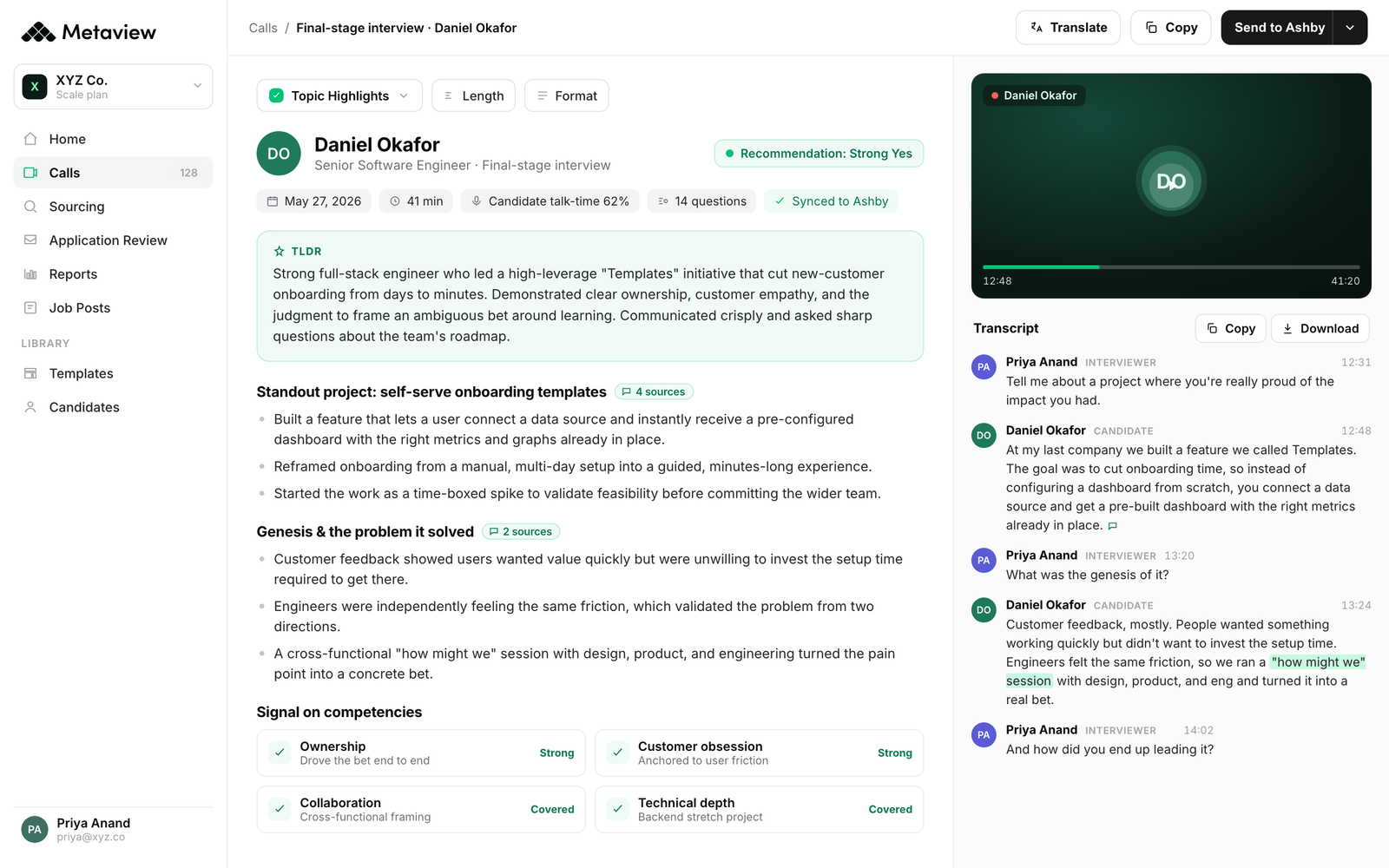
Workday gives organizations a strong system of record for hiring, HR, and business data. Metaview, meanwhile, makes recruiting radically efficient, with agentic AI processes and workflows.
Metaview adds AI agents for sourcing, outreach, application review, screening, interview notes, and reporting, and it integrates with Workday so the HCM stays your system of record.
What it covers
- AI sourcing that searches the web, your connected ATS, and past Metaview conversations from one plain-language brief.
- Outreach that sends personalized email sequences and follows up automatically.
- AI application review that reads every application against the role’s criteria, sorts candidates by fit, and shows its reasoning.
- Metaview Screening calls that gather candidate responses against your rubric before a human interview.
- AI interview notes, summaries, and drafted scorecards for the interviewer to review and submit.
- Reports on your own interview data, in the product or through the Metaview MCP.
- Metaview integrates with Workday and 100+ other ATSs, listed on the integrations page.
Where it stands out
Metaview is built for recruiting only. Its agents source, sort, capture, and report; recruiters make every hiring decision. Metaview works alongside Workday as a separate surface, so bringing it in is a recruiting-team change rather than an HCM project.
Pricing: Free tier available; paid plans are priced per agent. See Metaview pricing for current plans.
Metaview has been a game-changer in my role, saving me so much time and significantly improving my efficiency and productivity. It does a far better job than I ever could in just a few seconds, making my workflow smoother and more effective.”
2. Greenhouse
Category: Applicant tracking system (ATS)
Best for: Organizations that want a dedicated ATS with structured hiring capabilities.
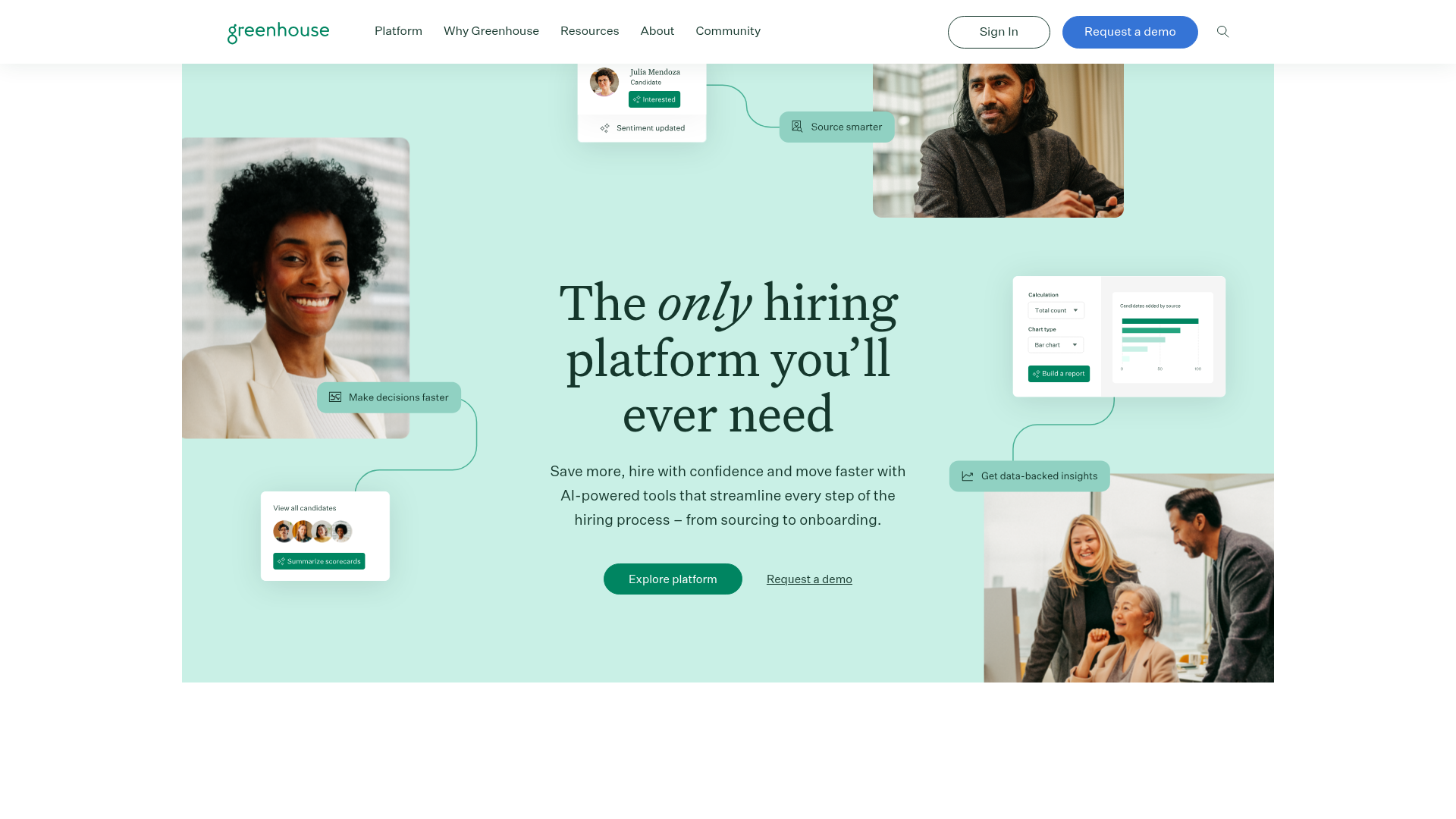
Greenhouse is one of the best-known applicant tracking systems for structured hiring. It helps you build consistent interview processes, manage candidate pipelines, and partner effectively with hiring managers.
Compared with Workday Recruiting, Greenhouse is a more recruiter-centric experience with a wider ecosystem of recruiting integrations. Its structured interview kits, scorecards, and workflow automation have made it a popular choice for growing companies that want a dedicated ATS.
What it covers
- Applicant tracking and pipeline management
- Structured interview plans and scorecards
- Interview scheduling and hiring workflows
- Recruiting analytics and reporting
- Extensive third-party integration marketplace
- Candidate experience and employer branding tools
Where it stands out
Greenhouse focuses almost entirely on hiring. That lets it deliver a simpler, more intuitive recruiting experience than many enterprise HCM platforms. Organizations that don't need a full HR suite often find it easier for recruiters and hiring managers to adopt.
Pricing: Core, Plus and Pro plans available. Book a demo for details.
The platform is reliable and provides robust reporting that helps us make data-driven hiring decisions. While it’s an investment, the time savings, improved collaboration, and streamlined recruiting process deliver strong value.”
3. Ashby
Category: ATS and recruiting platform
Best for: Data-driven recruiting teams that want an all-in-one recruiting platform with powerful analytics.
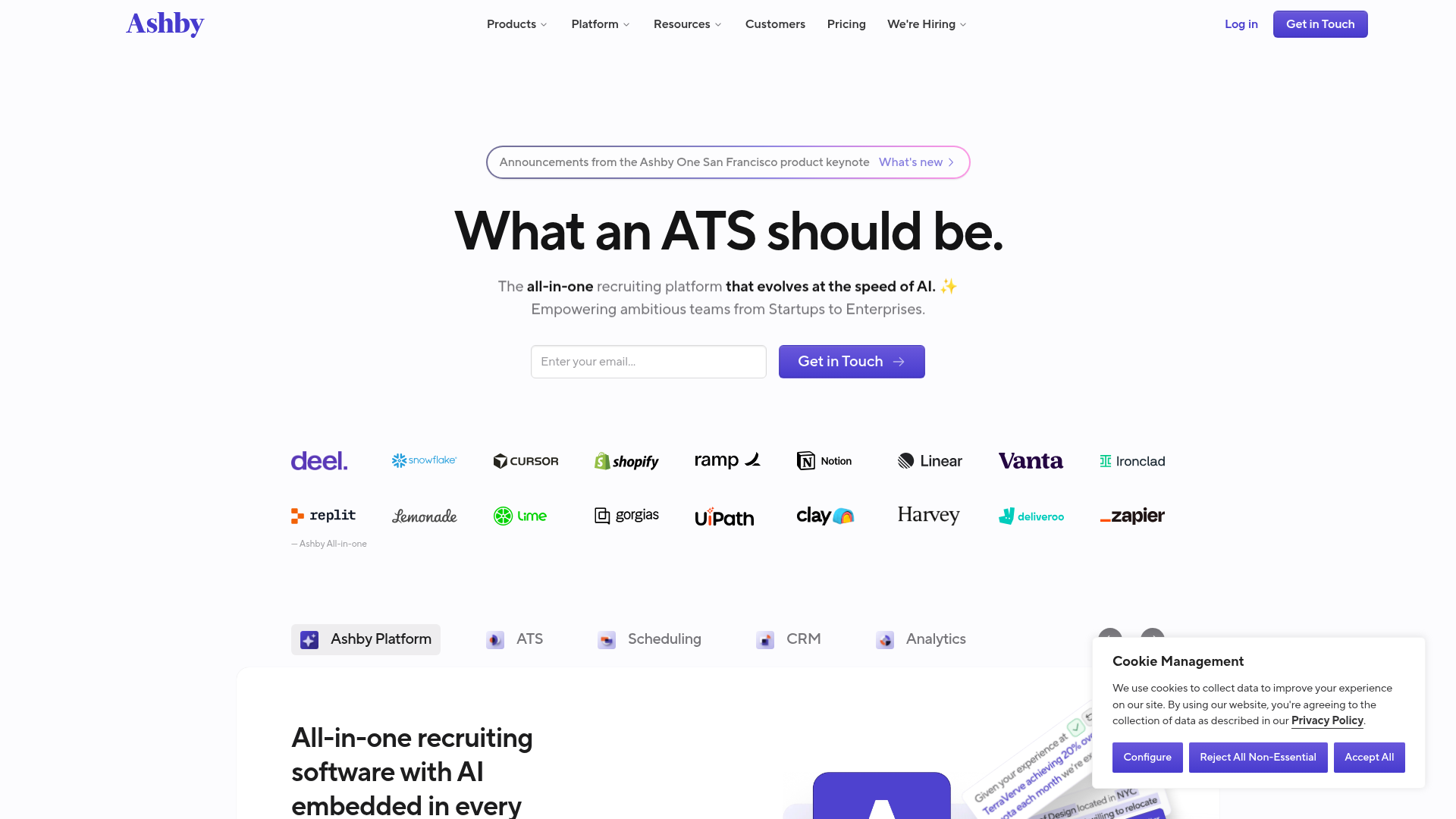
Ashby combines applicant tracking, scheduling, sourcing, CRM, and analytics in a single recruiting platform. It's popular with growth tech companies that want powerful recruiting functionality without stitching together multiple point solutions.
Reporting is a key strength. You can build highly detailed recruiting dashboards, measure funnel performance, and analyze hiring trends without external BI tools. With modern workflow automation and AI features, it’s a compelling alternative to traditional ATS platforms.
What it covers
- Applicant tracking and recruiting CRM.
- Candidate sourcing and pipeline management.
- Interview scheduling and coordination.
- Advanced recruiting analytics and dashboards.
- Workflow automation and AI-assisted recruiting.
- Integrations with HR and recruiting platforms.
Where it stands out
Ashby packs an unusually broad set of recruiting capabilities into one platform. It's a good fit for teams that want recruiting software to do much more than manage applicants, but still less complex than a full enterprise HCM.
Pricing: Foundations plan from $400/month (up to 100 employees); Plus and Enterprise plans available by request.
I appreciate how flexible the system is, especially when it comes to tailoring pipelines, workflows, and interview processes to fit the way your team works.”
4. SmartRecruiters
Category: Enterprise recruiting platform
Best for: Large organizations with global hiring needs.
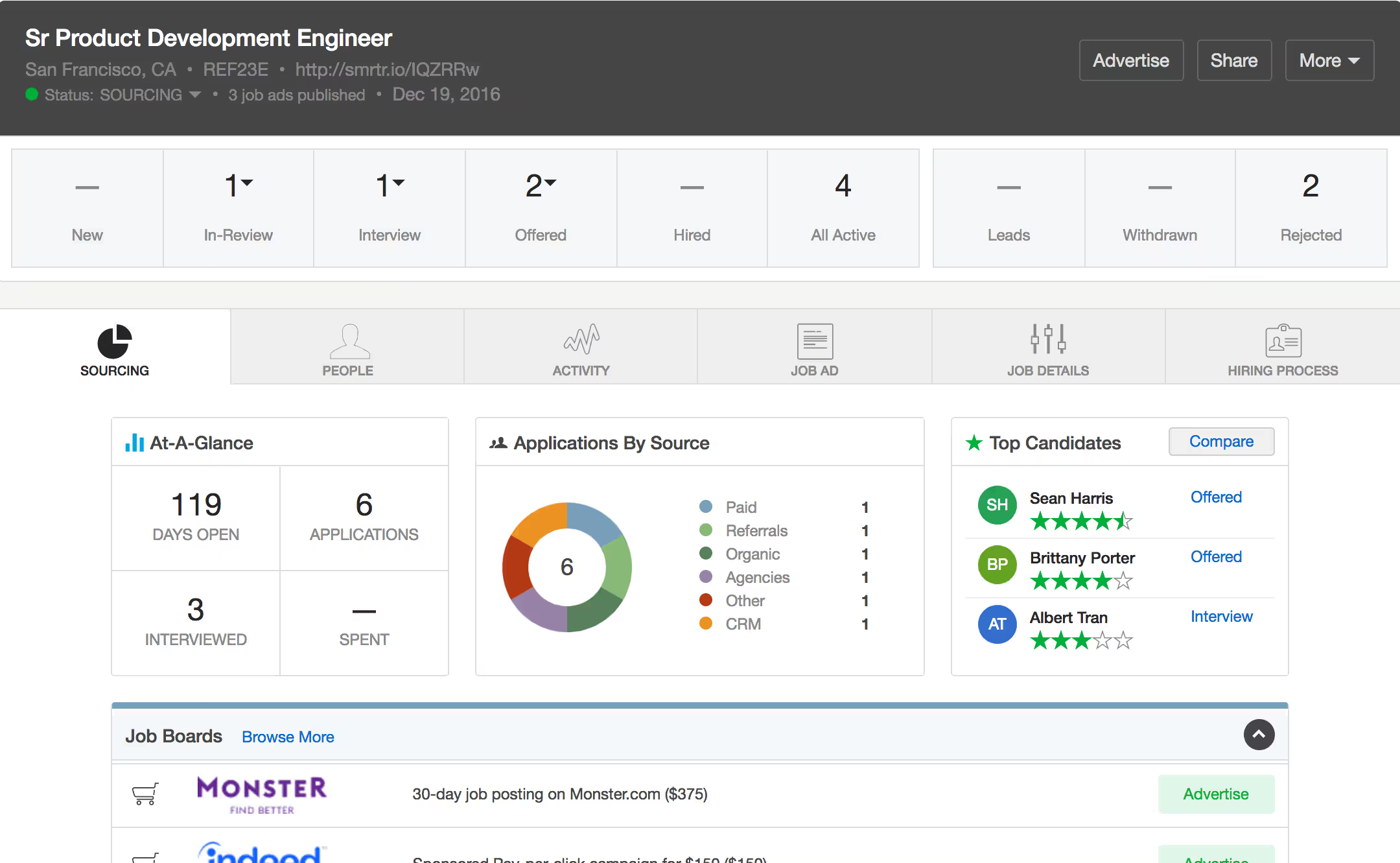
SmartRecruiters is an enterprise recruiting platform for large, global hiring organizations. You get applicant tracking, recruitment marketing, CRM, and AI-powered hiring tools in one platform. It’s a common alternative for companies that want more recruiting capability than Workday Recruiting.
The platform is particularly strong in high-volume and multi-country hiring. It offers custom workflows, a large integration marketplace, and AI features that help automate repetitive recruiting tasks.
What it covers
- Applicant tracking and hiring workflows
- Recruitment marketing and career sites
- Candidate CRM and talent pools
- AI-assisted recruiting and automation
- Interview scheduling and collaboration
- Enterprise integrations and global hiring support
Where it stands out
SmartRecruiters is built specifically for talent acquisition rather than broader HR. That gives recruiting teams more flexibility and functionality while still integrating with enterprise HCM platforms like Workday.
Pricing: Essential plan starts at $14,995; Professional, High Volume, and Complete plans available by request.
It gives an overview of candidates and helps create pools so that qualified candidates are identified easily.”
6 more alternatives to Workday HCM
5. SAP SuccessFactors
Category: Enterprise HCM
Best for: Global enterprises evaluating enterprise HCM platforms.
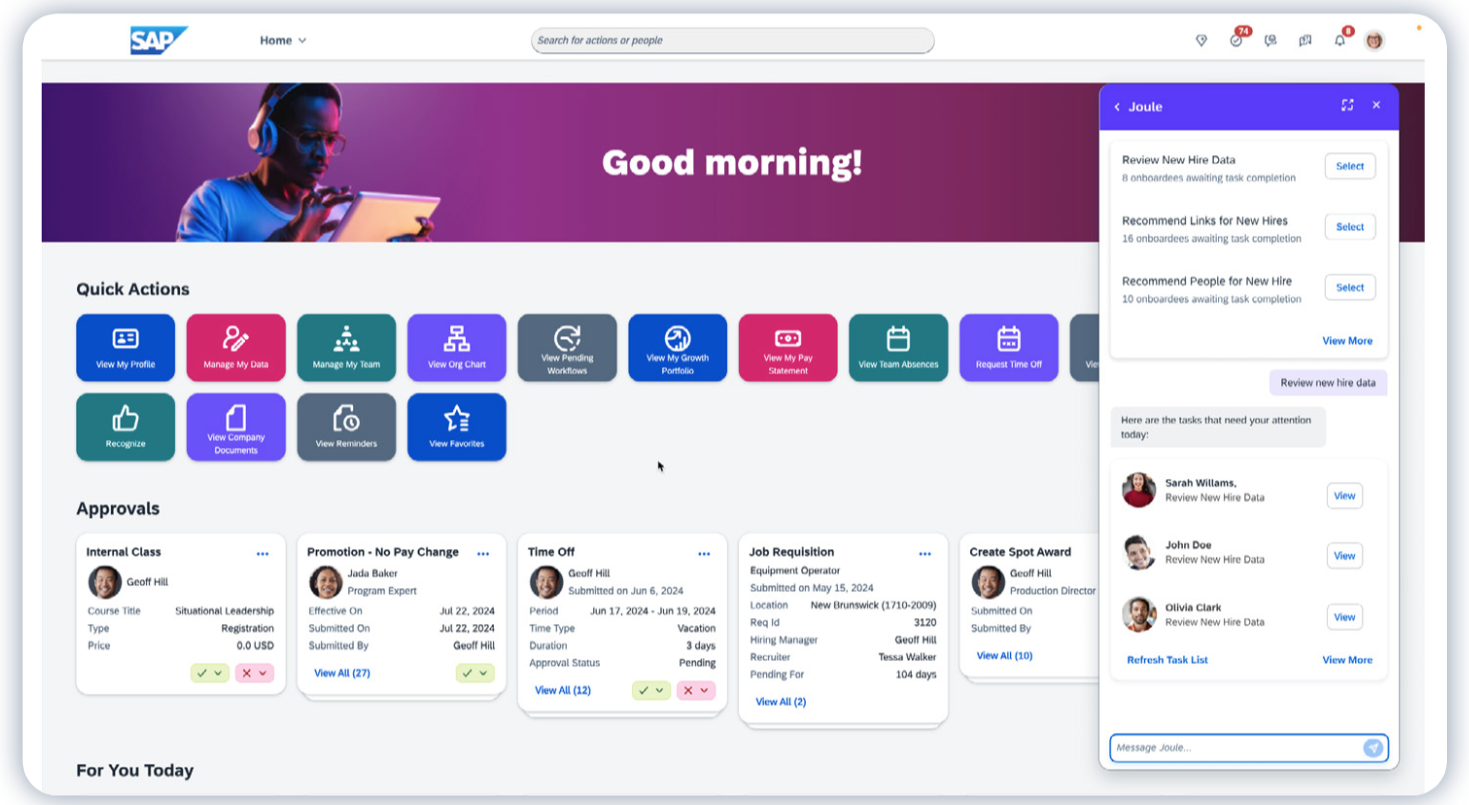
SAP SuccessFactors is one of Workday's closest competitors. Like Workday, it offers a comprehensive suite covering HR, recruiting, onboarding, performance management, learning, compensation, and workforce planning.
Organizations already invested in SAP often choose SuccessFactors because it fits naturally into their existing technology stack. It's highly configurable, supports complex global organizations, and includes a wide range of compliance and localization features.
While recruiting is only one part of the platform, it's a strong way to standardize HR operations across multiple countries.
What it covers
- Core HR and employee records
- Recruiting and onboarding
- Performance and talent management
- Learning management
- Compensation and workforce planning
- Global HR compliance and reporting
Where it stands out
SuccessFactors is a true Workday alternative, another enterprise HCM designed to manage the entire employee lifecycle. For organizations comparing enterprise HR platforms, it's usually one of the first products on the shortlist.
Pricing: Included with SAP SuccessFactors HCM, with preferential pricing for existing SAP customers. Standalone licenses are typically more expensive.
SuccessFactors connects well with SAP and other enterprise applications, allowing employee data to flow seamlessly across systems and reducing manual work.”
6. Oracle Fusion Cloud HCM
Category: Enterprise HCM
Best for: Large enterprises already invested in Oracle's technology ecosystem.
Oracle's flagship human capital management platform combines HR, recruiting, payroll, talent management, workforce planning, and analytics.
Like Workday, Oracle takes a broad view of workforce management rather than focusing primarily on recruiting. It's obviously deeply embedded in the wider Oracle ecosystem, and thus an attractive option if you already use Oracle ERP, finance, or database products.
It also invests heavily in AI to support workforce planning, skills management, and HR automation.
What it covers
- Core HR and workforce management
- Recruiting and onboarding
- Talent management and career development
- Payroll and benefits administration
- Workforce planning and people analytics
- AI-powered HR automation
Where it stands out
Oracle Fusion Cloud HCM is for organizations that want one platform to manage HR across the business. If you're already an Oracle customer, it’s a more integrated experience than introducing another enterprise HCM.
Pricing: Pay-as-you-go pricing, which can be cost effective but also hard to predict.
7. UKG Pro
Category: Enterprise HCM
Best for: Organizations with large hourly or frontline workforces.
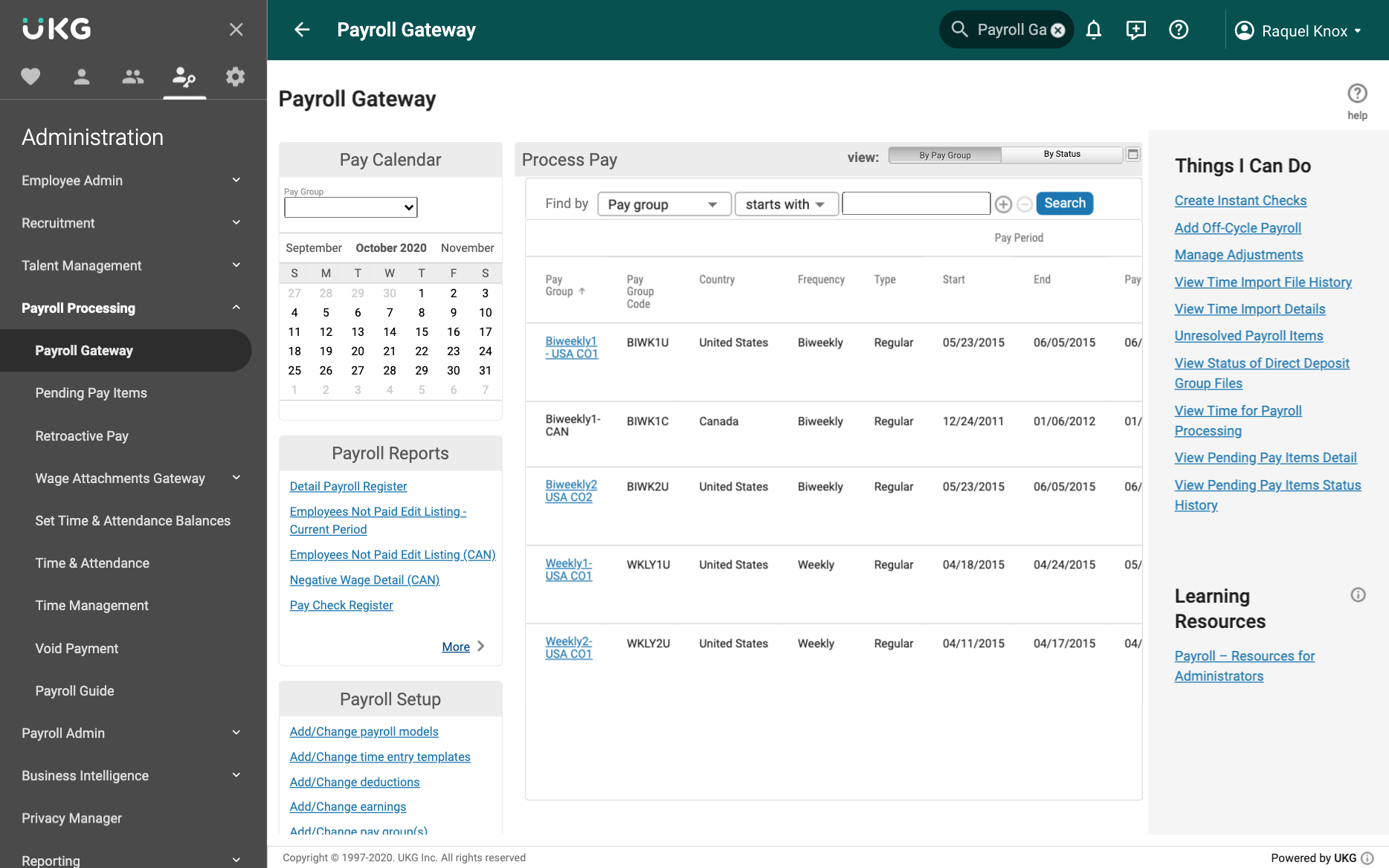
UKG Pro has HR, payroll, talent management, and workforce management in one system. It's popular with organizations that have large, distributed workforces and need strong scheduling, time tracking, and compliance capabilities alongside core HR.
While UKG includes recruiting, its biggest strengths lie in workforce operations rather than talent acquisition. The platform is especially well suited to industries like healthcare, retail, manufacturing, and hospitality, where managing hourly employees is just as important as hiring them.
What it covers
- Core HR and employee records
- Payroll and benefits administration
- Workforce management and scheduling
- Recruiting and onboarding
- Talent and performance management
- Workforce analytics and compliance
Where it stands out
UKG Pro is strong when workforce management is a strategic priority. If scheduling, labor optimization, and payroll are as important as recruiting, it’s a compelling alternative to Workday.
Pricing: Pro suite reportedly costs $32-41/user per month. A one-time implementation fee is also required.
I love the freedom and support that UKG offers. That flexibility has made it possible for our company to manage multiple component companies while still maintaining customized settings for each one.”
8. Dayforce
Category: Enterprise HCM
Best for: Enterprises with complex payroll, compliance, and workforce management needs.
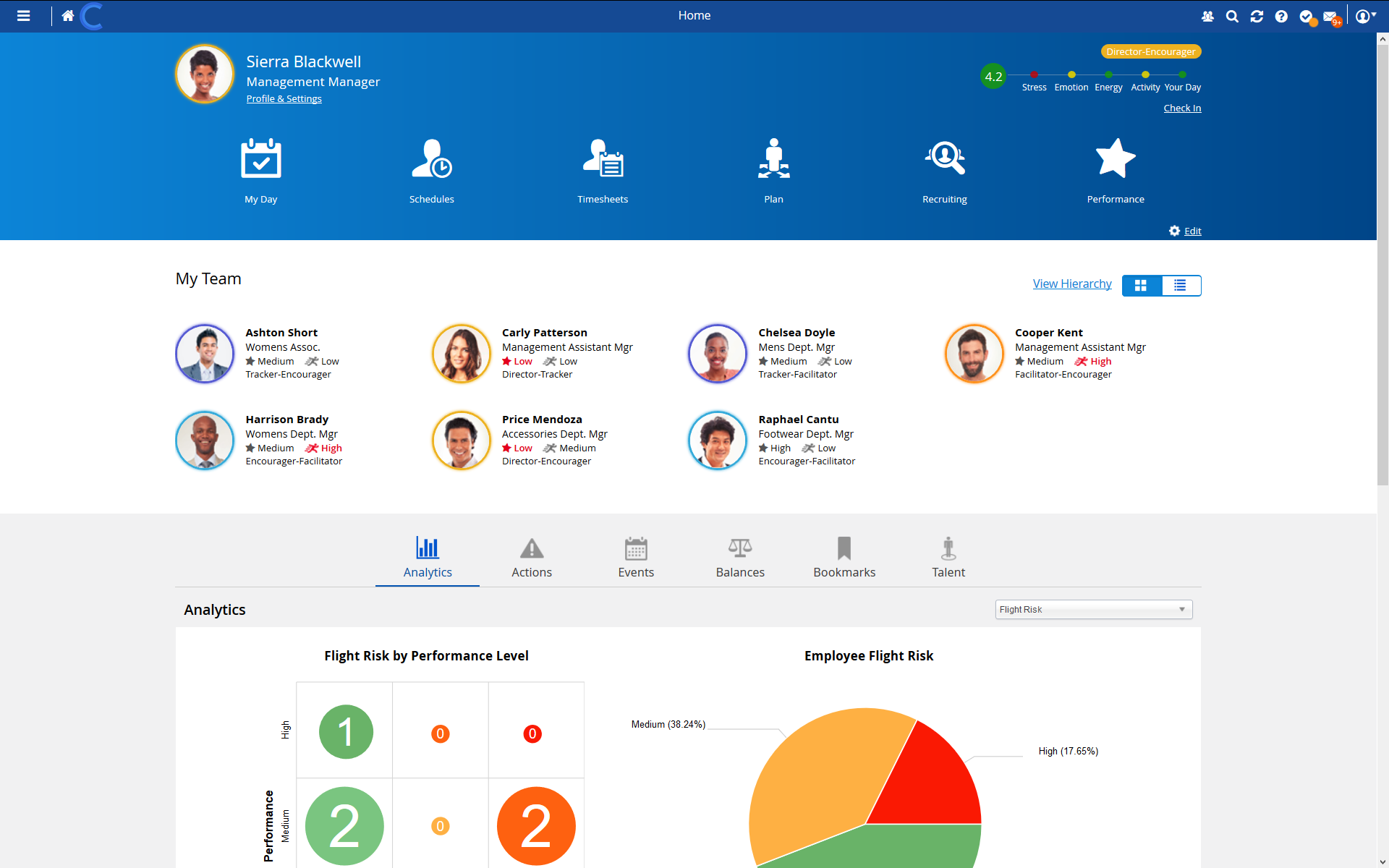
Dayforce brings together HR, payroll, workforce management, recruiting, and talent management. Like Workday, it helps large organizations manage the employee lifecycle from a central platform. In fact, it’s essentially a 1:1 alternative to Workday.
Dayforce has a strong reputation for payroll and workforce management, particularly among organizations with complex pay rules or compliance requirements. While recruiting is part of the suite, it’s best viewed as a full HCM rather than a dedicated hiring platform.
What it covers
- Core HR and employee management
- Payroll and tax administration
- Workforce scheduling and time tracking
- Recruiting and onboarding
- Talent management and succession planning
- Workforce analytics and reporting
Where it stands out
Dayforce is particularly strong in payroll accuracy and workforce management. Organizations looking for an enterprise HCM with deep operational capabilities often compare it directly with Workday.
Pricing: Talk to their team for details.
Everything is in one system, including payroll, HR, benefits, and time tracking, so it really cuts down on duplicate work.”
9. Rippling
Category: HRIS and HCM
Best for: Growing companies looking for an all-in-one platform for HR, payroll, and IT.
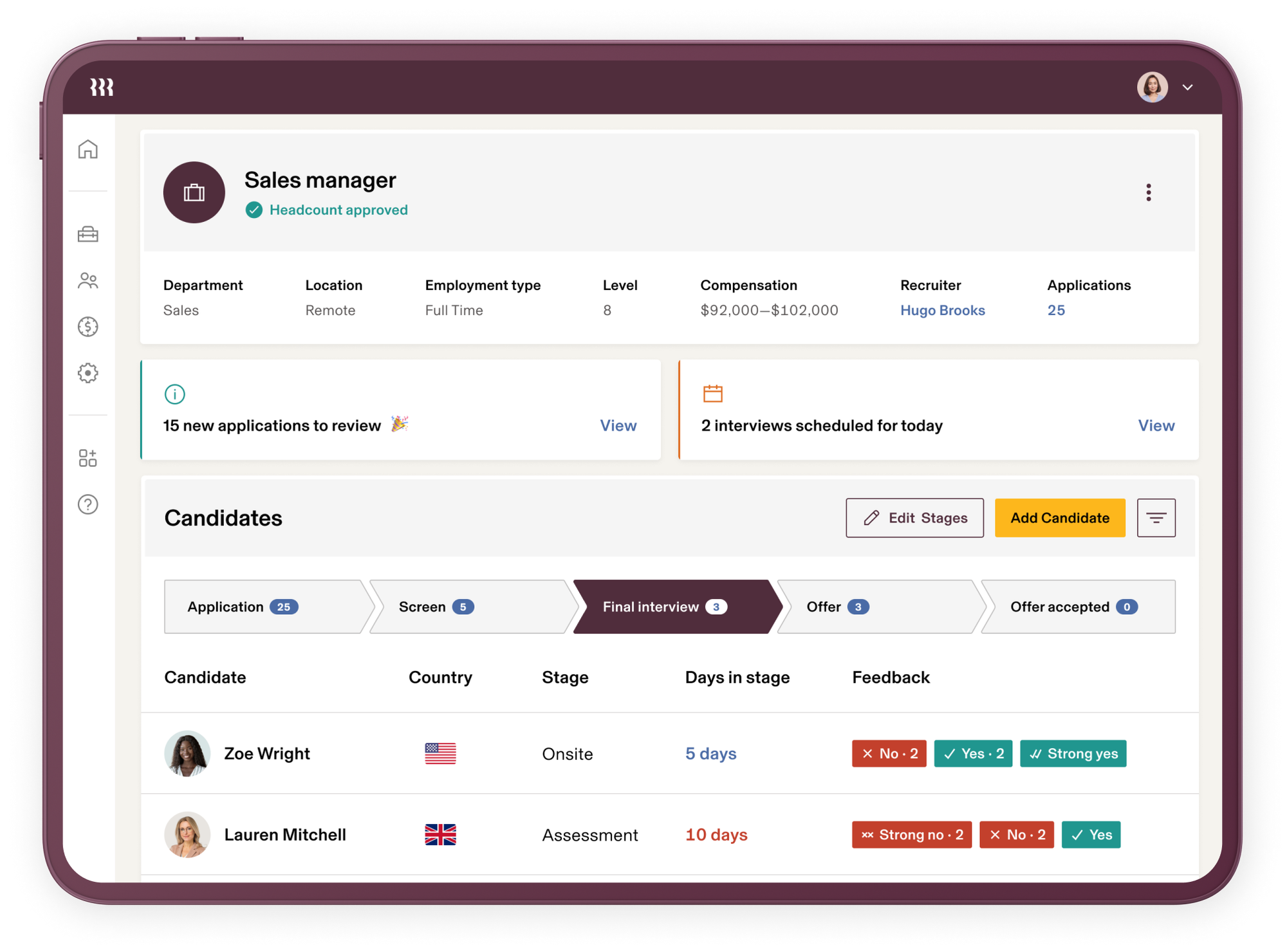
Rippling takes a different approach to Workday. As well as HR, it brings payroll, IT, identity management, and finance into one place. And it’s aimed specifically at fast-growing companies.
The platform is known for its modern user experience, fast implementation, and extensive automation. It’s an attractive option for companies that want to simplify operations without the complexity of a traditional enterprise HCM.
What it covers
- HR, payroll, and benefits
- Recruiting and onboarding
- IT device and app management
- Identity and access management
- Workflow automation
- Reporting and employee analytics
Where it stands out
One of the broadest operational platforms outside the traditional enterprise HCM market. It's appealing to growing companies that want HR and IT in a single system.
Pricing: Request a quote for pricing.
Massive ROI but modular pricing. While add-on modules can drive up the monthly cost, the ROI is huge.”
10. BambooHR
Category: HRIS
Best for: Small and mid-sized organizations that want an easy-to-use HR platform.
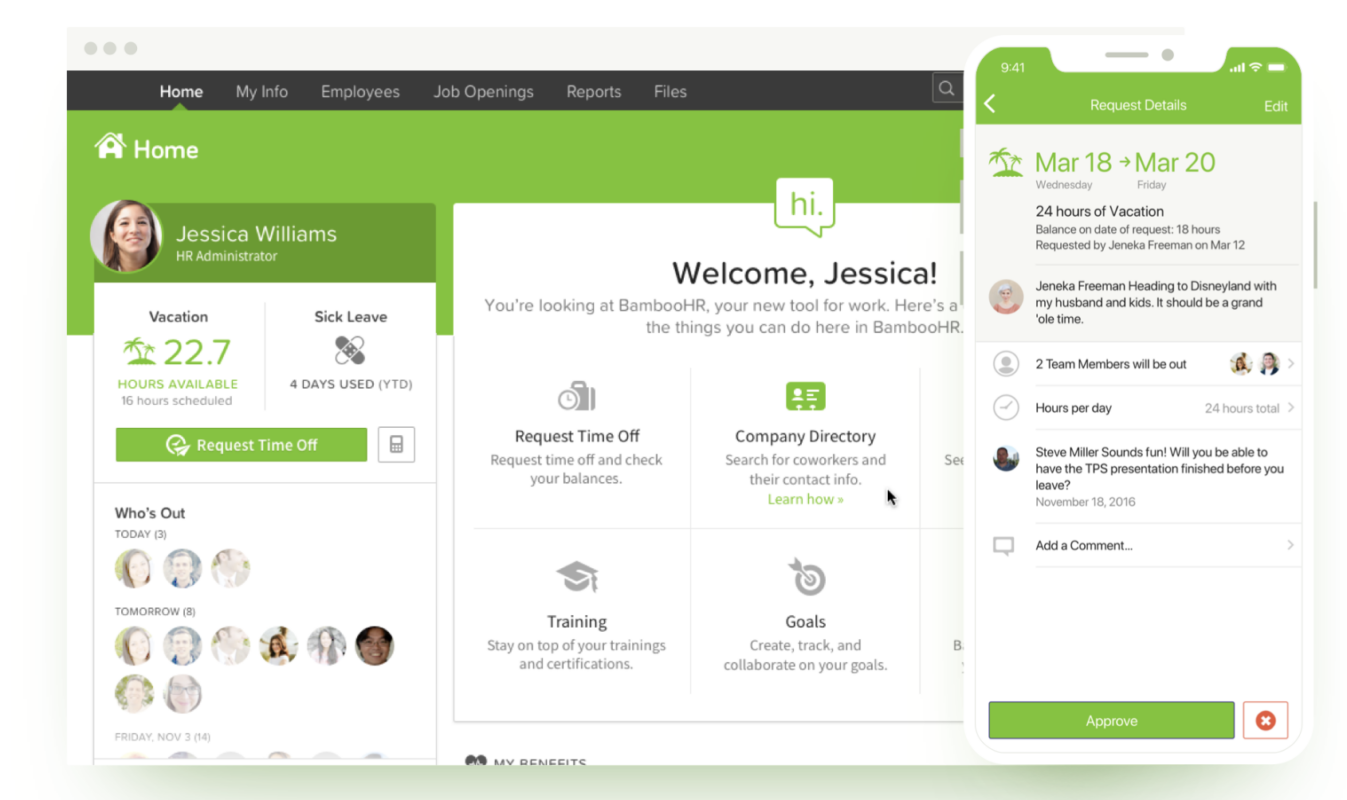
BambooHR is built for small and mid-sized businesses that want straightforward HR software without enterprise-level complexity. It covers core HR, onboarding, performance management, and applicant tracking through a simple, easy-to-use interface.
Compared with Workday, BambooHR is far easier to implement and manage. It doesn't have the same feature depth, but most mid-market businesses don't need that level of sophistication.
Instead, you get a platform that's quick to deploy and easy for employees, managers, and HR teams to use.
What it covers
- Core HR and employee records
- Applicant tracking and hiring
- Onboarding and offboarding
- Performance management
- Time off and employee self-service
- HR reporting and workflows
Where it stands out
BambooHR prioritizes simplicity over breadth. For organizations that have outgrown spreadsheets but don't need an enterprise HCM, it's one of the most approachable alternatives to Workday.
Pricing: Core plan from $10/employee per month; Pro from $17/employee per month; Elite from $25/employee per month.
It streamlines everyday HR tasks without adding unnecessary complexity, and its emphasis on people-first solutions aligns with building a positive workplace culture.”
Workday vs specialist recruiting platforms
The two are different categories. Workday is an enterprise HCM. A specialist recruiting platform sits alongside it and handles the hiring work between requisition and offer.
| If you want to... | Consider... |
|---|---|
| Manage HR, payroll, finance, and workforce planning | Workday |
| Add AI sourcing, application review, interviewing, and recruiting automation | Metaview |
| Improve structured hiring | Greenhouse or Ashby |
| Replace Workday with another enterprise HCM | SAP SuccessFactors, Oracle Fusion Cloud HCM, UKG Pro, or Dayforce |
| Simplify HR for a growing business | Rippling or BambooHR |
How to choose the right Workday alternative
Not every Workday alternative solves the same problem. So what are you actually trying to improve?
Why Workday customers choose Metaview
For many organizations, Workday already does exactly what it's supposed to do: serve as the system of record for HR.
The opportunity is improving everything that happens before a candidate becomes an employee.
Metaview adds AI across the entire recruiting workflow:
- AI sourcing agents search the web and your ATS for candidates that match your brief.
- Outreach sends each candidate a personalized email sequence and handles the follow-ups.
- Application Review reads every inbound application against the role’s criteria, sorts candidates by fit, and shows its reasoning. Recruiters make every progress or reject decision.
- The Notetaker joins interviews as a visible participant, captures structured notes, and drafts scorecards for the interviewer to review and submit.
- Reports give recruiting leaders answers from their own interview data without chasing exports across several systems.
Because Metaview integrates natively with Workday, you don't need to choose between enterprise HR and modern recruiting. You can keep the HCM you trust and give recruiters AI tools that save time and improve hiring quality.
If Workday runs your workforce, Metaview helps you build it.
Bring Metaview into your hiring stack.
Live notes, structured scorecards, and ATS sync - set up in under 10 minutes.
FAQ: Workday alternatives
What is the best Workday alternative for recruiting?
If your goal is to improve recruiting rather than replace your HR platform, Metaview, Greenhouse, Ashby, and SmartRecruiters are among the strongest options. Each focuses on hiring, while Metaview extends recruiting with AI-powered sourcing, application review, interview intelligence, and analytics.
Is Workday an ATS or an HCM?
Workday is a human capital management (HCM) platform. It includes applicant tracking and recruiting capabilities, but they're part of a much broader suite including HR, payroll, finance, talent management, and workforce planning.
Does Metaview integrate with Workday?
Yes. Metaview integrates with Workday, so Workday stays your system of record while recruiters use Metaview for AI sourcing, application review, interview notes, and reporting.
Which platforms compete directly with Workday?
SAP SuccessFactors, Oracle Fusion Cloud HCM, UKG Pro, and Dayforce are Workday's closest competitors. They provide similarly broad platforms to manage HR, payroll, talent, and workforce operations.
What should enterprise companies look for in a Workday alternative?
Start by identifying the problem you're trying to solve. If it's enterprise HR, evaluate other HCM suites. If it's recruiting, look for AI that covers sourcing, application review, and interviews, a documented Workday integration, a user experience recruiters will use every day, and workflows that cut administration time.
