
Lateral recruiting fills an open role with someone who already does the job, at the same level, in a different company or a different team. Same title, same seniority, fresh context. The candidate isn’t reskilling. The recruiter isn’t projecting potential. Both sides are running a calibration exercise on whether the work in the new room matches the work in the old one.
That calibration is the part most teams skip. They run a tight loop on external entry-level hires and a tight loop on internal promotions, and then they treat the lateral move as a halfway version of both, with half the discipline. The result is a 28-day search that ends with a hire who looks right on paper and re-orgs out in nine months.
This is a recruiter’s playbook for running a lateral search with the same calibration discipline you’d run on an external senior hire. The definitional part takes one section. The rest is what the recruiter actually does, where the signal lives, and what changes when the interview audio comes back into the workflow.
What lateral recruiting is.
Lateral recruiting is hiring someone for a role at the same level they currently hold, either from another company or from another team inside the same company. A senior product manager moves to a senior product manager seat. A staff engineer trades one staff engineer chair for another. The title doesn’t move, the work and the context do.
The category covers three real patterns recruiters see in 2026:
| Pattern | Where it shows up | Where calibration usually breaks |
|---|---|---|
| External lateral, same industry | Senior IC poached from a direct competitor | Hiring manager assumes “they already know our space” and skips half the technical loop |
| External lateral, new industry | Senior IC moves from fintech to healthtech | Recruiter assumes “they did the job before” and skips the domain-context interview |
| Internal lateral, cross-team | Senior IC moves from one product squad to another | Both sides assume “we already know them” and run two interviews instead of a real panel |
The pattern is the same across all three. The recruiter walks in with the wrong assumption about what calibration the candidate has already passed, and the hiring manager walks in with the wrong assumption about what calibration is still owed. The interview loop gets compressed to match.
Why lateral hires fail (and why it isn’t the candidate).
Lateral hires don’t fail because the candidate can’t do the work. Almost by definition, they can. They fail because the operating model in the new room is different from the operating model in the old one, and nobody surfaced the difference in time to renegotiate the offer.
68% of searches start with high alignment when AI is core to hiring, versus 49% when it isn’t, according to Metaview’s 2026 report, surveying 505 recruiting leaders and hiring managers across North America and EMEA. That 40% kickoff-alignment lift compounds across the search. Lateral hires sit at the wrong end of it because the kickoff is the meeting teams skip when they think they don’t need it.
The three places lateral calibration usually breaks:
- Scope. “Senior PM” in one company runs three squads and one platform team. “Senior PM” in another runs one squad and reports to a director. Same title, different surface area.
- Stakeholder gravity. A senior IC at a 200-person company spends 60% of their week with engineering. The same level at a 2,000-person company spends 60% with cross-functional partners. The job changed.
- Decision rights. A staff engineer who shipped without a design review at company A is going to bounce off a design-review-required culture at company B inside six months. Nobody discussed it in the loop.
Most teams treat lateral hires as a faster version of the external search. They aren’t. They’re the search where calibration is least visible and most expensive to skip.”
The lateral recruiting playbook.
The framework is short. The discipline is the part teams skip.
Run the intake meeting you’d run on any other senior hire.
The most common failure mode in a lateral search: no intake meeting. The hiring manager says “we know what we need, let’s just see the candidates.” The recruiter agrees, the search opens, and the calibration error compounds.
Run the intake meeting. Specifically:
- Name three must-haves the candidate must walk in already doing
- Name two trade-offs the hiring manager is willing to flex on
- Name one deal-breaker the manager only mentions when pushed
The deal-breaker is the one that gets lost in lateral searches. The hiring manager assumes the lateral candidate already knows it, doesn’t ask, and finds out in the panel that the candidate doesn’t. Metaview’s intake notes flag the deal-breaker the moment the hiring manager says it, so it lands in the screening brief without the recruiter having to remember.
Build a panel that calibrates against the new room, not the old.
The panel for a lateral search should test the work the candidate does next, not the work they did last. That sounds obvious. In practice the panel ends up with two interviews from peers who knew the candidate’s prior employer, and the actual calibration on the new team’s operating model never happens.
The fix is one panelist per stake:
| Stake | Panelist | What they’re testing |
|---|---|---|
| Scope and ownership | A peer at the new level | Whether the candidate’s prior surface area matches the new one |
| Stakeholder gravity | A cross-functional partner | Whether the candidate has run the kind of partnership the new role requires |
| Decision rights | The hiring manager’s manager | Whether the candidate’s prior cultural defaults will collide with the new ones |
Four panelists, one of each, plus a final with the hiring manager. The calibration is in the design of the panel, not in the questions any one interview asks.
Tighten the offer-prep conversation to the signals the panel actually captured.
The offer-prep conversation is where lateral searches close or slip. By the time a recruiter gets to it, the panel has run, the must-haves have shifted, and half the room has forgotten which interview surfaced which deal-breaker.
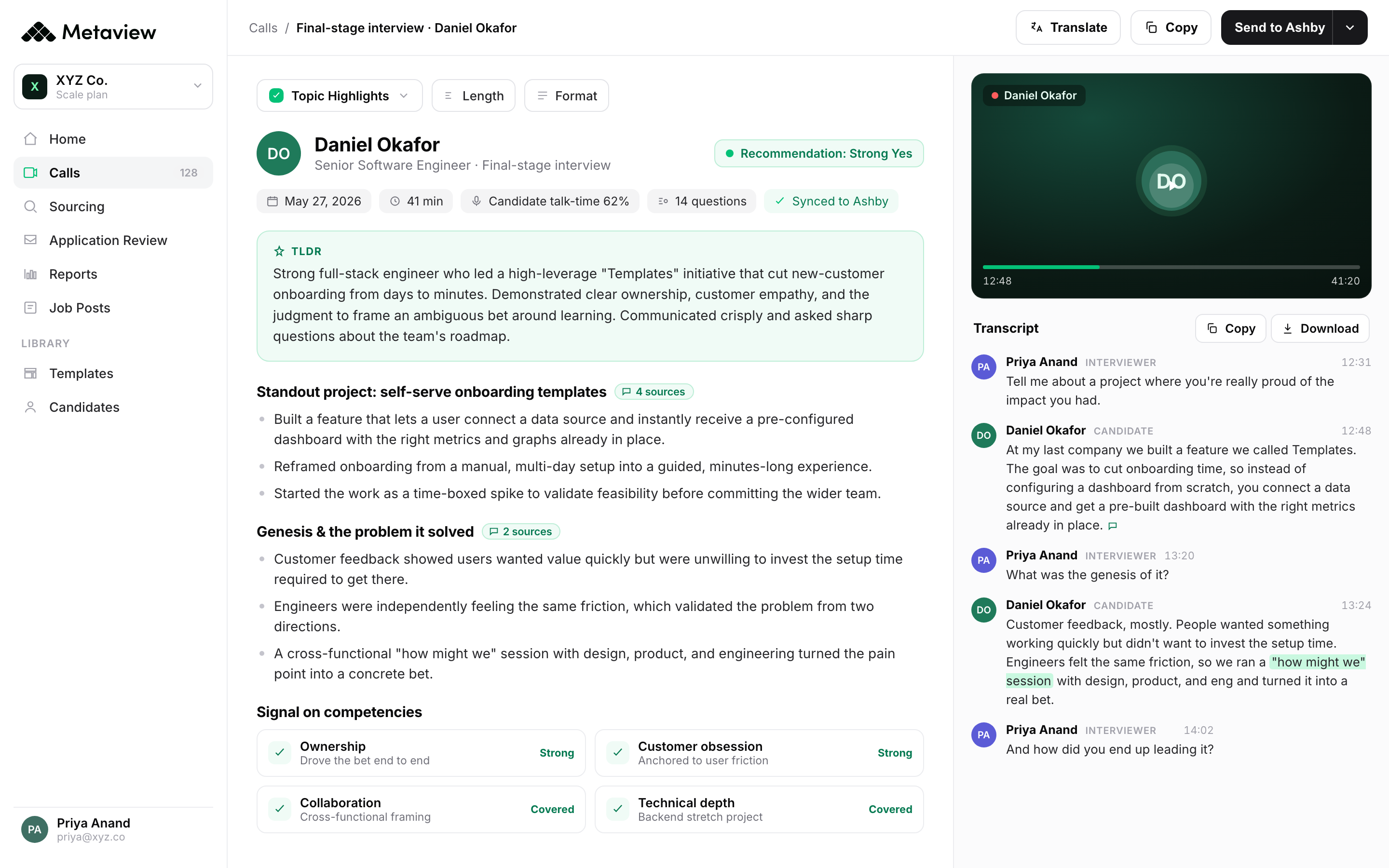
The recruiter who walks into offer prep with the captured signal from every panelist closes a different conversation than the recruiter who walks in with their best recollection. Metaview surfaces every per-competency note from every panelist, so the offer-prep brief opens with what the candidate said and what the panel concluded, not what the recruiter remembers under pressure.
The proof: three customer outcomes lateral teams care about.
Across the 4,000+ organizations running on the Metaview platform, the lateral-hire failure pattern shows up in the data: roles that closed inside the SLA but had to be reopened inside 12 months. The customers who fix the failure pattern almost always fix it in the same place, at the intake and panel-design step.
At Brex, Joel Baroody runs senior IC searches against the captured signal from every prior round, and the variance between panelists on the same competency dropped 38% across the engineering hiring window. Same role, same hiring panel, fewer judgment calls splitting the difference on the wrong axis.
At Quora, Hannah Wardle, Global Head of Recruiting, runs the same play on tech-leadership hires. “All of our hiring team said that Metaview saves them hours. We’re now getting feedback from hiring managers in 10 to 20 minutes, which is just ideal for a recruiting team that works with time-to-hire targets.” The 10-to-20-minute debrief loop is the difference between a lateral search closing on Thursday and slipping to next Monday.
How Metaview operationalizes the calibration discipline.
The reason lateral calibration usually fails is operational, not strategic. The recruiter and the hiring manager agree calibration matters. They just can’t reproduce, two weeks later in the offer-prep meeting, what the hiring manager committed to in the intake.
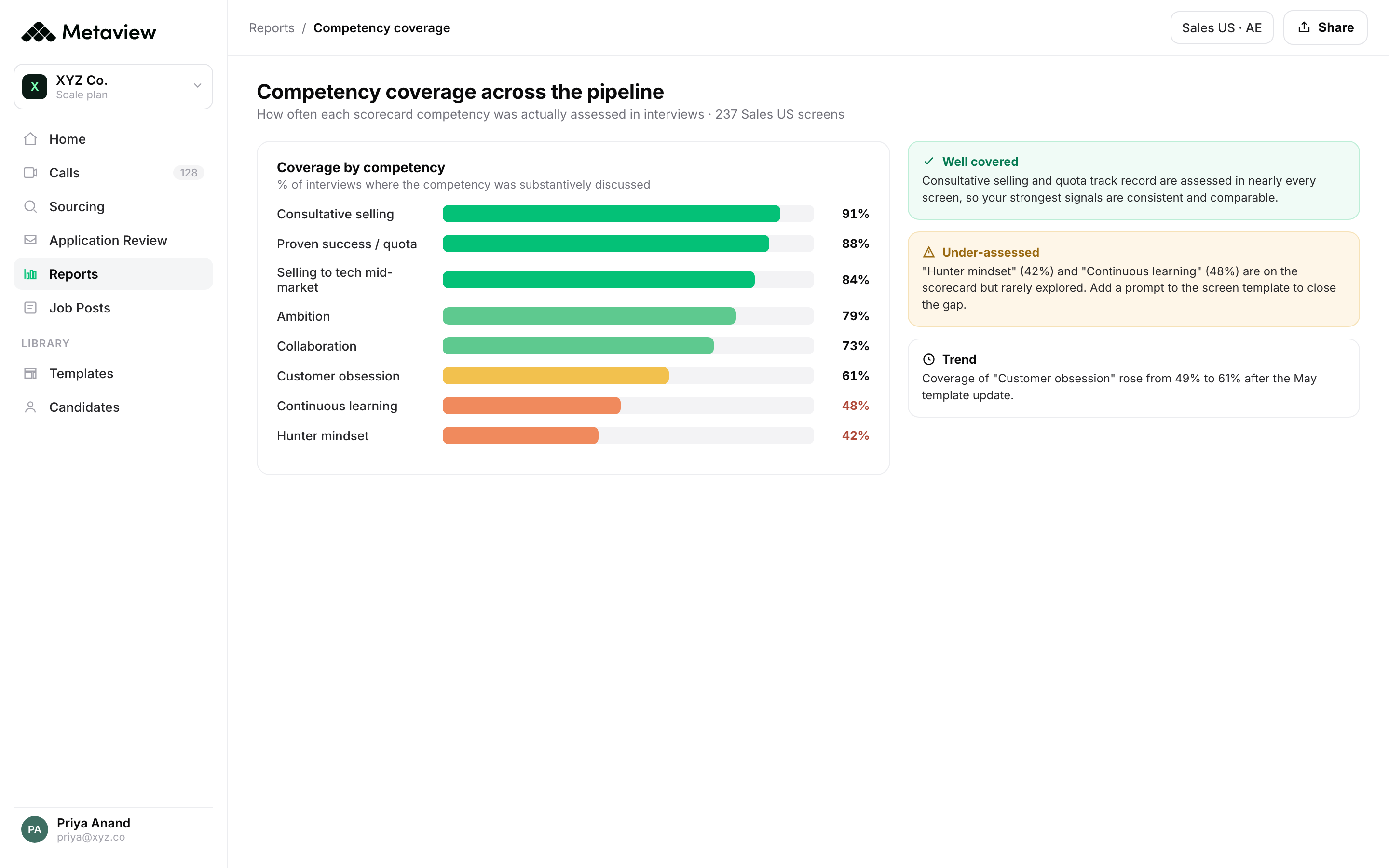
Metaview captures every spoken word in your interviews, and uses it to keep the intake commitment visible across every stage of the search. The must-haves the hiring manager named in the intake show up in the screening sort. The deal-breaker that surfaced in the panel shows up in the offer-prep brief. The trade-offs the hiring manager flexed on in week one don’t quietly re-tighten in week three.
For a lateral search specifically, that means:
- The intake meeting commitment is captured and structured into a calibration brief the recruiter takes into the panel kit
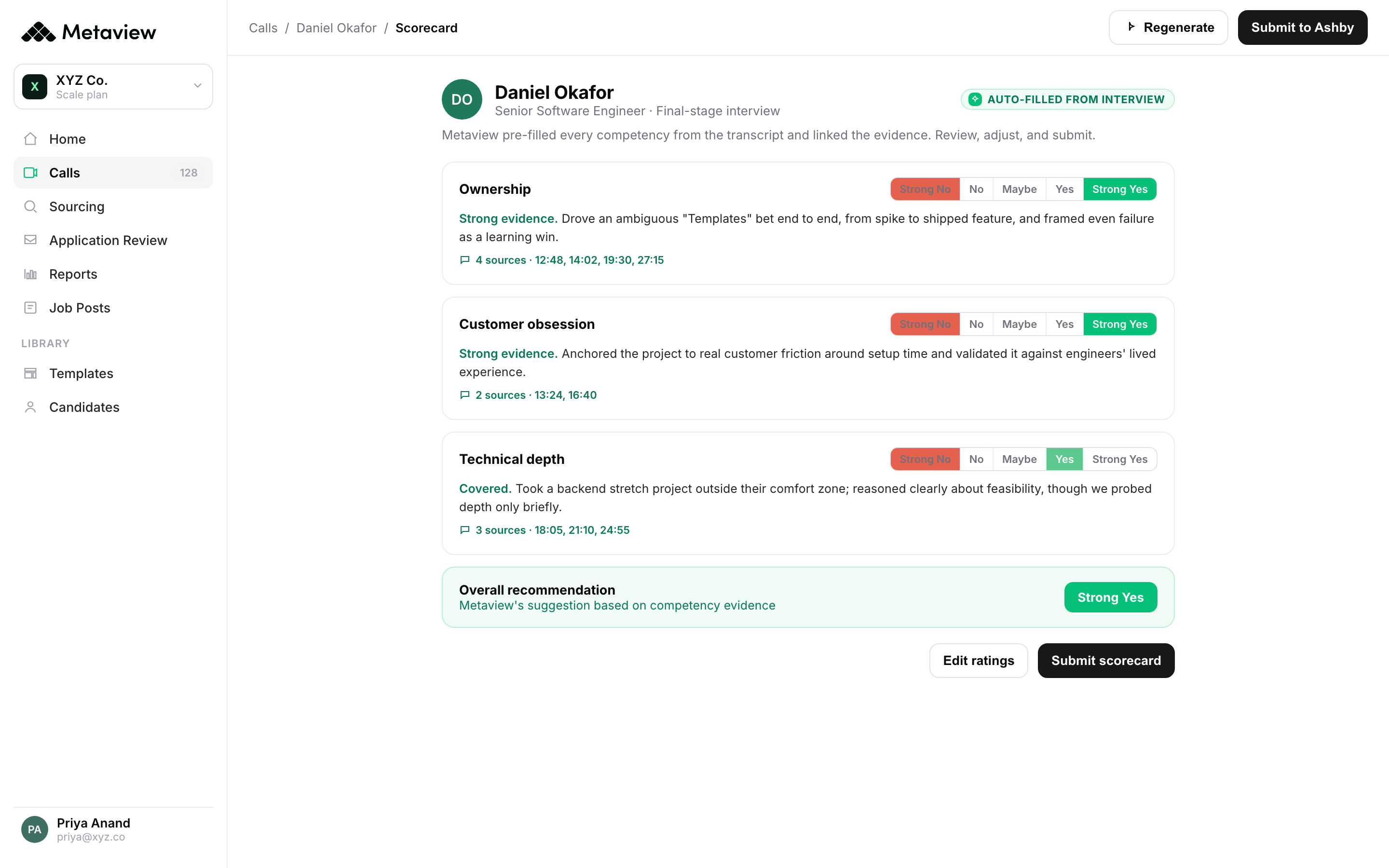
- Every panel interview is captured and mapped against the must-haves, so the offer-prep conversation opens with what the panel agreed on
- The offer-prep brief lands in the recruiter’s inbox the moment the final-round debrief ends, with the per-competency signal already in it
Bring Metaview into your hiring stack.
Live notes, structured scorecards, and ATS sync - set up in under 10 minutes.
FAQ.
Frequently asked.
Is lateral recruiting different from internal mobility?
Yes, though the lines get fuzzy. Internal mobility is a program that surfaces internal candidates against open roles. A lateral move is an outcome that can come from internal mobility or from external sourcing. The calibration discipline is the same either way.
Why do lateral hires fail more often than expected?
They fail on calibration, not credentials. The candidate can almost always do the work. What fails is the match between the prior operating model and the new one, and nobody surfaced the gap in time to renegotiate.
What’s the right panel size for a lateral search?
Four. One peer at the new level for scope, one cross-functional partner for stakeholder gravity, one second-line manager for decision rights, and the hiring manager for the final. Smaller panels lose signal. Larger panels lose calibration.
How do you compete against the candidate’s current employer on a lateral move?
You don’t win on comp. You win on the role design and the team. The signals the candidate cares about, scope, ownership, stakeholder mix, are captured in their answers across the panel. The recruiter who walks into offer prep with those signals named closes a different conversation than the one who walks in with comp slides.
How does Metaview help on lateral searches specifically?
The intake brief, the panel notes, and the offer-prep brief are captured and structured into the same context layer. The calibration the hiring manager committed to in week one is still visible in week four, so the offer prep is grounded in what the panel agreed on, not what the recruiter remembers.
Related reading.
This sits inside Metaview’s hub on talent density. Adjacent reads worth opening next: the recruiter’s intake call playbook, and the intake and debrief notes launch, which extends the calibration discipline into the meetings most lateral searches skip.
