
Tech talent recruitment changed the day interview signal stopped disappearing the moment the call ended. Resumes and take-homes used to be the only durable artifacts of a tech panel. Everything else, the architecture probe, the way a candidate handled a vague problem, the moment a hiring manager’s read flipped, lived in someone’s head until it didn’t.
In 2026 the artifacts are different. The panel still runs. The take-home still gets graded. The architecture discussion still happens. The difference is that the interview itself is now captured, structured, and queryable, which means the operating model around it can be tighter than anything the recruiting team could run before.
This is the playbook for what tech recruiting actually looks like when interview signal is the durable asset, not the resume. The structural part is short. The discipline of running it is where most teams either compound advantage or burn out their recruiters.
What tech talent recruitment actually is.
Tech talent recruitment is the operating model for hiring engineers, product managers, designers, data scientists, and the adjacent technical roles. Same shape as any senior recruiting motion, sharper edges in three places: the technical screen, the panel design, and the speed at which the decision compounds or slips.
The signature challenges have been the same for fifteen years:
- The technical screen is the single highest-stakes filter in the loop, and it’s the place where rubric drift quietly kills consistency between candidates
- The panel is run by ICs and managers whose first job is the work itself, not interviewing, which means prep time, attention, and structured note-taking are all expensive
- The decision gap, the hours and days between the last interview and the offer, is where most strong candidates accept a competing offer
What changed in 2026 is that the interview audio became the durable layer. Resumes are still inputs. Take-homes are still calibration. The thing the operating model now runs on is the structured signal from the conversation itself.
The operating model: from resumes to interview signal.
The shift looks like this:
| Tech recruiting operating model | 2019 | 2026 |
|---|---|---|
| Durable artifact between rounds | Resume + take-home score | Captured, per-competency interview signal |
| Calibration on the technical screen | Recruiter’s notes after the fact | Structured per-competency capture, every screen |
| Decision in the debrief | Each interviewer’s recall under pressure | The actual quote that changed the read, pulled in the room |
| Time from final round to offer | 2 to 5 business days, depending on debrief schedules | Same day, in the median customer running structured capture |
| Cost of a panelist forgetting which round flagged the deal-breaker | One reopened loop and ~7 days of slip | None. The signal is in the panel kit |
This is the actual operating change in 2026, and it’s what every other part of the playbook below ladders up to.
The 2026 tech recruiting playbook.
Five steps. Each one is a place where the captured interview signal compounds advantage rather than evaporating.
Calibrate the role with the hiring manager in writing.
The intake meeting is the single most consequential hour in a tech search. Not because the hiring manager always knows what they want, but because the hour forces them to commit.
The intake should produce three artifacts:
- Three must-haves the candidate must show in the loop
- Two trade-offs the hiring manager is willing to flex on
- One deal-breaker the hiring manager only mentions when pushed
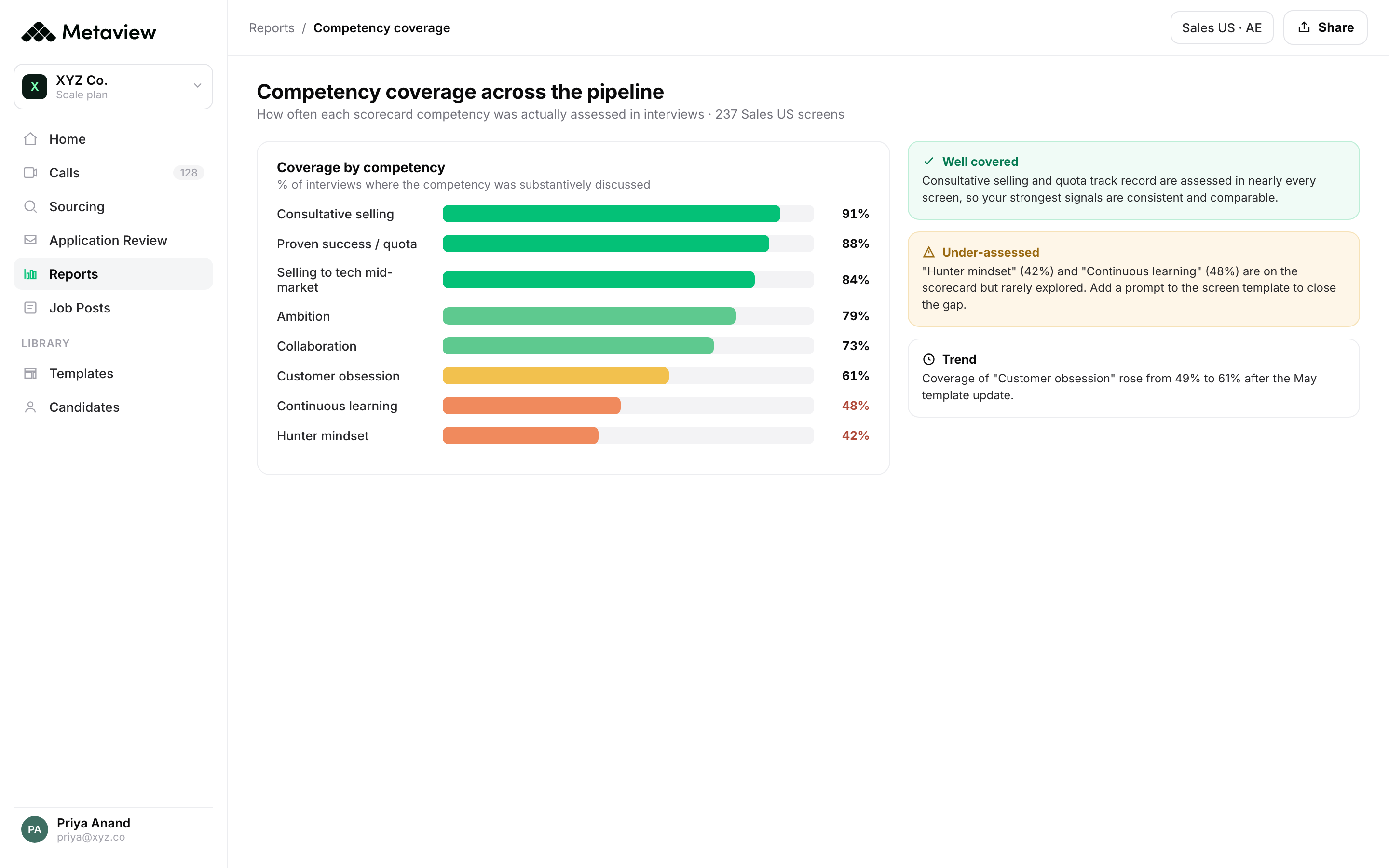
The deal-breaker is the one teams skip. The hiring manager assumes it’s obvious; the recruiter assumes the panel will surface it; nobody writes it down. Metaview’s intake notes capture the deal-breaker the moment the hiring manager says it, so the panel kit opens with it in writing.
Design the technical screen to score the same way twice.
Most technical screens drift. Screener A scores tighter than screener B by Tuesday afternoon. Screener B drifts back by Wednesday because they got burned on a candidate who couldn’t talk about the trade-offs once they got into the team. The variance compounds across the funnel.
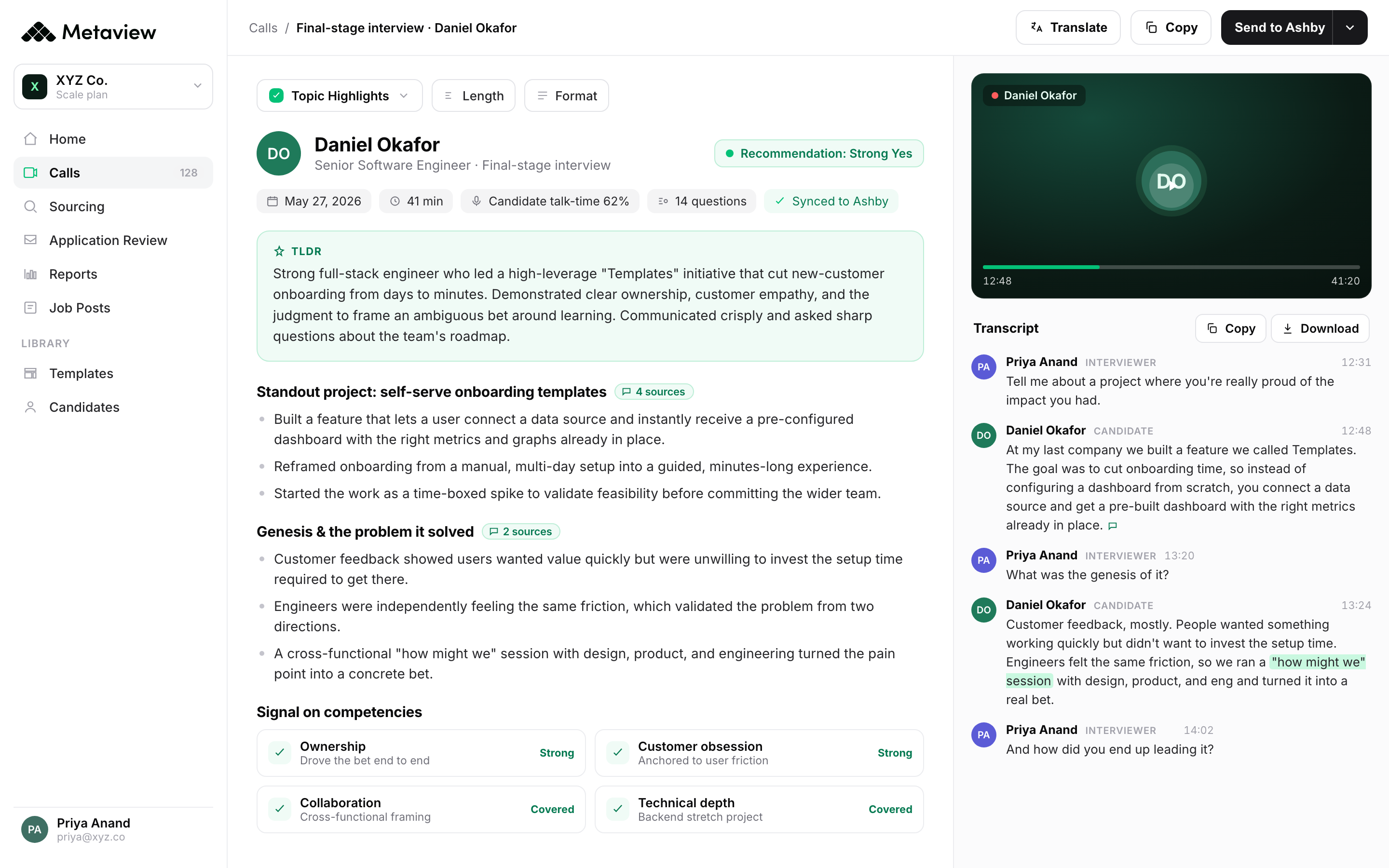
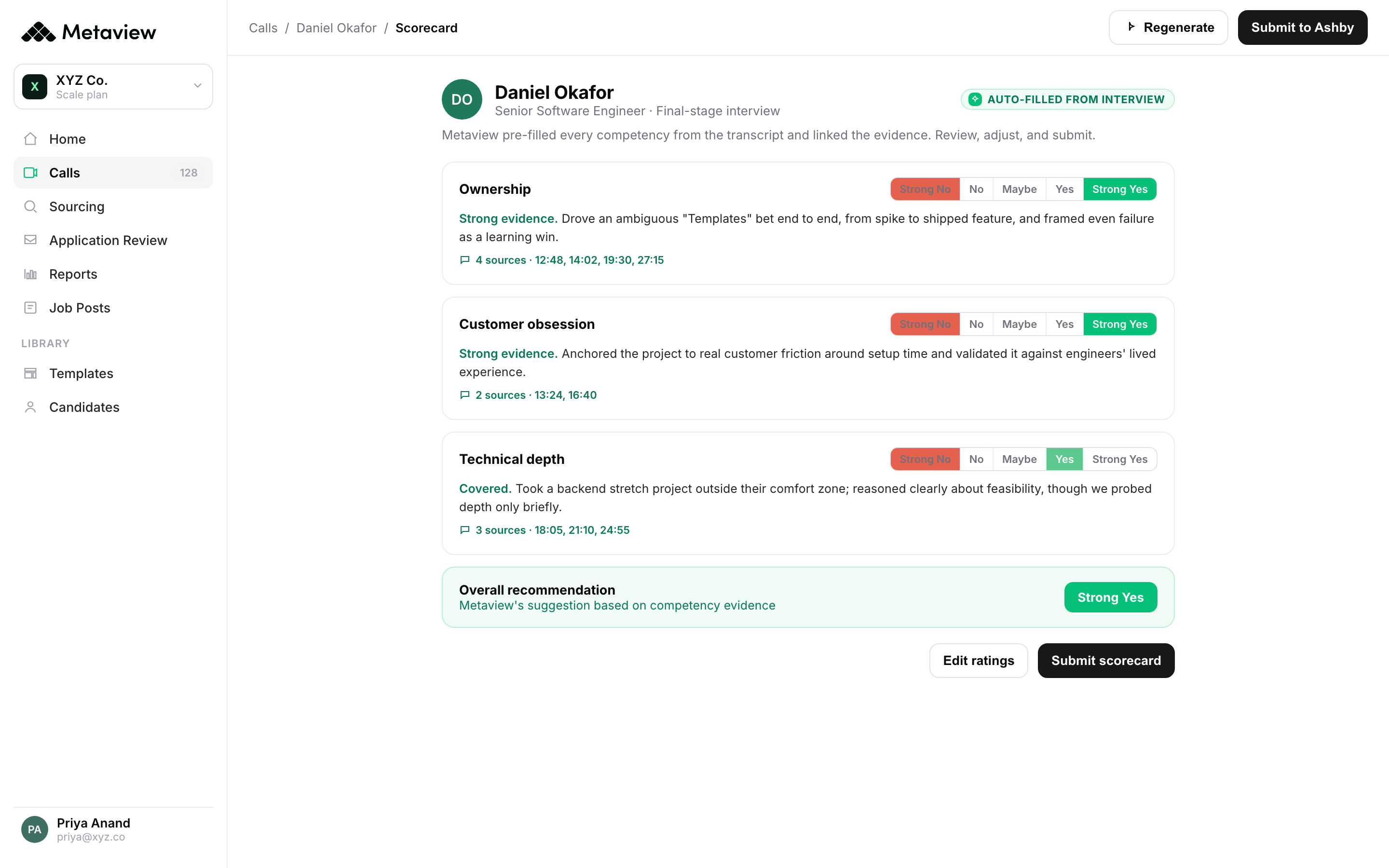
The fix is per-competency capture, not a stricter rubric. Capture what the candidate said about each must-have, and the same screener can compare against themselves across forty candidates. The rubric stays the rubric. The signal underneath it becomes durable.
When you’re doing technical interviews, you feel huge pressure to make sure that you don’t miss certain things that would be really important for this candidate.”

Build a panel that tests the work, not the resume.
Four panelists, one technical screener, the rest a panel of one peer at the candidate’s incoming level, one cross-functional partner, and the hiring manager. The panel is the calibration body for the search, and it has to test the work the candidate will actually do, not the work the resume describes.
Captured interview signal helps here in a specific way. The panel can pull the moment from the screen, the architecture probe, or the take-home discussion that surfaced a particular signal, without having to remember which interviewer asked the question. The debrief becomes a calibration meeting, not a memory test.
Close the decision gap to hours, not days.
The biggest opportunity to cut time-to-hire in tech recruiting is the post-final-round decision gap. The interview is over Friday at 3 PM. The recruiter pings the panel for feedback by 4 PM. By Monday afternoon, half the panel has forgotten which specific moment changed their read, and the recruiter writes the offer-prep call without it.
Metaview ships the structured debrief artifact to the hiring manager’s inbox the moment the final round ends, with per-competency notes, agreement maps, and quotes intact. The decision-prep meeting runs against signal, not recollection. At Quora, the feedback loop that used to take 2 days takes 10 to 20 minutes.
Run the offer prep against captured signal.
The offer is closed in two conversations: the verbal offer and the offer-prep call. Both run better when the recruiter walks in with the captured signal from every prior round. The flexibility signals the candidate mentioned in the screen, the team-fit cues from the panel, the trade-offs the hiring manager flexed on in the intake, all show up in the brief.
The recruiter who walks into offer prep with those signals named in writing closes a different conversation than the one who walks in with their best recollection.
What customers running this play are seeing.
Across the 4,000+ organizations on the Metaview platform, the tech recruiting outcomes cluster around the same three numbers.
At Catawiki, the engineering org hired 300 engineers in 12 months by running structured capture across every panel, so the loop never had to reopen to recover signal that an earlier round had already produced. The 30% fewer interviews per hire isn’t a sourcing efficiency, it’s a calibration one.
At Brex, Joel Baroody runs senior IC searches against the captured signal from every prior round, and variance between panelists on the same competency dropped 38% across the engineering hiring window. The panel converges faster because they’re calibrating against the same data, not against each interviewer’s recall.
At Quora, Hannah Wardle’s hiring team gets feedback from hiring managers in 10 to 20 minutes after the final round, not 2 days. The pattern is consistent across customers: when the structured signal lands in the hiring manager’s inbox the moment the meeting ends, the decision compresses.
How Metaview operationalizes the model.
The reason the operating model in this post is achievable now and wasn’t in 2019 is that the interview signal is finally the durable layer.
Metaview captures every spoken word in your interviews, and the data layer that captures it powers the rest of the recruiting workflow:
- The intake meeting produces a calibration brief that the screener takes into the screen, then the panel takes into the loop
- Every panel interview is captured and structured against the role’s must-haves, so the debrief opens with the signal already mapped
- The debrief produces a decision artifact, with per-competency agreement and disagreement visible, that lands in the hiring manager’s inbox in minutes
- The offer-prep brief carries forward the flexibility signals from every prior round, so the offer conversation runs against captured signal
The structured capture is the moat. No competitor can replicate the interview data layer because no competitor has 4,000+ organizations of structured panel signal flowing through them.
Bring Metaview into your hiring stack.
Live notes, structured scorecards, and ATS sync - set up in under 10 minutes.
FAQ.
Frequently asked.
What’s different about tech panels in 2026 compared to 2019?
The structured signal from each round survives into the next. In 2019 the durable layer was the resume and the take-home. In 2026 the durable layer is the captured interview, which means the panel stops re-litigating what an earlier interview already settled.
How do you reduce time-to-hire on senior engineers without lowering the bar?
Tighten the decision gap, not the loop. Most days lost in a tech search sit in the hours between the final round and the offer-prep meeting, not in the interviews themselves. Capturing the debrief signal so the offer prep runs against data, not recollection, is the highest-impact edit.
Are AI take-home tests still useful in 2026?
Take-homes still calibrate. What’s changed is that the discussion around the take-home, the part where a candidate walks through their reasoning, is now the durable artifact. The take-home is the prompt; the conversation about it is the signal.
How does Metaview handle architecture and systems-design interviews?
It captures the conversation and structures it per-competency. The team can pull the exact moment a candidate talked about a trade-off, a system boundary, or a failure mode, without having to remember which interviewer asked the question.
How does this change the recruiter’s day-to-day?
Less re-running interviews to recover signal. Less time spent rebuilding panel context for a covering recruiter. More time in the conversations that actually move the search, with the hiring manager and the candidate.
Related reading.
This post sits inside Metaview’s hub on talent density. The closest adjacent reads are the intake call playbook, the applicant screening framework for high-volume hiring, and the intake and debrief notes launch post.
