
The talent acquisition specialist's job got rewritten this year, and most job descriptions still haven't caught up. According to Metaview's 2026 AI & Hiring Alignment Report - surveying 505 recruiting leaders and hiring managers across North America and EMEA - 85% of companies that exceeded their hiring goals last year have AI core to how they hire. The implication for the talent acquisition specialist is sharp. The work that used to define the title (calendar coordination, application screening, note taking, status updates) is now infrastructure. The work that increasingly defines the title is everything that infrastructure surfaces.
The shift the best TA leaders describe is less about a title change and more about an operating-model split. The scheduler version of the role lives downstream of decisions: collecting feedback, pushing candidates through, updating dashboards. The strategic version lives upstream: shaping the brief, calibrating the panel, reading the signal mid-funnel, intervening before a hiring manager loses interest in a candidate they should be progressing. Same title. Different working surface.
This piece is for TA leaders who already see the shift and want a sharper model for it. What follows: the six core responsibilities of a talent acquisition specialist in 2026 and the layer of work AI now handles inside each, where the talent-acquisition-specialist-vs-recruiter line really sits when you strip out the title politics, the four skills that compound on the strategic side (and the two that no longer carry weight), the way the career path actually splits this year, and a five-step operating model that gets a TA specialist on the strategic side from day one.
What a talent acquisition specialist does in 2026.
A talent acquisition specialist owns the candidate-facing execution of an organization's hiring strategy: sourcing pipelines, screening calls, interview coordination, hiring manager alignment, candidate experience, and the data that tells you whether any of it is working. That definition hasn't fundamentally changed since 2019. What changed in 2026 is the share of each of those responsibilities that now happens in software.
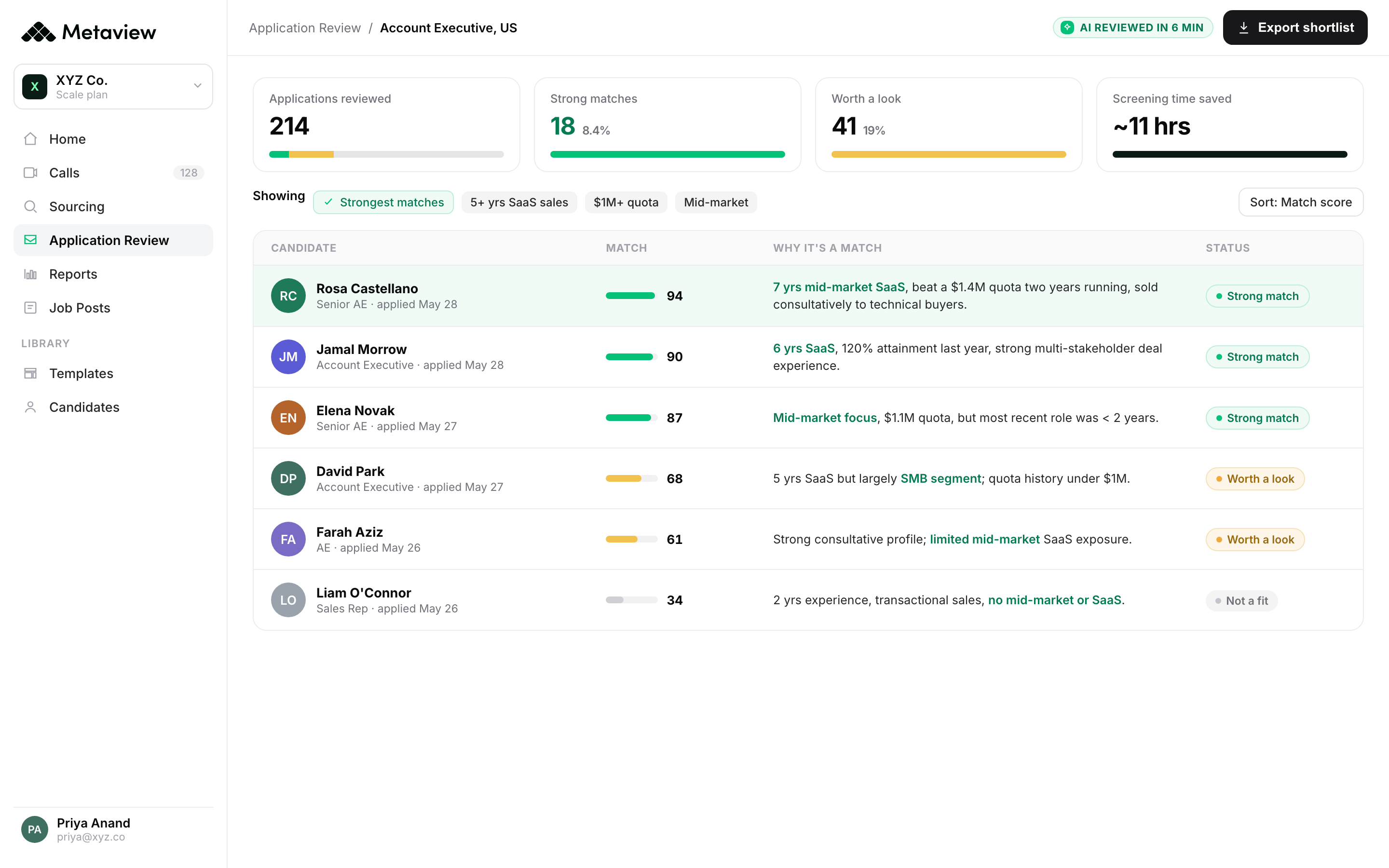
The day-to-day surface looks different. The 30 minutes a specialist used to spend writing up a screening call after the call ended is now mostly read-and-edit on AI-drafted notes. The hour a specialist used to spend triaging an inbound application list is now mostly arbitration on a pre-flagged queue. The two hours a specialist used to spend chasing a hiring manager for written feedback is now mostly review of a system-generated summary the hiring manager produced inline. The work didn't disappear. It moved.
That movement is the substance of the role transformation. When a specialist isn't producing the artifacts anymore (when the artifacts produce themselves and the specialist edits, calibrates, and acts on them) what fills the freed time becomes the actual question. The TA leaders running this well treat that freed time as the strategic surface of the job: time spent on the brief, on the panel, on the candidate they're closing, on the signal the funnel is throwing off.
The numbers around this transition are sharper than most TA leaders realize. According to Metaview's 2026 AI & Hiring Alignment Report - surveying 505 recruiting leaders and hiring managers across North America and EMEA - the teams that have moved fastest on this aren't just slightly ahead. They're operating with a structural advantage their peers haven't quantified yet.
The 6 core responsibilities, and the layer AI now owns.
Below are the six responsibility areas the role still owns end-to-end. For each, the responsibility didn't disappear in 2026: it split into a layer the system handles and a layer the specialist handles. The split is what defines whether a specialist is operating on the scheduler side or the strategic side.
Candidate sourcing.
The specialist still owns the pipeline shape: which channels, which sub-segments, which talent communities. What moved into software is the persona research, ICP enrichment, and the boolean and natural-language query construction. A specialist used to spend an afternoon translating a hiring manager's "I want someone like our last good hire" into a workable LinkedIn search. The specialist now spends 10 minutes refining the query the system suggested and the rest of the afternoon on the messaging that gets the response rate up.
Application screening.
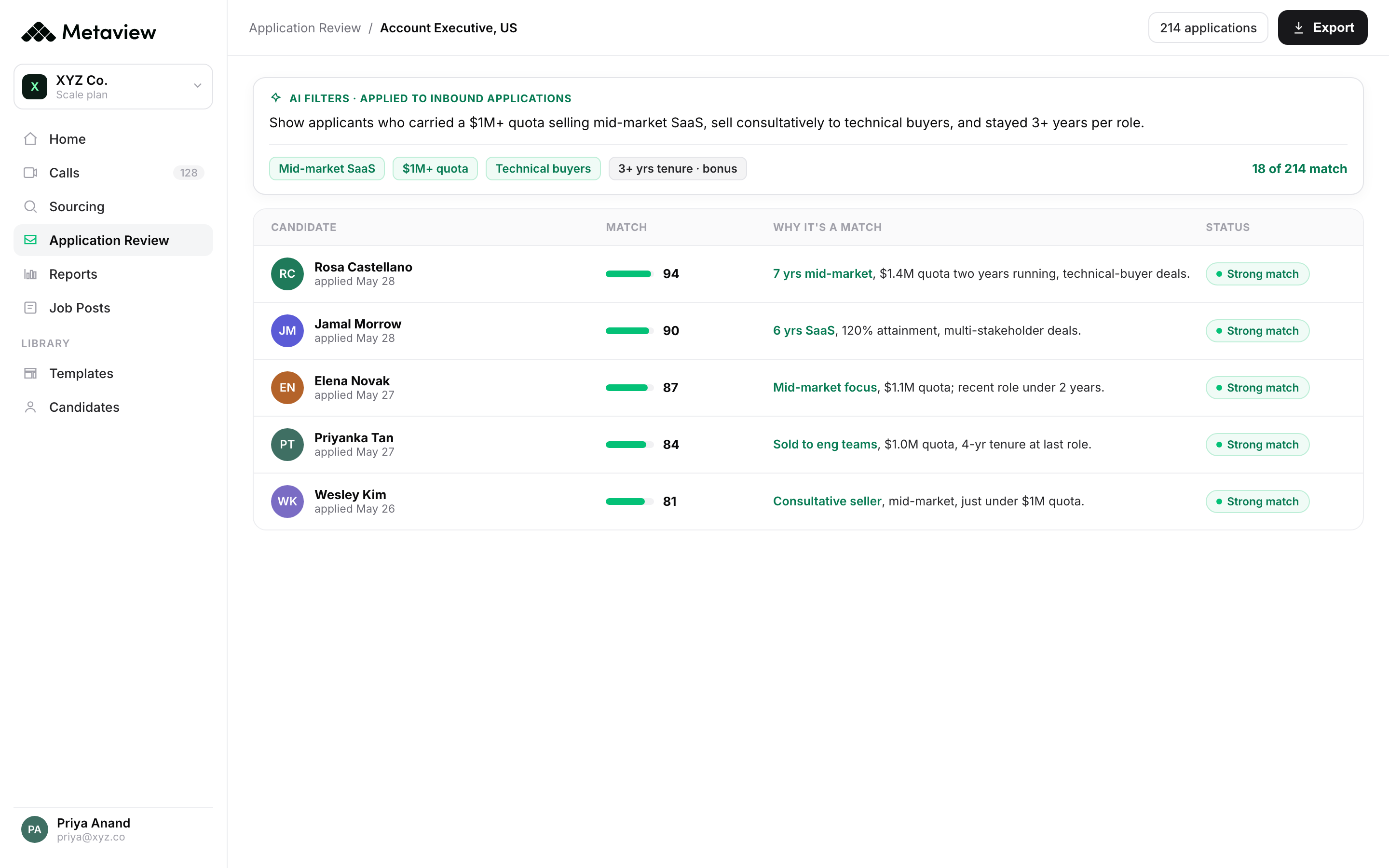
The specialist still owns the calibration of what "qualified" means for this role at this stage. What moved is the first-pass parse: resume-to-rubric mapping, fraud and AI-generated-content flagging, ICP fit scoring. The screening queue isn't an inbox anymore. It's a pre-sorted shortlist with reasons attached. The specialist's job is to validate the sort, override the misses, and feed corrections back into the rubric.
Interview coordination and support.
The specialist still owns the panel construction: who interviews this candidate, against which competency, with what calibration. What moved is the scheduling logistics, the auto-detection of which template a meeting should use, and the mid-interview note capture. The specialist used to be the bottleneck on every interview write-up. The specialist now owns the structure of the interview, not the artifact it produces.
Hiring manager alignment.
The specialist still owns the brief: the operating reality that the hiring manager and the panel have agreed on what good looks like. What moved is the inline transcription and structured summary of the intake call, the persistent record of "what we said good looked like in week one," and the cross-interview consistency check that catches drift before it shows up in offer-rejection rates. The brief that used to live in someone's head now lives in the system, with the specialist owning whether the system's record matches the team's actual operating model.
Candidate experience management.
The specialist still owns the relationship: the tone of the touch-points, the closing, the candidate-side commitments. What moved is the response-time floor, the consistency check across interviewers, and the post-interview summary that lets the specialist re-engage with specifics rather than generics. A 2026 specialist follows up on a candidate's named concern from interview 2 because the system surfaced it, not because the specialist held it in working memory.
Recruiting data and reporting.
The specialist still owns the questions: what are we trying to learn about this funnel, this role, this panel. What moved is the manual aggregation, the spreadsheet rollups, and the wait-for-monthly-review cadence. A specialist now asks a natural-language question about offer-acceptance variance by interviewer and gets an answer the same hour. The data layer flipped from artifact production to inquiry execution.
Across all six, the pattern is identical. The specialist no longer produces the artifact; the specialist owns the question the artifact answers. That distinction is what TA leaders should look for when they're trying to assess whether a specialist on their team has crossed the operating-model line.
Talent 1.0 is advice. Talent 2.0 is doing.”
Talent acquisition specialist vs recruiter.
The "TA specialist vs recruiter" question gets asked constantly and answered badly. The standard explanation (TA specialists are strategic and recruiters are tactical, TA specialists are full-cycle and recruiters are reqs-by-the-pound) collapses on contact with how actual teams are structured. A senior recruiter at a 200-person scale-up does more strategic work than a TA specialist at a 5,000-person enterprise on a heavily-coordinated panel. Title doesn't predict working surface; structure does.
The structural difference that actually matters in 2026 is whether the role has a strategic layer at all. Whether the operating model on that team gives the specialist time, tooling, and brief-level authority to work upstream of decisions, or whether the role is structured to live downstream of them. That's the question worth answering. The title is a side effect.
- Specialist time is consumed by artifact production: notes, summaries, status updates.
- Intake calls are one-shot; the brief lives in someone's head and decays by week two.
- Funnel data lands in a monthly review, not a same-day question.
- Hiring manager treats the specialist as the operations layer they wait on.
- Search outcomes measured on volume: screens, schedules, interviews shipped.
- Specialist time is spent on the brief, the panel, and the candidate close.
- Intake captures the operating definition of "good"; recalibrates every two weeks.
- Funnel questions get answered the same hour via natural-language query.
- Hiring manager treats the specialist as the second voice in the room.
- Search outcomes measured on offer-accept on calibrated panels, panel variance, HM NPS.
Most teams without the strategic layer aren't there by choice. They're there because the role got built around the artifacts the specialist used to produce, and the artifacts haven't been re-examined since the production cost dropped to near zero. The cleanest move a TA leader can make this year is to audit which responsibilities on their team are still structured around artifact production that no longer needs to happen, then reallocate the time those used to consume to the strategic surface. The same audit lifts the recruiting business partner conversation out of theory and into operating mechanics.
The 4 skills that compound (and the 2 that don't).
TA skill lists are usually unfalsifiable: "strong communication," "stakeholder management," "ability to operate in ambiguity." Most of them are still true. Most of them don't differentiate. The four below differentiate in 2026 because they sit at the intersection of what the system can't do and what the strategic surface of the role demands.
Reading interview signal in aggregate, not in isolation.
A 2026 specialist doesn't just review one panel's notes for one candidate. They read across the panel. Does the interviewer who scored "strong yes" usually score that way, or is this an outlier? Did three interviewers cite the same concern and only one flagged it? The skill is funnel-level pattern recognition, anchored in the structured data the interview layer is now producing on every search. The same pattern is the one that closes the gap most often missed in funnel troubleshooting.
Brief-level calibration with the hiring manager.
Most TA specialist roles still treat the intake call as a one-shot. The strategic version treats it as the start of a calibration loop that runs the length of the search. Early rejections feed back into the brief. Early advances feed back into the brief. The specialist owns whether what the panel is evaluating against still matches what the role actually needs.
Natural-language querying of the hiring layer.
The skill that compounds the fastest in 2026 is the ability to ask a sharp question of the funnel data. "Show me every candidate who got a strong-yes from the first-round technical interviewer and a no from the hiring manager, this quarter." That question used to take a week of analyst time. It now takes 30 seconds. The specialist who knows what to ask compounds; the specialist who waits for someone to build the dashboard doesn't.
Operating-model design.
The strategic surface of the talent acquisition specialist role increasingly looks like a small-scale operating model build. Which interviews, in what order, with what calibration, against what brief, with what data layer feeding back. The specialists who do this well are functionally designing a hiring system, not running a process.
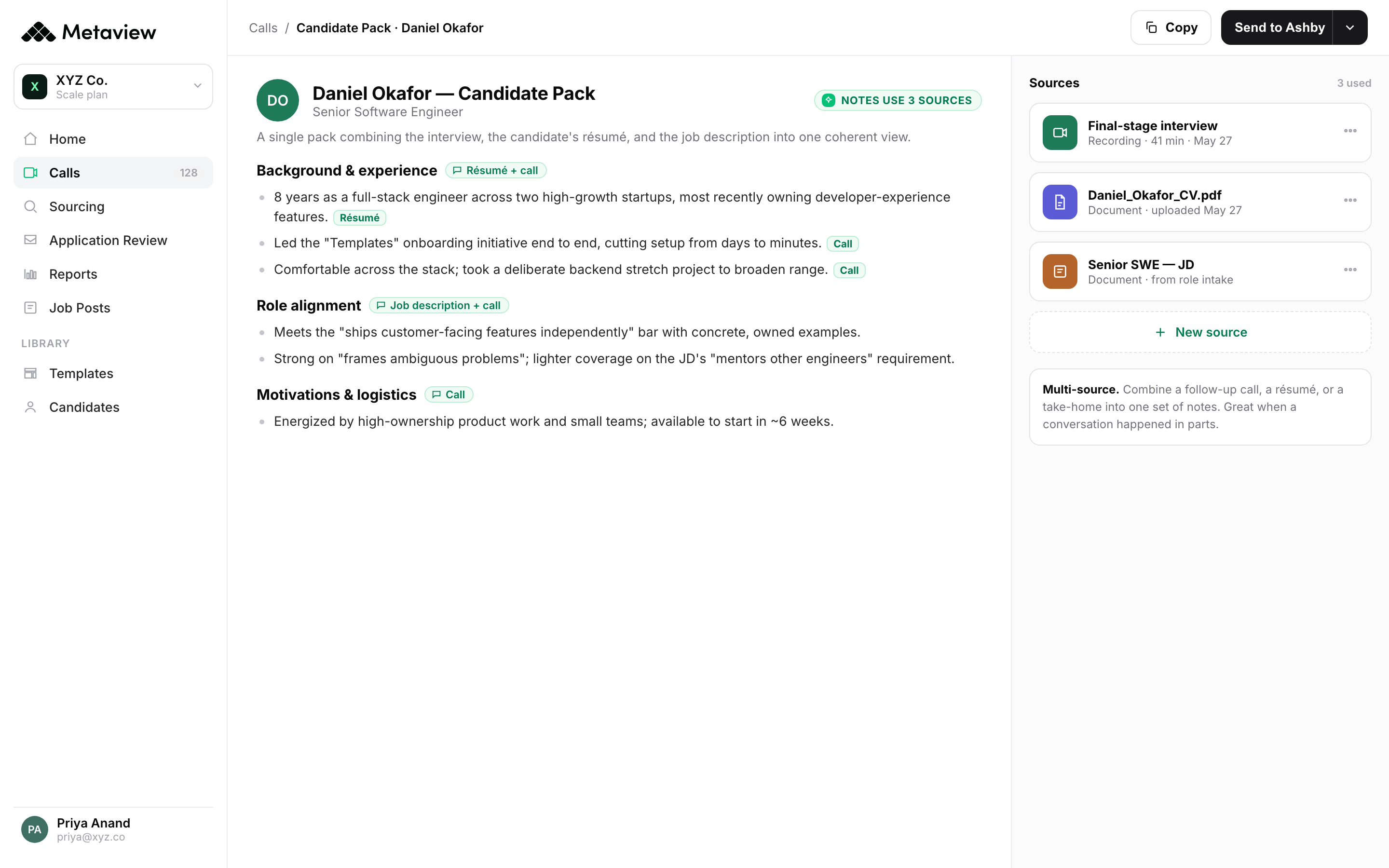
- 1Cross-panel summary reads the whole interview loop, not one transcript at a time.
- 2Strong-yes-then-no patterns surface here. This is the variance flag the strategic TA acts on.
- 3Hiring manager flags become brief revisions, not unresolved feedback comments.
The two skills that no longer carry the weight they used to: speed of post-interview write-up (now a system property, not a specialist trait) and volume of inbound resumes processed per hour (now a queue-management problem, not a screening skill). Both used to be standard interview questions for the role. Neither tells you anything useful about a 2026 specialist's strategic ceiling.
The career path splits: TA architect vs TA partner.
For most of the last decade, the talent acquisition specialist career path was monotonic: coordinator, specialist, senior specialist, lead, manager. In 2026 it's bifurcated. The role can ladder up into a TA architect track (operating-model builder, data-layer owner, infrastructure mindset) or a TA partner track (embedded business partner, hiring-manager calibrator, executive search builder). The two tracks reward different skills, attract different operators, and produce different leaders downstream.
The TA architect path treats the hiring function as a system to design. The work moves from running searches to designing the search infrastructure that runs at scale: interview templates, evaluation rubrics, capture workflows, data-layer queries, integration points with the ATS. The promotion path leads to TA Operations, TA Engineering, or Head of TA Systems titles that didn't exist in most orgs three years ago.
The TA partner path treats the hiring function as a relationship to embed. The work moves from filling reqs to becoming the trusted second voice in the room when a hiring manager is shaping a team: defining what the next three hires should look like before any of them is open. The promotion path leads to embedded TA partner roles, executive search lead, or Head of Talent for a business unit. The strongest version of this path looks structurally similar to the recruiter-hiring-manager relationship done well, scaled.
Most TA specialists in 2026 will lean toward one or the other based on whether they're more energized by system design or by relationship depth. The mistake some TA leaders make is forcing a specialist down a path that doesn't match: typically pushing the system-minded operator into a partner role they'll burn out of, or pushing the relationship-minded operator into an architect role they'll under-deliver on. The split is real. Honor it.
Over the last few months, our Talent Acquisition team has been using Metaview, and it has made a significant impact. What excites me most is how Metaview is freeing up our time. While the AI handles the heavy lifting of summarizing discussions, we're able to engage in more meaningful conversations with candidates. We're now even using Metaview for our briefing calls with Hiring Managers, allowing us to gain a deeper understanding of the roles we're sourcing for.”
A 5-step operating model for the strategic side.
Setting up a talent acquisition specialist for the strategic side of the role isn't a hiring decision. It's an operating-model decision. Five steps the best TA leaders take in the first quarter of a specialist's tenure:
- Time-back the artifact work first. Audit what the specialist is producing manually that the system should be producing: interview notes, post-call summaries, status update emails, weekly funnel reports. Move all of it into the capture and reporting layer before adding any new responsibility. You're buying the strategic time before spending it.
- Anchor every search on a structured brief. Before the search opens, run a 30-minute structured intake with the hiring manager, captured in the system, surfaced back as the persistent record of what "good" looks like. Every panelist gets the brief. Every interview maps to a competency in the brief. The brief becomes the audit trail when offer rejections or 90-day attrition starts asking why.
- Give the specialist data-layer access early. A specialist who can ask sharp questions of the funnel (by interviewer, by panel, by candidate persona, by source) compounds in skill faster than one who can't. Granting natural-language query access to the hiring data layer in week one (rather than month six) is the cheapest leverage investment a TA leader can make this year.
- Run a brief recalibration ritual mid-search. Every two weeks during an open search, the specialist and hiring manager review the funnel signal together. What is the system telling us about why we're not advancing the top of the funnel? What is the system telling us about why specific competencies keep scoring strong-yes-no? The ritual converts the data layer into actual brief revisions.
- Measure on strategic surface, not artifact volume. Reps the specialist owns: time-to-strong-brief, offer-accept rate on calibrated panels, panel consistency variance, hiring-manager NPS on the search. Not: number of interviews scheduled, number of screens completed, number of notes shipped. The metric you choose tells the specialist which side of the operating model their job lives on.
TA leaders who set this up in the first quarter generally see the role compound by the third. Specialists raise harder questions, hiring managers route more decisions through them, and the team's hiring outcome curve bends. Leaders who don't tend to see the same specialist stuck on the scheduler side a year later, asking why the title didn't translate into a working surface.
Siadhal Magos (Metaview co-founder + CEO) on the four shifts AI has unlocked for talent acquisition. 1:25 explainer, NOT a 10x Recruiting episode.
Bring Metaview into your hiring stack.
Live notes, structured scorecards, and ATS sync - set up in under 10 minutes.
