
Treat sourcing as recruiting, and you measure activity instead of hires. Recruiters send more messages, sourcers build longer lists, and the offer-acceptance number doesn't move because no one owns the close.
The teams that win on hires don't pick one or the other. They build the system between them. Sourcing surfaces candidates with context, recruiting returns structured feedback on what converts, and both jobs get sharper every week. The cost is hires.
The six dimensions that split sourcing from recruiting.
The clearest way to see where the work splits is to lay sourcing and recruiting side by side. Six dimensions cover most of the daily decisions a head of TA has to make about role design, success metrics, and where to invest along the recruitment funnel.
Our five-approach sourcing guide goes deeper on the sourcing side. This piece is about where the work splits and what each role owns.
| Dimension | Sourcing | Recruiting |
|---|---|---|
| Primary goal | Surface a qualified shortlist of people who could fit | Hire the right person through the end-to-end process |
| Where it sits in the funnel | Top of funnel, pre-application and early interest | Full funnel, intake through offer acceptance and start |
| Typical activities | Profile search, list building, outreach, pipeline nurture | Intake calls, interview plans, debriefs, offers, closing conversations |
| Core skills | Market mapping, persuasive messaging, persona-fit judgment | Stakeholder management, structured assessment, negotiation |
| Common bottlenecks | Low response rates, vague targeting, weak messaging | Slow feedback, misaligned criteria, interview inconsistency, offer delays |
| Success metrics | Response rate, list quality, pass-through to screen | Offer acceptance, quality of hire, time to fill, candidate experience |
| Ownership | Sourcer or full-cycle recruiter (depending on team structure) | Recruiter, in partnership with the hiring manager |
A useful rule of thumb sits underneath the table. If the work happens before a candidate enters a structured interview process, it's usually sourcing. If the work is about evaluation, hiring manager alignment, and decision-making through to offer acceptance, it's recruiting.
The split matters because each side has its metric. Teams that measure recruiting using sourcing metrics (messages sent, profiles surfaced) consistently under-invest in the moves that close candidates.
When to invest in a dedicated sourcer.
In most companies, the same person does both jobs. Full-cycle recruiters own sourcing alongside intake, interviews, debriefs, and closing. That's why sourcing often feels manual and time-consuming.
A dedicated sourcer earns their place when the volume of top-of-funnel work crosses the threshold where a recruiter can't do both without one suffering.
The decision math comes down to four variables: req volume per recruiter, role complexity, market scarcity, and the recruiter's available capacity. When two or three load heavy, a dedicated sourcer pays for themselves quickly.
The loop between them is where outcomes get made.
The most under-built piece of most hiring operations isn't sourcing or recruiting. It's the loop between them. Sourcing creates the pipeline; recruiting determines whether the pipeline turns into hires.
When the two operate as disconnected stages, even excellent sourcing feels like it isn't working. Great recruiting can't compensate for a weak pool. The loop is the lever.
- Candidates land without context, recruiters re-learn each profile cold
- Sourcing stays generic because no one tells it which profiles converted and why
- Recruiters reconcile opinions across the panel from memory, slowing decisions
- Candidates the sourcer surfaced stall at offer because the close moves slow
- Candidates land with context. Why this person, why now, what they care about
- Sourcing gets sharper because structured interview feedback reshapes the targeting
- Recruiters compare candidates against the same rubric, reducing reconciliation time
- Offers move faster because the case for the candidate is built across the process
The loop closes when sourcing delivers candidates with explicit context (why this person, why now, what they care about) and recruiting returns structured feedback (why candidates pass or fail, which profiles convert, where the funnel stalls).
When that's working, recruiting becomes more predictable and sourcing stops being a manual grind with uncertain payoff. When it isn't, both jobs underperform their own targets.
How AI changes the split.
AI compresses both jobs but doesn't erase the distinction. On the sourcing side, AI absorbs the most mechanical work, including list building, profile screening, and initial outreach drafting. That frees the human side of the role for qualification and relationship-building.
On the recruiting side, structured interview data (captured live, surfaced across the panel) closes the feedback gap that used to depend on chasing scattered notes.
The result is a measurably tighter operation across both sides:
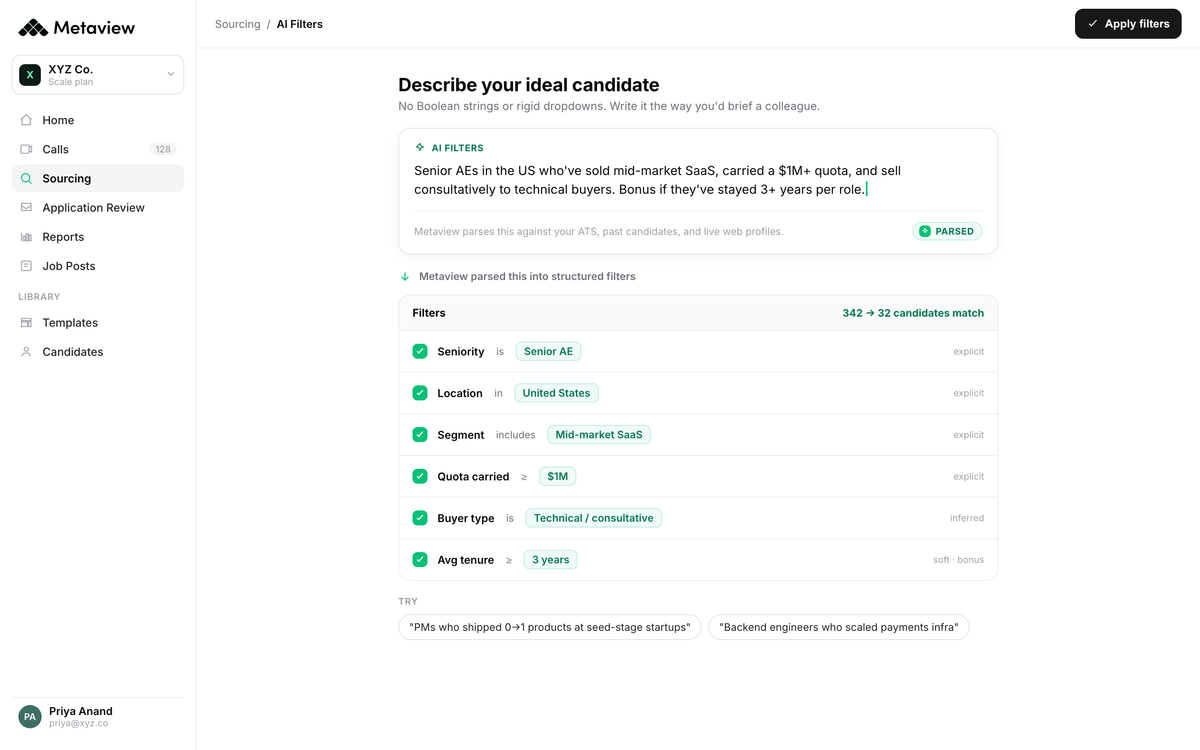
On the sourcing side, our AI Sourcing agents work the way a senior sourcer does. They read the role context, scan profiles for genuine fit, and prioritize outreach by likelihood of conversion.
Boolean strings turn into natural-language queries the recruiter can adjust mid-search, which sharpens both the quality of pipeline and the diversity of the candidate pool.
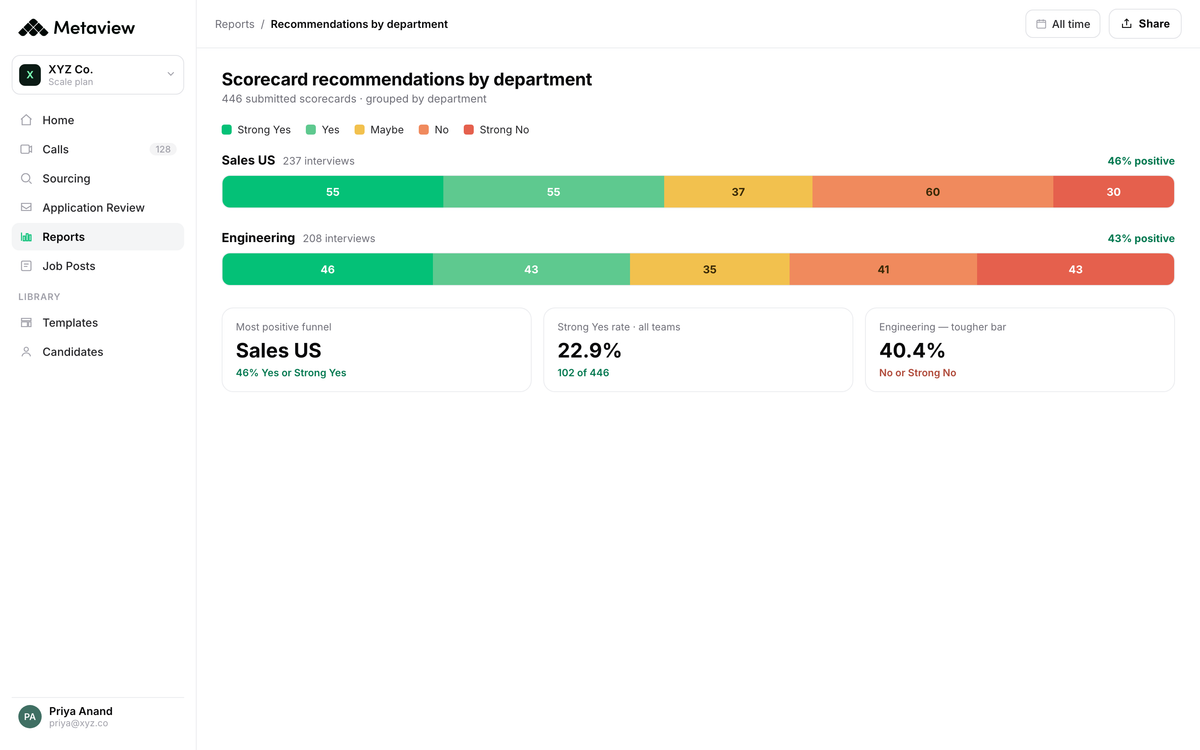
On the recruiting side, our AI Notetaker closes the gap by capturing every interview as structured signal, from intake through debrief. Competency-tagged notes, comparable scorecards, and panel summaries surface where candidates differentiated.
Reports turn that information back into pipeline intelligence the sourcer can use directly.
The role compression is real on the ground. Chris Adams, the #1 sourcer at Uber for most of the last decade, former Talent Partner at Atomic, and founder of TalentHerder, names the modern shape of the job directly:
You can do sourcing, but we also want you to close these candidates for this pipeline. So you have to be able to flex your muscles as a sourcer in this day and age.”

Sourcers surface candidates, recruiters land them.
The distinction between sourcing and recruiting earns its keep when teams use it to allocate investment, set the right metric for each, and build the system between them deliberately.
Volume sourcing without strong recruiting stalls at offer.
Great recruiting processes never lead to anything without a rich hiring pool to source from. The best teams invest in both, and recognize that the lever isn't either side alone. It's the system between them.
Bring Metaview into your hiring stack.
Live notes, structured scorecards, and ATS sync - set up in under 10 minutes.
Frequently asked.
What is sourcing?
Sourcing is the proactive work of identifying and engaging people who could fit a role, including those who aren't applying. It sits at the top of the recruiting funnel and produces one output: a qualified shortlist the rest of the process can act on. The activities count toward a single goal: search candidate profiles, build pipelines, send outreach, and read early signs of interest. Modern sourcing splits across five approaches, including outbound, inbound, internal, referral, and AI sourcing.
What is recruiting?
Recruiting is the end-to-end work of hiring talent, from understanding the role to closing the offer. It includes sourcing, but covers intake meetings, interview coordination, candidate evaluation, hiring-manager alignment, offer preparation, and closing hires. Unlike sourcing, recruiting is about outcomes rather than activity. Recruiters guide candidates and hiring managers through the process, balance speed against quality, and own whether the right person accepts. Where sourcing produces a shortlist, recruiting produces a hire.
Do all recruiters need to source?
In most teams, yes. Full-cycle recruiters own both jobs. Dedicated sourcers earn their place when req volume crosses ten per recruiter on common roles, or earlier when roles are deeply specialized or markets are scarce. Below those thresholds, full-cycle stays faster and cheaper because the same person carries context from outreach through offer.
What success metrics distinguish sourcing from recruiting?
Sourcing metrics are leading indicators. Response rate, list quality, persona match, pass-through to first screen. Recruiting metrics are lagging. Offer acceptance, quality of hire, time to fill, candidate experience scores. Teams that measure recruiting with sourcing metrics (messages sent, profiles surfaced) tend to over-invest in volume and under-invest in the moves that close.
How does AI change the sourcing-versus-recruiting split?
AI takes the mechanical work. List building, profile screening, and initial outreach drafting on the sourcing side; live note capture, panel comparison, and pattern surfacing on the recruiting side. What it doesn't take is the qualification call, the hiring-manager calibration, the offer negotiation, or the candidate-experience judgment. The roles compress around the human-judgment moves but the underlying split (discover versus close) stays useful.
