
RPO solves capacity. It does not solve learning.
When a recruiting team signs an RPO contract, the external provider takes on the work. They run the searches, screen the candidates, capture the feedback, and report on the funnel. The hires happen.
Then the contract ends. The hires stay. The intelligence that produced them, who said what in which interview, which hiring manager actually screens well, which sourcing channel actually converts, leaves with the vendor.
This guide compares recruitment process outsourcing against AI-powered recruiting, where each one fits, and how teams are using AI to get RPO-style leverage without losing the institutional knowledge.
RPO vs AI recruiting at a glance.
Five dimensions that decide which model fits your team. Cost, speed, scale, control, and what happens to the hiring knowledge once the work is done.
| Dimension | RPO | AI recruiting (Metaview) |
|---|---|---|
| Cost model | Per-hire or monthly retainer to the provider | Per-seat or platform-wide; no per-hire markup |
| Speed to ramp | 2 to 6 weeks of vendor onboarding before the first hire | Under 10 minutes from ATS connection to first AI evaluation |
| Scalability | Strong for predictable, repeatable role types | Scales with volume without renegotiating capacity |
| Control | Externalized; brief, oversee, and review vendor output | Internal team owns every decision; AI explains its reasoning |
| Knowledge retention | Hiring intelligence often leaves with the provider | Every interview becomes structured data inside your stack |
What recruitment process outsourcing is.
Recruitment process outsourcing (RPO) is a model where an external provider takes responsibility for some or all of your recruiting work. Unlike agency placements, RPO providers operate as an extension of your team, with dedicated recruiters, standardized processes, and shared reporting.
Most engagements bundle sourcing, screening, scheduling, candidate experience, and process reporting. The two common shapes are full RPO (the provider runs the entire lifecycle across roles) and partial RPO (specific stages are outsourced while the internal team keeps the rest).
Lighter options exist too. Some services take on only the shortlist: HireBasis, for example, searches its global candidate database, screens candidates for skills, experience, and salary fit, and sends back a shortlist of interview-ready candidates.
Where it works: predictable high-volume hiring on well-defined roles, where speed and process consistency matter more than nuance. Retail, frontline, and standardized enterprise roles are the common fits.
Where it falls short: roles that need contextual judgment, hiring managers that expect tailored shortlists, and teams that are still defining what good looks like. RPO solves capacity. It rarely improves decision quality.
What AI recruiting is.
AI recruiting platforms absorb the operational layer of hiring without offloading ownership. Tools like Metaview source candidates from intake calls, evaluate inbound applications against your Ideal Candidate Profile, capture interviews as structured data, and report on pipeline health.
Where RPO replaces a recruiter's hands, AI replaces a recruiter's admin work. Sourcing happens in minutes off an intake call. Screening happens 24/7 in the background. Interview notes write themselves. The recruiter spends the saved time on the parts that still need human judgment.
Where it works: teams that want to grow output without growing headcount, that need the hiring intelligence to compound inside the company, and that are willing to trust AI for the operational layer if it shows its reasoning.
Where it falls short: pure operational capacity on highly transactional roles at very high volume. If the bottleneck is raw recruiter hours on standardized hiring, an RPO can still be the faster fix.
Where RPO and AI recruiting overlap.
Both models do the same two things: free your internal team from operational load and bring structure to the recruiting funnel.
The split is who keeps the learning. RPO keeps it in the vendor's playbook. AI keeps it in your stack.
How to choose between RPO and AI recruiting.
Four scenarios that map cleanly to one model or the other.
Where Metaview fits.
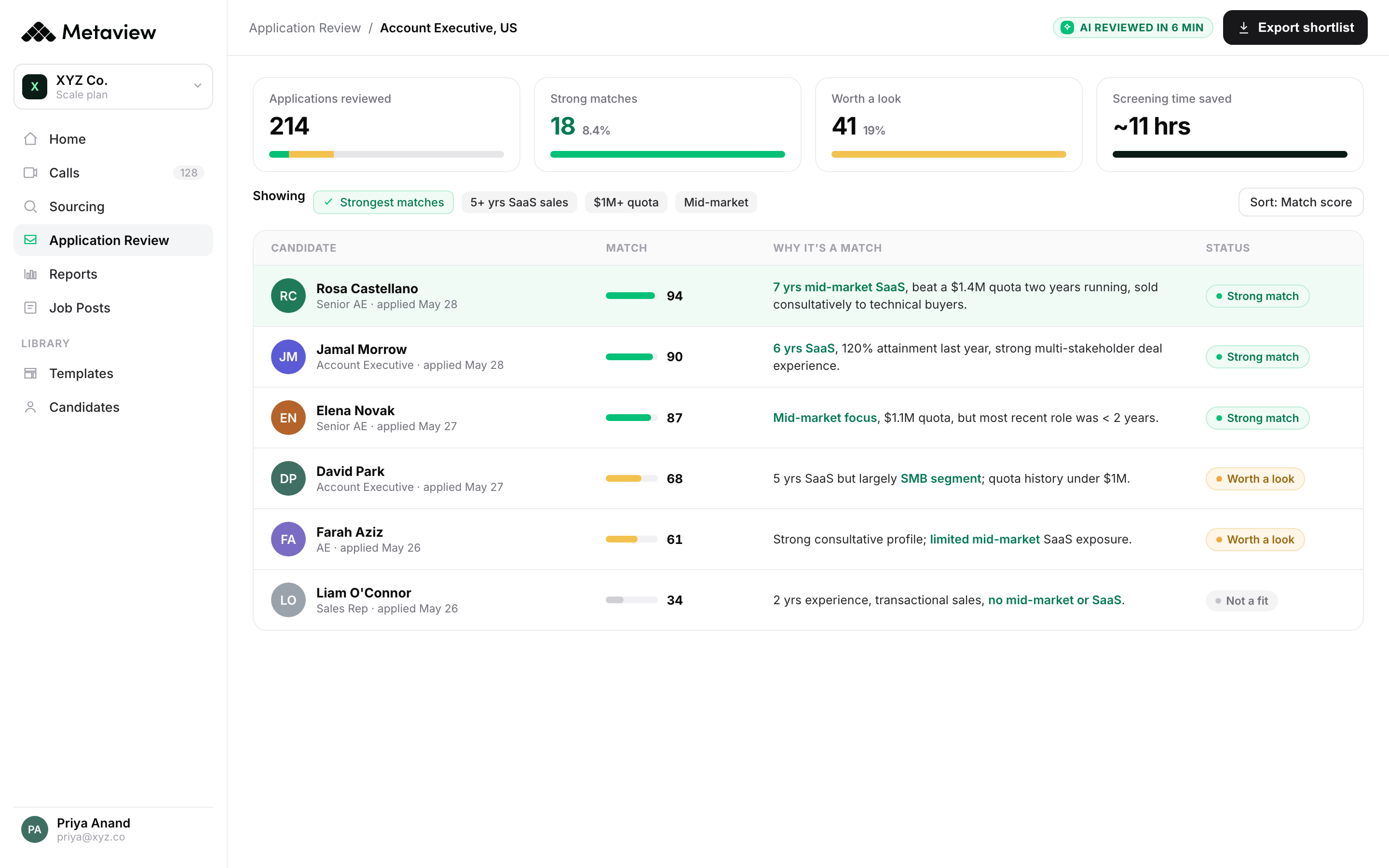
Metaview gives a recruiting team RPO-style leverage without the RPO trade-off. AI Sourcing runs off the intake call. Application Review triages inbound. Notetaker turns every interview into structured data. The team owns every decision; the platform absorbs the work that did not need a human in the first place.
The intelligence stays inside the company. Every accept and reject sharpens the Ideal Candidate Profile. Every interview adds structured signal that the next sourcing run uses. The system gets better as you hire.
Michelle Sumrall, a Talent Acquisition Leader using Metaview AI Sourcing, described what that looks like end-to-end.
I just wrapped a recruitment strategy intake call with my corporate west coast team. Minutes later, my Metaview notes landed in my inbox. Then another notification: ‘We’ve found 9 candidates based on your recent intake call.’ In less than 10 minutes, I had insights, structure, and a shortlist of potential candidates.”
Comparing approaches at adjacent layers of the stack? See our guides on CRM vs ATS for recruiting and the best applicant tracking software.
Bring Metaview into your hiring stack.
Live notes, structured scorecards, and ATS sync - set up in under 10 minutes.
Frequently asked.
Is RPO cheaper than AI recruiting?
In the short term, often yes for a short engagement. Over a longer horizon, the management overhead, rework, and dependency cost flip the math. AI tools change the equation because the per-seat platform cost stays flat while volume grows.
Can AI fully replace an RPO provider?
For high-volume transactional hiring at scale, the operational headcount an RPO brings is still useful. For most growth-stage and mid-market teams, AI absorbs the admin-heavy work that justified the RPO contract in the first place.
What is the biggest risk of relying on RPO long-term?
Loss of hiring intelligence. When the work happens outside the company, the data and the learning live outside too. Your team gets faster at briefing vendors, not at hiring.
Should fast-growing companies avoid RPO?
Not categorically. But they should be selective. Partial or project-based RPO can fill a real gap while internal systems mature. Full-cycle RPO often locks in dependency before the team has figured out what good looks like.
How do I decide between RPO and AI recruiting?
Map where your recruiters spend time today. If most effort goes into coordination, documentation, screening, and alignment, AI absorbs more of that work and keeps the learning inside the team. If the gap is raw operational capacity on standardized roles, RPO can be the faster fix.
