
Every talent leader has lived the same review meeting. A hire who looked airtight at offer time underperforms by month four. The team rewatches the loop in their heads. The technical bar was met. The references checked out. Two of the panelists privately admit they had a flicker of doubt in round two. Nobody wrote it down. By debrief, the flicker had been smoothed into a green tile, and the offer went out at 9:14 the next morning.
That is not an evaluation problem. The signal was in the room. The team noticed it. The problem is that the signal had to travel four days through three calendars, two Slack channels, and a scorecard nobody opened twice. By the time the decision happened, the doubt had decayed into a feeling, the feeling had been overruled by speed pressure, and the hire that did not work had already been manufactured. Mis-hires are a recall problem, not a selection problem.
This piece is about the three specific moments where the recall problem compounds: intake, interview capture, and the 48 hours after. Each one decays signal in a predictable way. Each one is fixable as a piece of infrastructure, not a piece of discipline. Get all three right and you stop relearning the same lesson with a different name on the offer letter.
The 3 moments where mis-hires get manufactured.
The post-mortem on a bad hire almost always names a person. The interviewer who missed it. The hiring manager who pushed. The recruiter who rushed. That is a comforting story because it puts the cause inside a single human, and humans are easy to swap out. It is also wrong. The same teams who manufacture mis-hires also produce great hires from the same panel, the same calendar, and the same week of pressure. The variable is not the people. The variable is whether the signal makes it intact from one room to the next.
There are three places where the signal predictably decays. Intake, where success criteria show up as a paragraph that hiring managers nod at and recruiters interpret three different ways. Interview, where the moment a panelist notices something is the same moment they have to keep listening, take notes, and write a scorecard a day later. And debrief, where 48 hours have passed, three other candidates have been seen, and the only thing left of the doubt is a feeling that did not make it onto the ATS form.
Each moment is fixable. Not by being more disciplined. By taking the moment off the human and putting it into the infrastructure of the process. The rest of this piece is about exactly that.
Why more rigor does not fix it.
The natural fix when a mis-hire shows up is to add more rounds. Another panel. A take-home. A second technical bar-raiser. The room feels safer for a quarter, then the same problem returns with a different shape. That is because the recall problem is upstream of the rigor problem. Adding rigor does not stop the doubt from decaying between interview and decision. It just produces more moments of doubt that can decay.
There is a hidden second cost too. More rigor means slower cycles. Slower cycles mean the team loses the candidates who are good enough to have two other offers. The mis-hire rate stays the same. The hire-the-second-best-candidate rate goes up. The team has paid a real price for fake safety. Time-to-hire compresses the wrong way when rigor is the answer to a recall problem.
The 2026 data backs this up directly. According to Metaview's 2026 AI & Hiring Alignment Report, surveying 505 recruiting leaders and hiring managers across North America and EMEA, teams with high cross-functional alignment and good relationships hit their business goals at radically different rates than teams that don't. The signal that travels from intake through debrief is the leading indicator. The rigor of any single round is not.
Everyone is trying to go faster on time-to-hire. Great. You're probably also fastest to attrition. Probably not great.”

Moment 1, Intake: the success-criteria gap.
Almost every mis-hire post-mortem can be traced back to a sentence the hiring manager said in the intake call that nobody captured cleanly. It was usually specific. It was usually the actual bar. It came out somewhere between minute 18 and minute 27 of the kickoff, when the hiring manager stopped quoting the job description and started saying what they really wanted. By the time it got back to the recruiter as a written paragraph, it had lost its edge. Two interviewers asked for a different version of it. Two others did not ask for it at all.
The fix is not a longer intake template. The fix is treating intake as a recording, not a conversation that produces a paragraph. When the hiring manager says I do not want someone who has built this in a 5,000-person org, I want someone who has built it twice from scratch, the recruiter does not have to remember it. The system already has it. The system can also feed it into the scorecard for every downstream interviewer so the bar shows up the same way at round one, round three, and debrief.
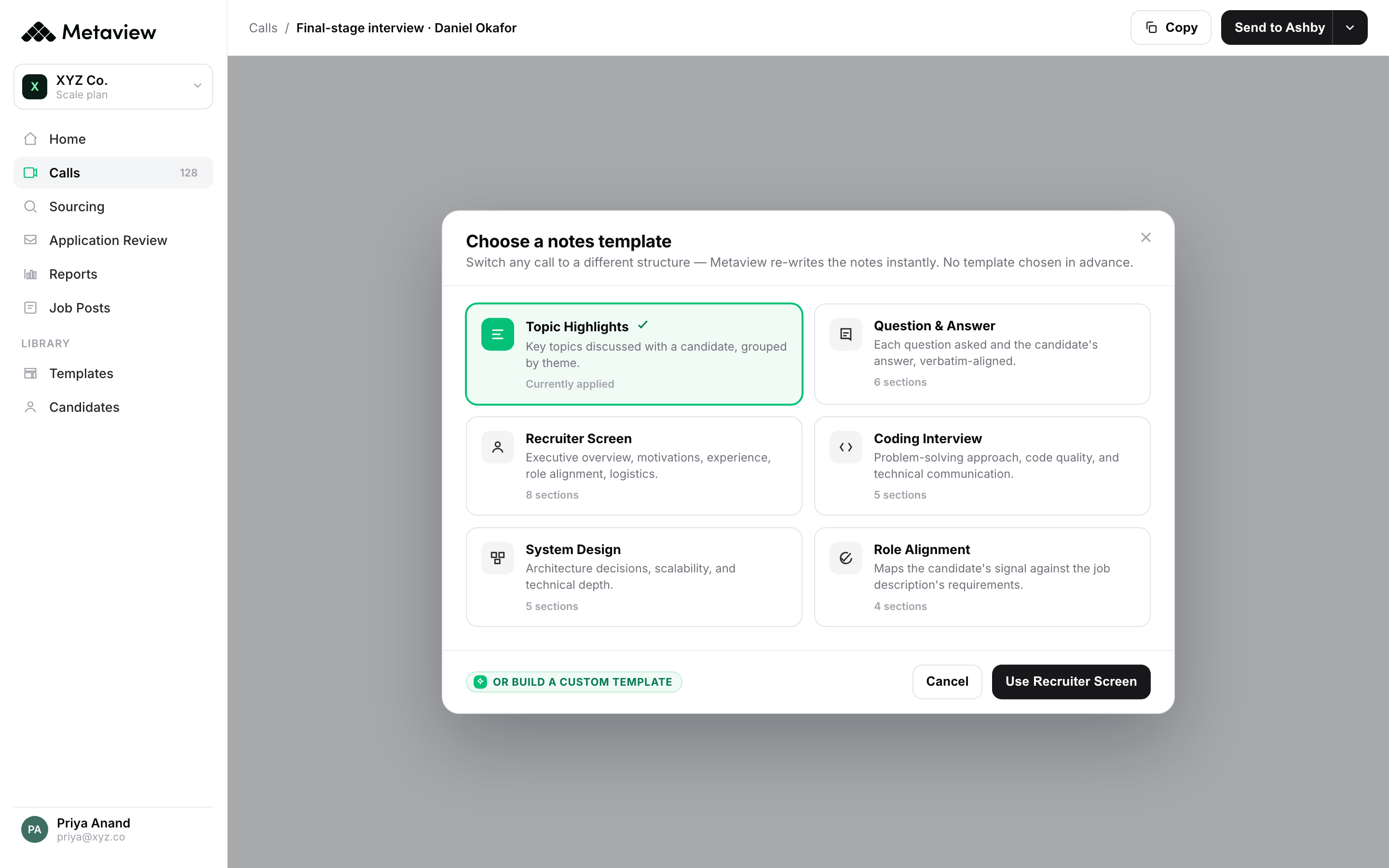
Specific intake moves that make this real: capture the hiring manager's actual words, not the rewritten ones; tie those words to scorecard competencies so every interviewer sees the bar before they ask; and put the recording somewhere panelists can re-listen, not somewhere the recruiter has to summarize. The hiring manager's I really want someone who has done X under Y conditions never has to be paraphrased again.
Moment 2, Interview: memory-dependent capture.
The interview itself is the moment where the most signal exists. It is also the moment where the least of it gets reliably written down. The interviewer has three jobs in the room: ask the question, listen for the answer, and notice the answer behind the answer. The fourth job, document the signal as it happens, almost always loses. Either the interviewer is paying attention to the candidate or they are paying attention to the notes app. They cannot do both well.
What gets written down later is a reconstruction. The interviewer remembers the strong moments. They remember the awkward moments. They remember whether they liked the person. They do not remember whether the candidate said the specific thing that maps to the specific competency the hiring manager actually cared about. That is the signal that disappears, and it is the signal that predicts whether the hire works.
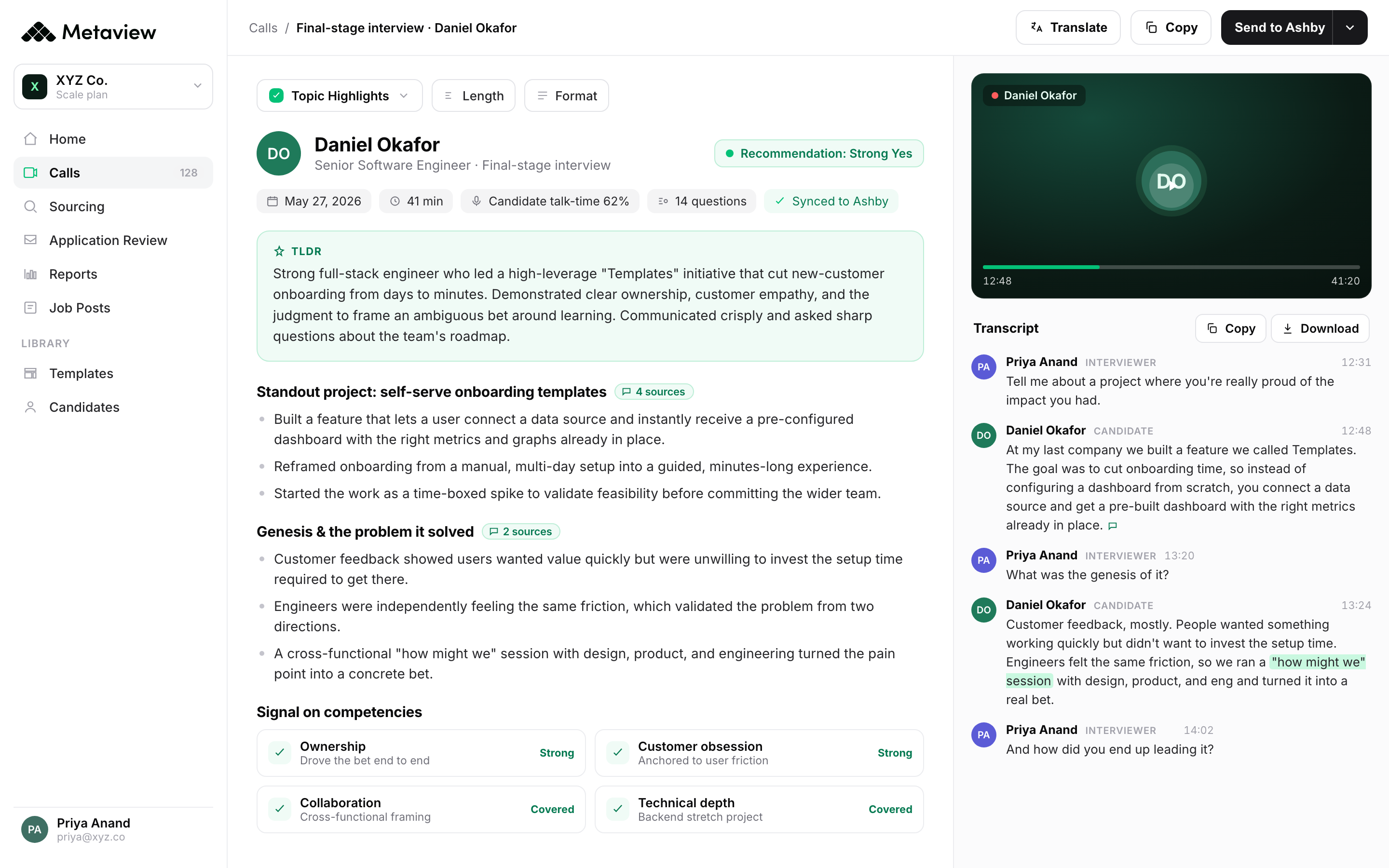
The capture layer fix is not asking interviewers to write better notes. It is taking the writing off them. Live capture during the interview produces structured notes against the actual scorecard, the moment the interview ends. The competency is already mapped, the quote is already captured, and the next interviewer in the loop can see exactly what was asked and what was said without re-asking the same question.
Moment 3, Debrief: the 48-hour signal decay.
By debrief, the signal has been sitting for 48 to 96 hours. The interviewer has done two other loops since. The recruiter has talked to nine other candidates. The hiring manager has been in back-to-back. The doubt that was crystal-clear at the end of round three has, by Friday's decision call, been smoothed into either a 3 or a 4 on a scorecard scale that nobody calibrated.
Worse, the debrief itself rewards consensus. Whoever speaks first sets the tone. Whoever has the loudest strong yes shifts the room. The interviewer who had the flicker of doubt rarely raises it once two senior people have said green. Not because they are unsure of their judgment, but because the structure of a debrief meeting is built for fast convergence, not for structured dissent. The doubt that should have killed the mis-hire never gets aired.
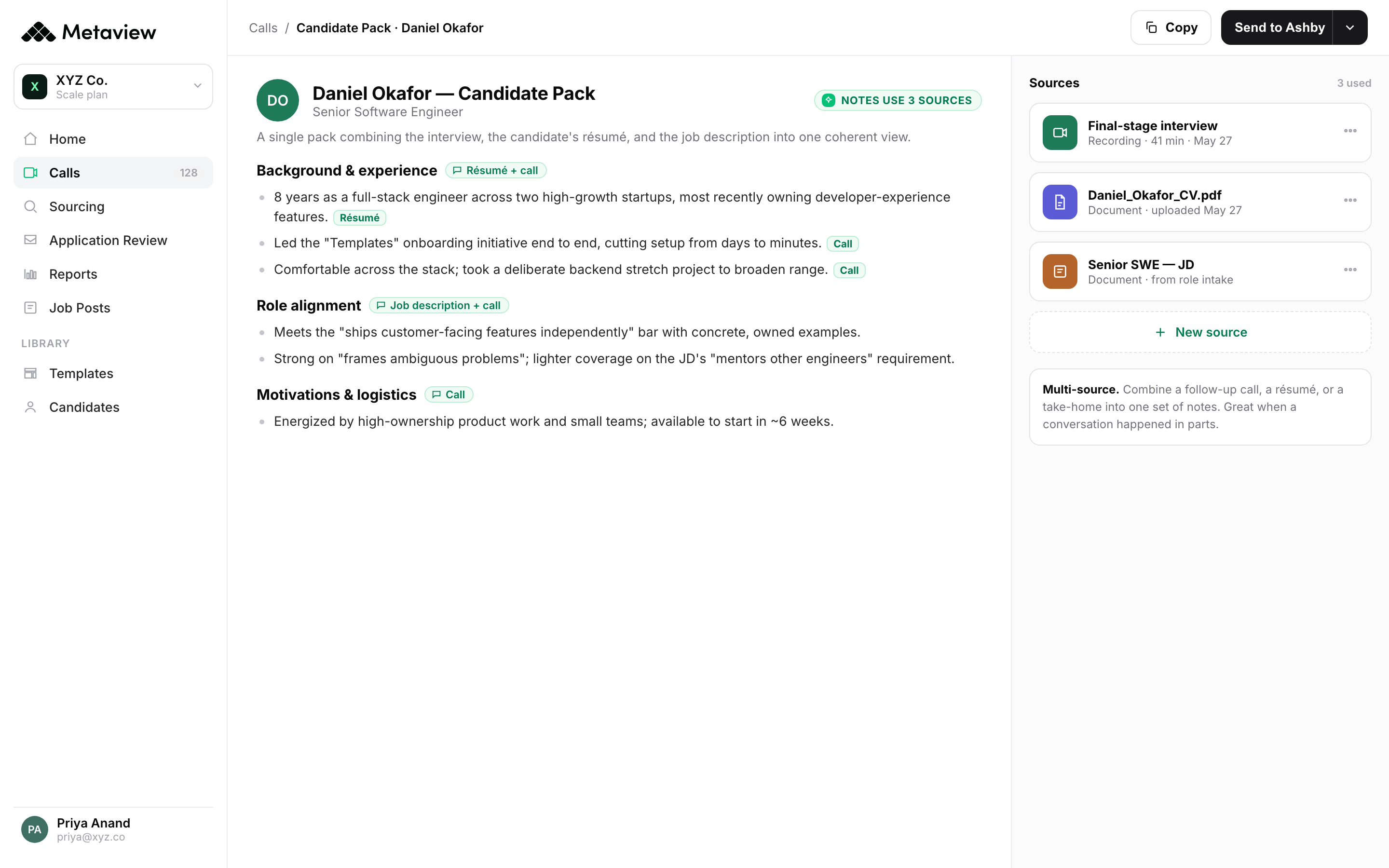
- 1 The full panel's evidence sits in one view before the debrief. Interviewers see what they said and what their peers said, side by side, without anyone having to retell.
- 2 Specific moments are pre-surfaced against the scorecard. The flicker of doubt that lived in one panelist's head is now a structured cell the whole room can react to.
- 3 Cross-panel disagreements are visible up front, not at minute 25 of the debrief. Dissent has somewhere to go before consensus closes the room.
This is the moment that matters most for mis-hire prevention. Not because the debrief is where the bad decision gets made, but because the debrief is where the structured trail from intake and capture either survives or gets averaged away. A team with great capture and a bad debrief still ships mis-hires. A team with average capture and a structured debrief catches doubts early enough to do something about them.
The real cost (and how to measure it).
The 30% of first-year earnings number from the U.S. Department of Labor is the conservative floor. The Topgrading work by Bradford Smart puts the total mis-hire cost between 5 and 27 times the role's annual salary once productivity loss, replacement cycles, opportunity cost, and cultural drag are added in. A $150,000 IC role costs the org at least $45,000 and realistically $750,000+ when it does not work. That is one hire.
The reason the number is so wide is that most of the cost is invisible at the moment of decision. The hire shows up. The team adjusts around them for two quarters. By the time anyone admits it is not working, the productivity tax has compounded. The instinct is to calibrate against the cost of the wrong hire by adding more interview rounds, but as the table below shows, the leverage point is the signal trail, not the round count.
| Where the cost compounds | Manual screening + notes | Generic AI notetaker | Metaview |
|---|---|---|---|
| Intake fidelity | Hiring manager's actual words get paraphrased into a JD. Bar drifts by round 3. | Transcript exists. Nobody reads it. Scorecard still gets built off the rewrite. | Intake call is captured, structured, and pushed into the scorecard. The actual bar follows every interviewer. |
| Live signal capture | Interviewer divides attention between candidate and notes. The behind-the-answer signal often disappears. | Generic summary of the meeting. Not structured against the role. Not mapped to the scorecard. | AI Notes structured against the scorecard competencies. Quotes captured against the actual bar. |
| 48-hour recall | Interviewer reconstructs from memory 1 to 3 days later. Strong moments survive. Doubts decay. | Summary is searchable but unstructured. Useful for ctrl-F, useless for cross-panel calibration. | Structured trail per interviewer, autofilled into the ATS scorecard. The doubt that existed in the room is still in the record. |
| Debrief signal | Whoever talks first sets the tone. Quiet dissent gets averaged away. | Transcript exists, but nobody opens it during the debrief. The room defaults to consensus. | Multi-source summaries open the debrief with the structured trail already visible. Disagreements surface before consensus closes. |
| Post-hire learning | The bad hire is a story the team tells. No data feeds back into the next role. | Past interviews exist but are not connected to outcome data. | Hire outcomes feed into a queryable signal layer. The next intake starts smarter than the last one. |
Once you make a hire, we see the interview scores. How do we then validate the interview wasn't a false positive? We have a 90-day check we need to do more consistently. And an idea I'm kicking around is, what if a hire who gets a 4 (the highest calibration score) is worth more than one hire on the recruiter scorecard. Layer in quality, not just quantity.”

The 30-day mis-hire prevention audit.
The mis-hire prevention work does not require buying anything new for the first 30 days. It is a structural audit of the signal trail your team already has. The point is to find out which of the three moments is leaking, then close that one moment. Most teams discover their biggest leak is the one they assumed was fine, because the leak is invisible in the hiring funnel until you rebuild the trail from intake forward.
- Days 1 to 5, the mis-hire reverse-engineer. Take your last 3 mis-hires. Find the moment in each interview loop where someone noticed something. Map it to whether it survived to debrief. The pattern will tell you which of the three moments is doing the damage at your org.
- Days 6 to 10, the intake audit. Read your last 5 intake notes. For each one, ask: would a fresh interviewer reading this know what the hiring manager actually wants? Where the answer is no, that is the leak. Add capture to the intake call and stop letting the bar live in someone's head.
- Days 11 to 18, the capture audit. Pull last week's interview notes for one active loop. Compare what the interviewer wrote down to what got asked on the call. The delta is your capture problem. If interviewers are doing reconstruction-from-memory, the documentation problem has already started.
- Days 19 to 25, the debrief audit. Sit in on 2 debriefs without speaking. Time how long it takes for the room to converge. Note who speaks first. Note who has the quiet doubt. That is the moment that needs structure: pre-loaded summaries, dissent surfaced before consensus, time-boxed disagreement.
- Days 26 to 30, pick one moment, fix it. Do not try to fix all three at once. Pick the one that showed up in step 1. Wire up the capture layer for that moment first. Re-measure your mis-hire rate at the 90-day mark and at the 6-month mark. The signal trail compounds.
If the prevention work points back to a generic AI notetaker problem, this short take from Siadhal Magos covers exactly why a recruiting-specific capture layer changes the recall calculus. A generic transcript is searchable. A purpose-built capture layer is structured against the role, which is the part the debrief actually needs.
 Joel Baroody
Bring Metaview into your hiring stack.
Live notes, structured scorecards, and ATS sync, set up in under 10 minutes.
