
Most teams treat job requisitions as paperwork. The hiring manager wants to hire someone. The recruiter opens a template. A few days later, after a handful of back-and-forth Slack messages, a half-aligned requisition lands in the approval queue and the role finally moves to sourcing.
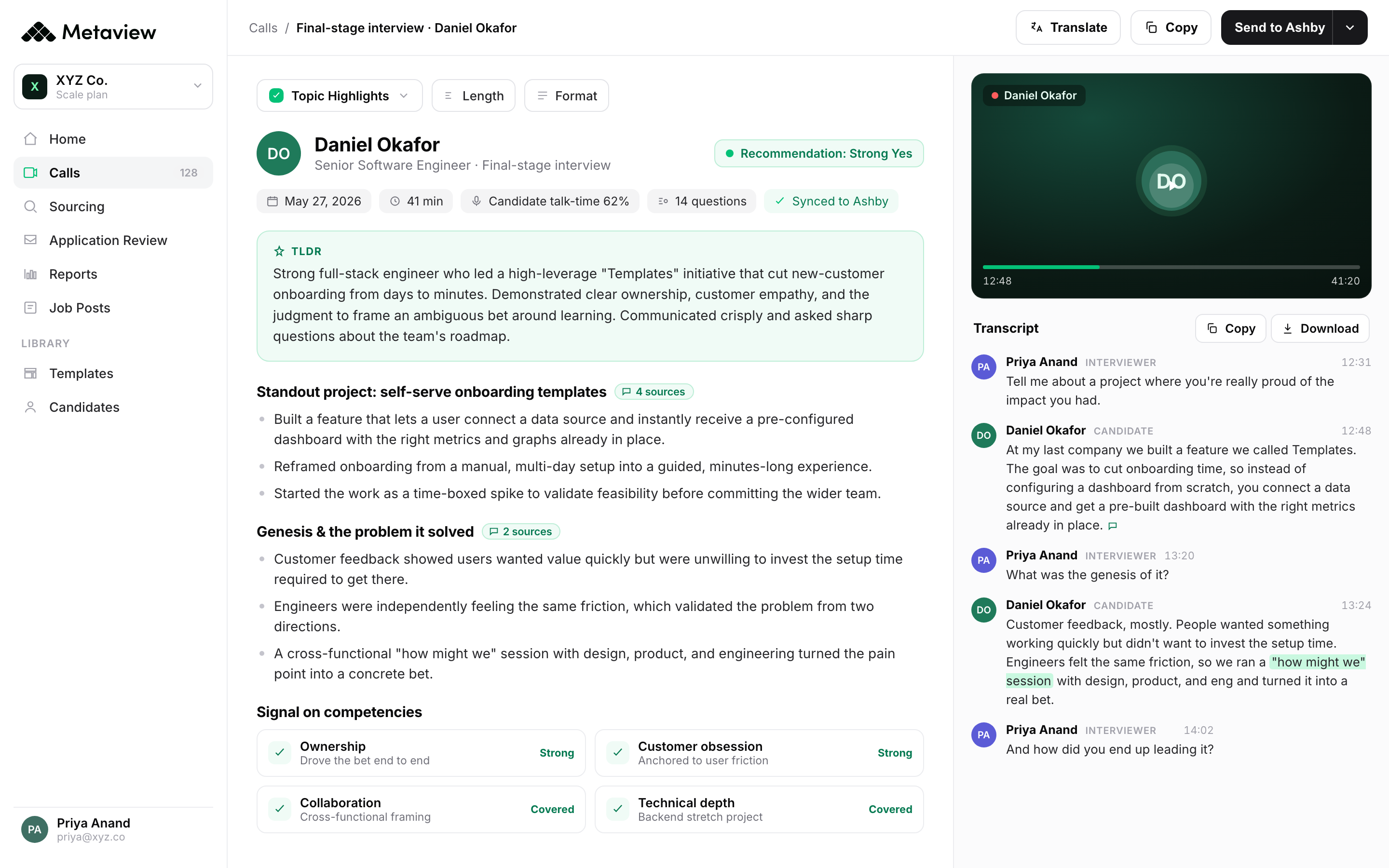
The framing is wrong. Requisitions stall because the substance of what the hiring manager actually needs (the texture of the role, the trade-offs they care about, the must-haves vs nice-to-haves they would argue for in a room) lives in a 30-minute intake call. The requisition document is the residue. And when recruiters reconstruct that residue from memory, scratch notes, and a job-description template, the intent thins out fast.
This piece breaks down what a job requisition actually is, how it differs from a job post and a job description, what belongs in a strong one, the six-step workflow that turns the intake call into approved scope, and where AI changes the unit economics of writing requisitions in the first place.
Why requisitions actually stall (the intent-capture gap).
A job requisition is the internal document that authorizes a hire. It defines the role's purpose, scope, budget, reporting line, and the path to approval. Recruiters, hiring managers, finance, and HR all rely on it as the source of truth before sourcing begins. In a clean process, it is the spine of the search.
In practice, most requisitions are written from one of three thin sources: a scratch-notes summary the recruiter typed during the intake call, a template the recruiter cloned from a similar role last year, or a Slack exchange where the hiring manager rattled off the essentials between meetings. None of these carry the actual substance of what the hiring manager said. The substance lived in the conversation, where they explained why this role exists right now, what success looks like in the first six months, and which trade-offs they would accept under pressure.
That gap, between what the hiring manager said and what the requisition says, is where most search misalignment is born. The role ships to sourcing with implicit assumptions, the recruiter screens against a version of the role the hiring manager would only half-recognize, and two weeks later the team is back in the room rewriting scope.
The pattern shows up in the data. According to Metaview's 2026 AI & Hiring Alignment Report, surveying 505 recruiting leaders and hiring managers across North America and EMEA, only 49% of searches start with high alignment between recruiter and hiring manager when teams do not use AI. When AI is core to hiring, that number jumps to 68%. The kickoff is not the problem. The translation of the kickoff into the requisition is.
Hiring problems are rarely about talent. The best teams win because recruiting, hiring managers, and leadership stay aligned, move quickly, and remove friction with the right systems, increasingly powered by AI.”

Requisition vs job post vs job description.
These three documents get conflated constantly, and the conflation is what causes recruiters to grab a job-description template at the start of a search instead of capturing requisition-level intent.
A job requisition is internal. It approves the role and aligns stakeholders before any external work begins. A job description is internal-leaning. It defines the responsibilities, level expectations, and qualifications that ladder up to the role's purpose. A job post is external. It sells the role to a candidate. Three different documents, three different audiences, three different jobs.
The mistake is starting at the wrong end. When recruiters open a job-description template at the start of the process, they skip past the budget, headcount-type, and approval-path questions that the requisition is supposed to settle first. Two weeks later, when finance asks “is this a new role or a backfill,” everyone realizes the requisition never actually got written.
| Dimension | Job description | Job post | Requisition |
|---|---|---|---|
| Audience | Internal team | External candidates | Internal stakeholders |
| Purpose | Define the role | Sell the role | Authorize the hire |
| Key fields | Responsibilities, level, qualifications | Hook, mission, comp, application path | Budget, headcount type, approval path |
| Approval | Often paired with the requisition | Marketing or employer-brand review | Required from HR, finance, leadership |
| When written | Alongside the requisition | After the requisition is approved | Before sourcing begins |
| Lives in | ATS or careers wiki | Careers site or job board | ATS or HRIS |
What belongs in a strong requisition.
A strong requisition answers fifteen things, grouped into four categories. The role. The people. The money. The constraints. When all fifteen are answered before sourcing begins, you avoid the rewrites, scope creep, and approval ping-pong that swallow the next two weeks.
The role.
- Job title, level, and team
- Business justification (what problem this hire solves)
- Core responsibilities and scope
- Required skills (must-haves vs nice-to-haves, with seniority expectations)
- Estimated start date and interview plan
The people.
- Hiring manager and reporting line
- Approvers (HR, finance, leadership)
- Headcount type (new role vs backfill)
The money.
- Compensation range
- Approved budget
- Employment type (full-time, part-time, contract, temporary)
The constraints.
- Location and work model (onsite, hybrid, remote)
- Urgency or hiring timeline
- Compliance or special considerations
- Internal notes (mobility candidates, succession context, anything that should not appear in the public post)
When these fifteen are explicit before sourcing begins, the search starts aligned. When even three of them are implicit, the search starts misaligned, and the misalignment compounds across every stage of the funnel.
The 6-step requisition workflow.
A strong requisition is built in six steps. Each one settles a different category from the fifteen fields above, and each one closes a different ambiguity that would otherwise resurface during sourcing or interviews.
Step 1: Define the business need.
Start with why the role exists right now, before locking in title, team, or level. Clarify the specific problem the hire solves, the outcomes the role owns, and how success will be measured at six and twelve months. The business-need question is the one most often skipped, and the one most often dragged back into the conversation later when a hiring manager realizes they actually wanted a more senior or differently-shaped role.
Step 2: Align on role scope and seniority.
With the business need locked, define what the role does, at what level, and where the must-haves end and the nice-to-haves begin. This is the recruiter and hiring manager's most important shared sentence. Get explicit on which skills can be learned in the first six months and which the candidate has to walk in with. Overly broad scope or an inflated must-have list will narrow the pipeline and slow time to hire, and often excludes strong candidates who would have grown into the role.
Step 3: Set the comp and budget guardrails.
The most expensive requisition rewrites happen at the offer stage, when a hiring manager wants the best person at any price and finance has not yet seen the number. Align on comp range, headcount impact, and budget approvals before the requisition moves forward. The discipline at this step is what protects the offer-acceptance rate three months out.
Step 4: Confirm the reporting line and stakeholders.
Name the hiring manager, the budget owner, and the approval path. The budget owner is often higher up than the hiring manager, and in growth-stage companies they sit in the C-suite. Naming this now keeps the requisition from getting stuck on a vague “we need finance to sign off” loop two weeks later. It also forces the recruiter and hiring manager to surface any disagreement on level or scope before the role moves to sourcing.
Step 5: Validate the skills and qualifications.
The requisition has to describe what the role truly requires, not an idealized profile built from the last person who held the role. Cross-check the skills list with what the hiring manager actually said in the intake. Two questions to pressure-test each requirement: can this be learned on the job in the first six months, and does the absence of this skill genuinely disqualify a candidate? If the answer to either is unclear, demote the skill to nice-to-have.
Step 6: Final review and sign-off.
Before the requisition moves into the approval queue, run a sanity check. Look for contradictions between responsibilities and level, vague language that leaves room for interpretation, and approval paths that have not been confirmed with the named approver. A reviewed requisition speeds approvals, prevents mid-process resets, and sets the entire search up for a clean handoff to sourcing.
Where AI changes the unit economics.
Writing a requisition by hand is repetitive but high-stakes. Done well, you set the next four weeks of work up cleanly. Done poorly, you reset twice and lose two weeks. AI changes the unit economics of this trade-off in four specific ways, and the change is sharper than just faster drafts.
First-pass drafts that start at the 50-yard line.
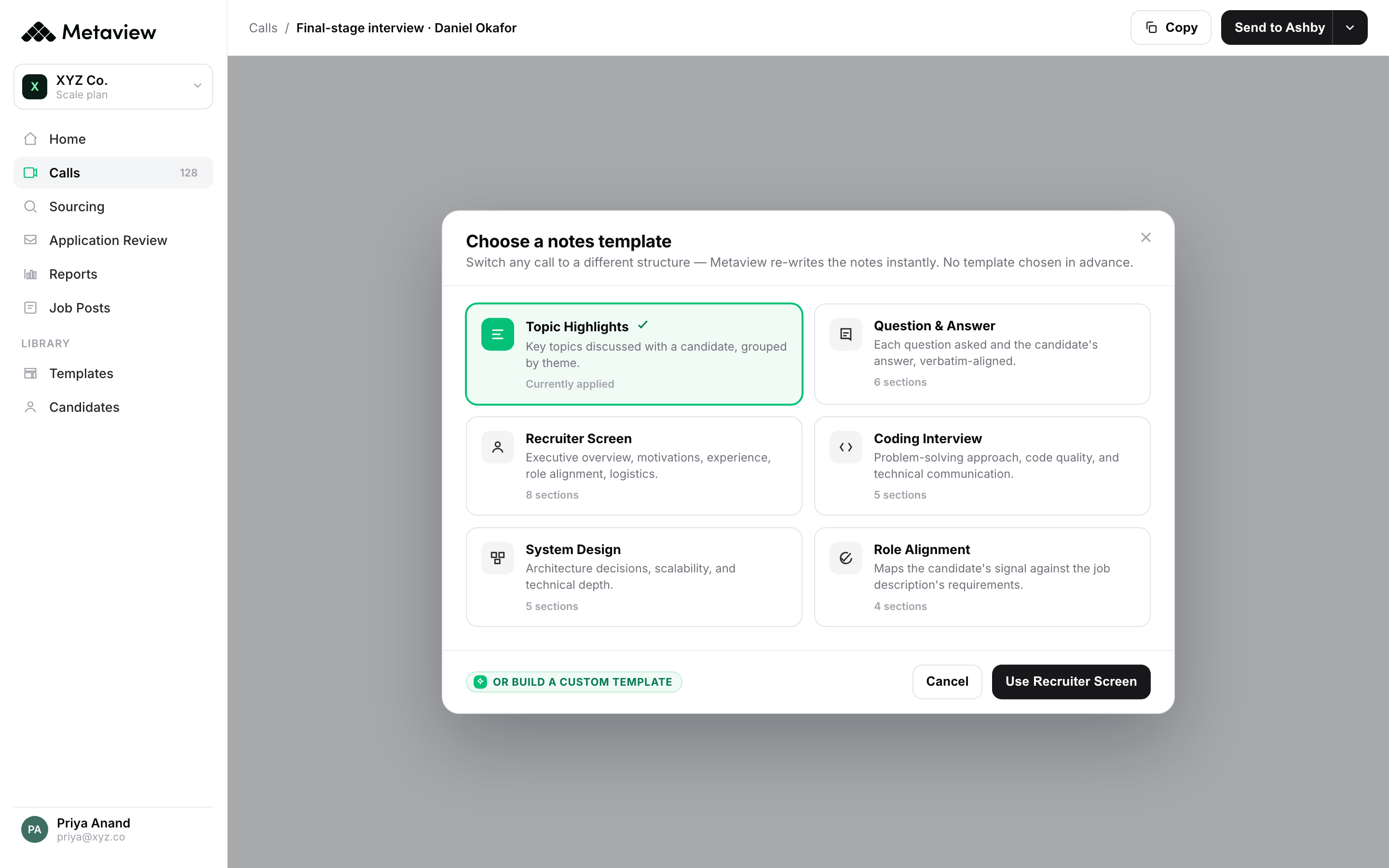
The hardest part of writing a requisition is the blank page. Generic job-description AI tools fill the blank page with averaged-out generic copy, which the recruiter then has to delete and rewrite. AI that has the intake conversation as input fills the blank page with the hiring manager's actual words, restructured into requisition fields. The recruiter edits 10-15% of the draft and ships. The unit economics shift from build from scratch to edit and approve.
Consistency across roles without a style guide.
Standardizing how roles are defined across teams is a known recruiter time-sink. Style guides go stale, glossaries get ignored, and similar roles end up with mismatched titles, levels, and language. AI that has read the team's recent requisitions enforces consistency without anyone having to maintain a doc. Titles match, level expectations ladder up, and the comp band stays inside the existing structure.
Sanity-check before sharing.
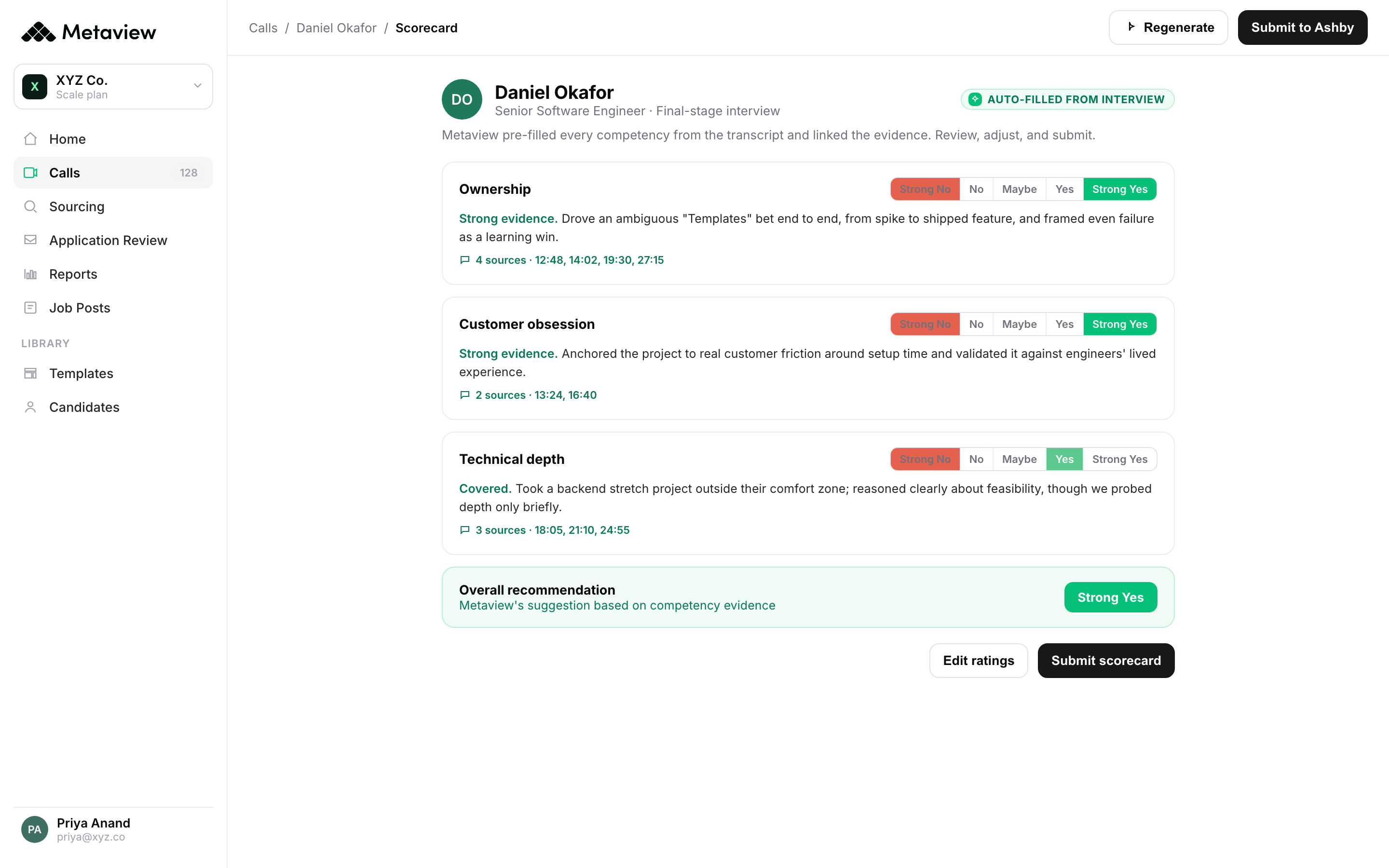
A requisition reviewer's job is to spot contradictions, missing fields, and unrealistic expectations. AI does this faster and at zero marginal cost. Before the requisition reaches finance or leadership, it has already been flagged for the kind of issues that would have caused a rewrite mid-approval.
Faster iteration with stakeholders.
Async iteration on a shared draft is faster than meeting-driven iteration over a Word doc. AI keeps the document consistent as different stakeholders propose edits, and surfaces the changes that change the substance versus the changes that change the formatting. Hiring managers, recruiters, and HR converge on the final version in days instead of weeks.
 Metaview Technologies
The Metaview loop: capture, structure, sanity-check, preserve.
Most requisitions are written in the wrong direction. The recruiter sits down with a blank template and tries to reconstruct what the hiring manager wanted. Metaview inverts the direction. The intake call is the source, the requisition is the artifact.
The loop has four moves. Capture the intake conversation automatically, so role goals, success criteria, must-have skills, and constraints become structured data the moment the call ends. Structure the captured data into a first-pass requisition and job post, so role scope, skills, seniority, and context are already on the page when the recruiter opens the draft. Sanity-check the draft against the team's recent requisitions and the patterns Metaview has seen across previous searches, so missing requirements, conflicting signals, and unrealistic expectations are flagged before the document moves to approval. Preserve the original hiring intent and the decisions made along the way, so the next requisition for a similar role can be refined from a known starting point instead of reinvented.
Metaview shipped this loop as a product called AI Job Posts in March 2025. The launch was explicit about the design choice: three creation paths, with “from an intake call” listed as the preferred path. The other two paths (from blank, or from a template) exist as fallbacks, but the asymmetry is intentional. Once a team has Metaview on the intake call, the blank-page path stops being the default.
The downstream effect is measurable. Teams that capture the intake call as structured data see the requisition collapse from a multi-day exchange into a single review cycle, the offer-acceptance rate hold up because comp guardrails were set before sourcing began, and the next requisition for a similar role start at a higher floor instead of from scratch. Across enough searches, the cumulative hours saved on requisition writing alone justify the workflow change, before the second-order benefits in wash-up discussions and downstream alignment even register.
We probably save around 10 minutes per interview, maybe a bit more. We do between 300 and 500 interviews a month, so 50 to maybe 80 hours saved for the business per month. That's a significant time and cost saving.”
Frequently asked questions.
What is a job requisition?
How is a requisition different from a job post or a job description?
Who typically approves a job requisition?
How long should a job requisition take to write?
Is a job requisition required for every hire?
Bring Metaview into your hiring stack.
Live notes, structured scorecards, and ATS sync - set up in under 10 minutes.
