
Full-cycle recruiting gets sold as a coverage model: one recruiter owns intake through post-hire, so the candidate experience stays consistent, the hiring manager talks to one person, and the handoffs that usually leak signal disappear. That sounds clean. The reason it gets brittle at scale is not the recruiter doing too much. It is the signal not getting captured.
Every stage of a hire produces information that the next stage needs. Intake produces priorities; sourcing produces market reactions; screening produces evidence; interviews produce calibrated reads; offers produce reasons the candidate did or did not say yes. When one recruiter owns the whole cycle, all of that lives in their head, their unsent Slack drafts, and a Notion doc nobody else reads. The day they take PTO, take a second req, or leave, the context dies with them.
This piece is for TA leaders deciding whether full-cycle is the right operating model for a given pod, function, or company stage. The argument is simple: full-cycle recruiting is a context-preservation problem, not a coverage problem. Done well, it is a system that survives any individual recruiter leaving. Done badly, it is a single point of failure waiting to happen. The capture layer is what separates the two.
Full-cycle recruiting is a context problem.
Start with the textbook definition, then walk it forward. Full-cycle recruiting (sometimes called end-to-end recruiting) is when a single recruiter owns every stage of a search on a given requisition, from intake with the hiring manager through to post-hire review. The alternative is a split model: sourcers find candidates, recruiters screen, coordinators schedule, the hiring manager runs the loop, and a TA leader signs off on the offer.
The reason full-cycle appeals is intuitive. Fewer handoffs means fewer dropped balls. The recruiter who heard the intake call is the same person framing the closing pitch. The candidate gets one consistent voice. The hiring manager builds a real working relationship with one person rather than a rotating cast. On paper, the context stays intact because it never leaves one human.
The reason it breaks is also intuitive, once you look. The context never gets captured. It stays inside the recruiter. The intake doc gets written quickly and then never updated when the requirements drift in week 3. The phone-screen note lives in a Notion page that the hiring manager does not open. The closing pitch is built from the recruiter's recollection of what mattered to the candidate, not from the candidate's actual words. Each stage has its own private receipt, and none of them connect.
This is what the alignment data shows, indirectly. According to Metaview's 2026 AI & Hiring Alignment Report, surveying 505 recruiting leaders and hiring managers across North America and EMEA, 67% of teams lose qualified candidates to competitors who move faster every month. Speed is downstream of signal capture. The team that knows what they are looking for at stage one moves first. The team that re-derives the intake every Friday is the team losing candidates.
Before the recruiters ever reach out to a candidate, they're like, is this bar high enough? Does this increase our talent density? Do they have good career trajectory? Does their work make an impact? The cultural shift fundamentally changed how my recruiters operated and who they engaged.”

The 6 stages, the 6 places signal quietly dies.
The six stages of a full-cycle search each have a different shape, a different stakeholder, and a different place where the signal quietly dies. Naming the failure mode at each stage is what makes the operating-model decision tractable.
Intake and role alignment.
Signal dies in: the intake doc that goes stale by week 2. Most intake calls cover priorities, must-haves, nice-to-haves, and the operating context of the role. Recruiters take fast notes during the call, write up a doc afterwards, and then the doc sits unchanged while the actual definition of the role drifts in weekly 1:1s with the hiring manager. By the time the first interviewer asks 'what are we calibrating against?', the answer is whatever the recruiter remembers from week 1.
Sourcing and outreach.
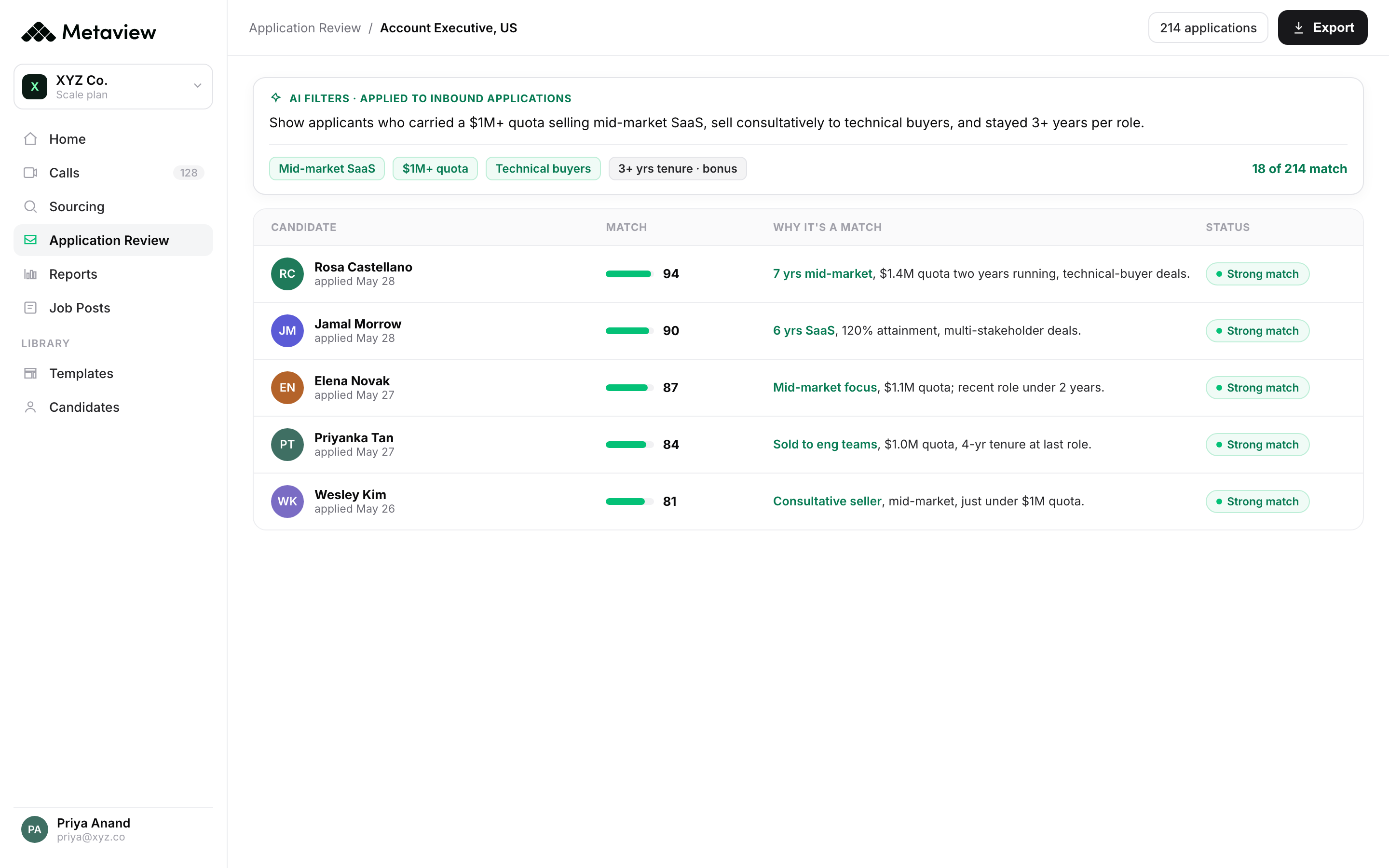
Signal dies in: Boolean strings that do not carry the intake context. The recruiter who heard the intake call knows that the hiring manager cares more about portfolio depth than years of experience. The sourcing query they run, or the prompt they pass to a generic AI sourcing tool, does not encode that. So the shortlist comes back optimized for keywords, not for the criteria the hiring manager actually discussed.
Screening and initial evaluation.
Signal dies in: the phone-screen note paragraph written 30 minutes after the call. The recruiter ran a 30-minute conversation that surfaced 8 to 12 useful data points about the candidate. By the time they sit down to write up the screen, they remember the 3 sharpest ones. The hiring manager sees those 3, makes a yes/no on advancing, and the other 9 data points never reach anyone else in the loop.
Interview coordination and feedback.
Signal dies in: scorecards filled out the day after, when memory has faded. Even structured interview loops tend to ship feedback 24 to 48 hours after the panel happened. By then, the interviewer is writing impressions, not evidence. Two panelists who scored the same candidate the same way often had completely different reasons, and the scorecard does not capture that. The debrief turns into a vibe check.
Offer management and close.
Signal dies in: a closing pitch built from the recruiter's recollection, not the candidate's actual words. The strongest closing pitches reference back to specific things the candidate said earlier in the process: what they are trying to optimize for, what they have ruled out, what made them open to this conversation in the first place. Most closing emails read like a stock summary of the company because that is what is easiest to write.
Post-hire review.
Signal dies in: nothing actually being measured because nothing was captured. Most post-hire reviews are a 6-month performance conversation between the hiring manager and the new hire, with the recruiter looped in by email. There is no structured connection back to the intake document, the screening notes, or the interview signal. So the next req on a similar role learns nothing from the last one.
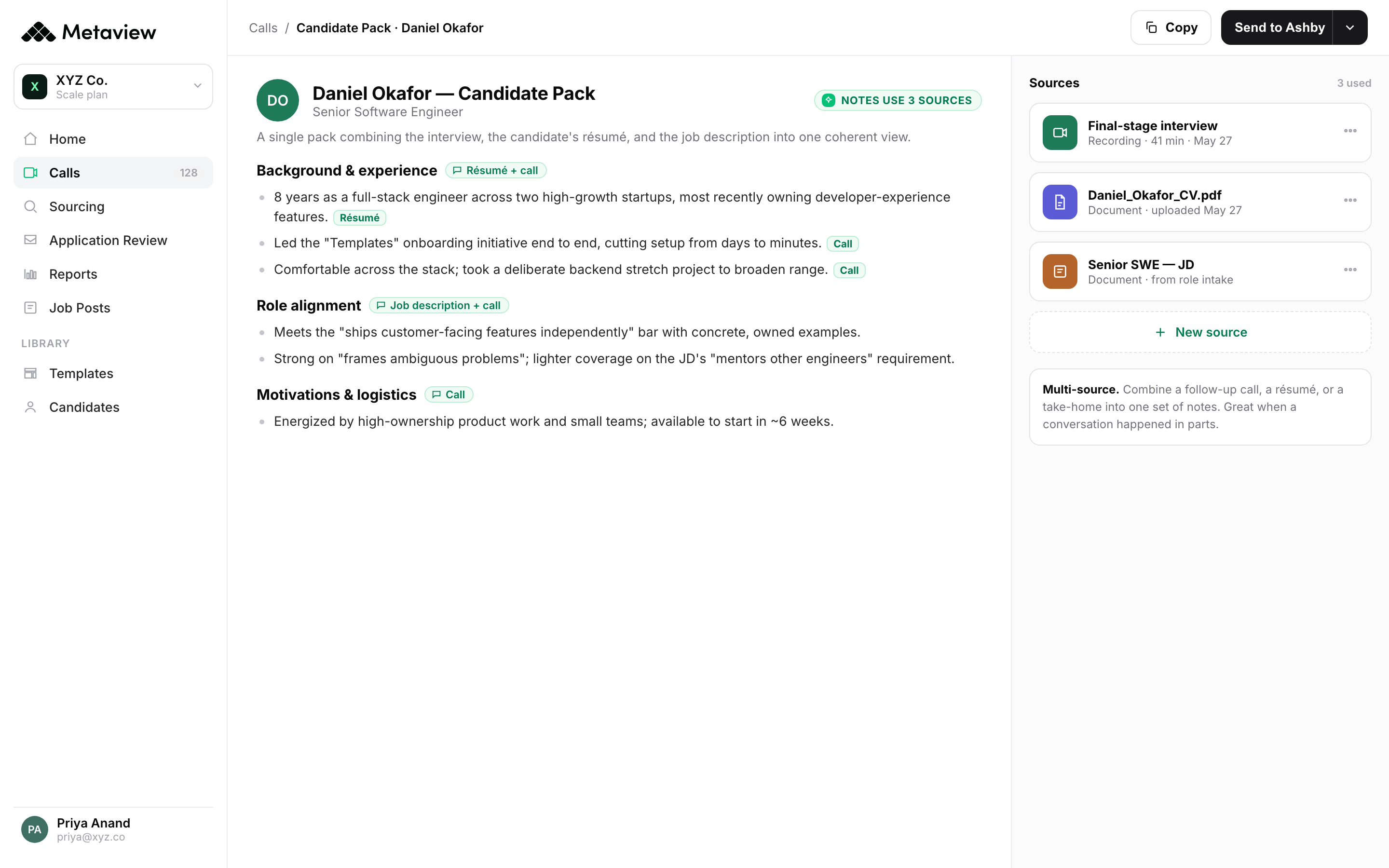
Drawn this way, the failure mode is the same at every stage: signal lives in one person's head and never gets structured in a way the next stage can use. The visual receipt of solving this looks like a connected, multi-source candidate summary that any reviewer can open and trust, with each stage's evidence preserved exactly as it happened.
- 1Intake priorities and must-haves preserved from the kickoff call.
- 2Sourcing rationale and outreach context kept with the record.
- 3Phone-screen signal captured during the call, not after.
- 4Each panel interview structured against the same competency rubric.
- 5Hiring manager feedback threaded inline, not in a separate doc.
- 6Decision-ready summary that any reviewer can open and trust.
When full-cycle works, when split works.
The most common framing of full-cycle vs. split-model is wrong. Teams treat it like a company-size question: small company means full-cycle, large company means split. That is a proxy for the real driver.
The real driver is signal continuity. If you have a way to preserve hiring signal across stages programmatically, splitting the workflow loses very little, because the next stage opens with the receipts from the previous one. If you do not have that capture layer, full-cycle is the only insurance against context loss, because the same human is sitting in every stage and remembers what they cannot prove. It is insurance, but it is brittle insurance.
Full-cycle is the right model when: the roles are low-volume and high-context (senior leadership, niche technical hires, brand-critical roles), the recruiter's relationship with the hiring manager is itself a deliverable, and the throughput per recruiter is less important than the depth on each search. A great full-cycle recruiter on a senior search is doing something a sourcer + coordinator pair often cannot do.
The split model is the right call when: the roles are high-volume and repeatable, throughput per recruiter matters more than per-req depth, and the team has already invested in the capture layer that lets the next stage open with the previous stage's receipts. The capture layer is what makes splitting safe. Without it, a high-volume split pipeline is a context-loss machine.
The honest answer for most TA orgs at 200 or more employees: use both. Full-cycle for the senior and niche searches where the relationship is the work; split for the high-volume pipelines where throughput is the work. The mistake is picking one structure for the whole org and pretending the trade-offs do not exist.
The 5 best practices that survive a recruiter leaving.
If you are running full-cycle on any portion of your reqs, the practices below are what separate a robust operating model from one that collapses when a recruiter takes PTO. Each one is a small move that makes the captured signal survive the individual.
- Treat intake as a capture event, not a meeting. The output of an intake call is not a doc the recruiter writes alone afterwards. It is structured notes generated from the conversation itself, reviewed by both sides while the context is fresh.
- Agree on success criteria before the first candidate goes in the funnel. What does a Yes look like on each competency? What evidence would change the hiring manager's mind? Write those down. Reference them at every debrief.
- Capture structured feedback immediately after every interview, not the next day. 30 minutes after a panel, the interviewer can still tell you what the candidate actually said. 24 hours later, they remember how they felt. Reasons beat impressions every time.
- Push back when requirements drift mid-process. If the hiring manager raises a new must-have in week 4, that is a signal to update the intake, recalibrate the loop, and re-evaluate the candidates already in flight. Drift without recalibration is how good candidates get rejected for the wrong reasons.
- Run a structured post-hire review on every req. Connect the intake document, the interview signal, and the 90-day outcome. The req you just closed is the highest-quality training data the next similar req will get.
Manual / Generic AI / Metaview across the full cycle.
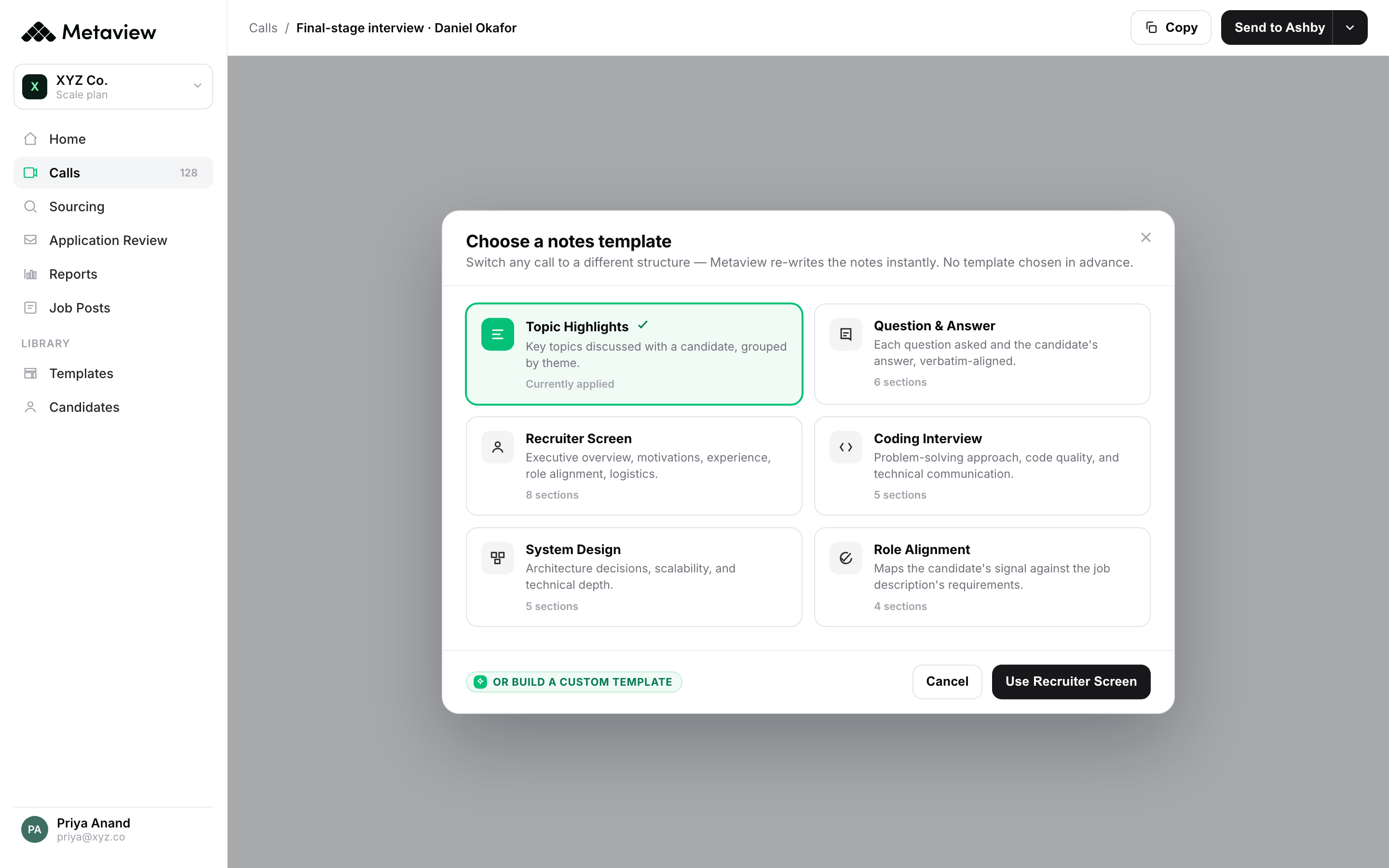
The clean way to evaluate any full-cycle operating model is stage by stage, comparing what the work looks like under three different setups: the manual setup most teams still run, a generic-AI setup that adds tooling but not structure, and a Metaview-style setup where the capture layer is the connecting tissue across all six stages.
| Stage | Manual | Generic AI | Metaview |
|---|---|---|---|
| Intake | Recruiter writes a doc after the call; doc goes stale by week 2. | Generic transcription tool produces a transcript nobody opens. | Live intake capture against an intake template; structured notes both sides can update. |
| Sourcing | Boolean strings that do not encode the hiring manager's actual priorities. | LLM rewriter that drafts outreach but does not connect to intake. | Sourcing agent that opens with the intake context already attached to the search. |
| Screening | Phone-screen note paragraph typed after the call. | Generic AI notetaker that produces a transcript with no structure. | Auto-scorecards filled against the role's competency rubric while the call is happening. |
| Interview coordination | Scorecards completed the next day; reasons fade to impressions. | Calendar AI plus a separate note tool; data lives in two places. | Auto-detected meetings with the right template; structured signal pushed back to the ATS. |
| Offer | Closing pitch built from the recruiter's recollection of the candidate. | AI summary of the resume, disconnected from interview signal. | Multi-source candidate summary that pulls together intake, screen, panel, and HM feedback. |
| Post-hire | Spreadsheet or nothing; no connection back to intake or interview signal. | Survey tool that asks the hiring manager 'how is it going.' | Searchable interview-to-outcome timeline; the closed req becomes training data for the next one. |
The post-hire feedback loop most teams skip.
Most full-cycle operations end at the offer. A candidate signs, the recruiter moves the req to closed, and the next intake call starts. The post-hire review either does not happen at all, or it happens 6 months later as a hiring-manager-led performance conversation that the recruiter is not part of.
That is the single biggest leak in most full-cycle setups. The req that just closed contains the highest-quality information the next similar req will get: which interviews actually predicted performance, which questions surfaced the strongest signal, which closing pitch resonated, which signals at intake turned out to matter and which did not. Every closed req is training data for the next one.
What this looks like operationally: the team can search past interview signal in natural language. Not 'which candidates did we hire from this company,' but 'which screening questions produced answers that correlated with offer acceptance,' or 'what did our last 5 senior hires say in their intake conversations that the rejected finalists did not say.' Those questions are answerable if the capture layer made the signal queryable.
 Savage Staffing
We may need to know whether a recruiter or hiring panel went deeper on a certain topic. Being able to go back to Metaview, pull those exact notes, and see exactly what was said has been really helpful.”

Bring Metaview into your hiring stack.
Live notes, structured scorecards, and ATS sync - set up in under 10 minutes.
Frequently asked questions.
What's the difference between full-cycle and split-model recruiting?
Full-cycle (or end-to-end) recruiting has one recruiter own every stage of a search on a given requisition: intake, sourcing, screening, interview coordination, offer, and post-hire. The split model breaks those stages across specialized roles, typically sourcers, recruiters, and coordinators, with the hiring manager and a TA leader involved at key decision points. Neither model is universally better; the right call depends on whether the team has a capture layer that preserves hiring signal across stages.
Can one recruiter really own intake to offer at scale?
On the right roles, yes. On the wrong roles, no. Full-cycle works well for low-volume, high-context searches where the recruiter's relationship with the hiring manager is itself a deliverable. It does not work for high-volume pipelines where throughput per recruiter matters more than depth per search. Most TA orgs of 200+ employees should run both models in parallel: full-cycle for senior and niche, split for high-volume.
How does AI change full-cycle recruiting in 2026?
The biggest change is the capture layer. AI that listens to every intake, screen, panel, and debrief, and structures the signal into a connected candidate record, removes the reason full-cycle used to be brittle: that all the context lived in one recruiter's head. With the signal captured and queryable, full-cycle becomes a system instead of a single point of failure, and the org can pick the operating model that best fits each search.
What's the biggest risk of full-cycle recruiting?
Context loss when the recruiter leaves or takes time off. If the signal from every stage lives only in the recruiter's memory, their unsent Slack drafts, and a Notion doc nobody else reads, the day they leave the search effectively restarts. Full-cycle teams that mitigate this through a structured capture layer get the benefits of the model (deep context, one consistent voice) without the brittleness.
How do you measure full-cycle recruiter performance?
Reps closed and time-to-fill are necessary but not sufficient. The metrics that actually predict whether a full-cycle recruiter is building a durable practice include: alignment-at-intake (does what they captured at week 1 still match what the hiring manager would describe at week 4), debrief lag (how fast structured feedback gets to the loop after every panel), post-hire signal closure (how often the closed req gets reviewed against its intake), and quality-of-hire at 90 days. Teams using AI to capture every conversation can pull these metrics directly; teams without that layer have to ask recruiters to self-report, which defeats the purpose.
