
Hiring at a startup feels like nine different problems. The first hire after the founders. The 10-person team that needs an engineering manager. The Series A push to 50. The Series B engine that has to scale to 150 without snapping. The instinct is to learn each one as a new problem. The teams that scale cleanly read it as one problem with stage cuts: the founder is the hiring manager until someone else is, and the calibration brief lives in the founder’s head until they write it down.
The hard part of how to hire for a startup is not picking the candidates. It is the operating model that runs underneath the picks. The teams that get this right run the first 50 hires as a system. The teams that get it wrong run 50 individual judgment calls, lose the signal between rounds, and reverse-engineer the answer in the offer call.
This post is for the founder who has done a handful of hires and knows the next 40 will compound the company. We map the operating model behind the first 50 hires, the four disciplines that make it work, and the interview-intelligence layer that lets the founder hand off to the first recruiter without losing the calibration.
What startup hiring actually is (and what it isn’t).
Startup hiring is the founder’s operating model for filling the company’s first 50 to 100 roles. Same shape as senior recruiting at a 5,000-person company, sharper edges in three places: the intake meeting (which usually doesn’t exist), the panel (which is improvised), and the closing call (which runs on memory). The founder is on every panel and is the final decision-maker until someone else can be.
The mistake most founders make is treating every hire as a one-off judgment call. The product roadmap gets a system. Fundraising gets a system. Hiring gets a vibe. The teams that scale cleanly treat the first 50 hires the same way they treat the roadmap: a calibration brief written once, captured signal that survives every round, and a closing conversation that runs on what the candidate actually said.
According to Metaview’s 2026 AI & Hiring Alignment Report - surveying 505 recruiting leaders and hiring managers across North America and EMEA - 58% of teams actively contemplate working around their hiring counterpart. For a founder, you are both sides of that statistic. You are the recruiter and the hiring manager. The bypass you are tempted to make is the calibration meeting with yourself.
Hiring problems are rarely about talent. The best teams win because recruiting, hiring managers, and leadership stay aligned, move quickly, and remove friction with the right systems, increasingly powered by AI.”
The four founder disciplines for the first 50 hires.
In priority order, ranked by the time-cost of getting each one wrong and by how many later hires inherit the discipline (or the lack of one). Start at the top.
1. Write the calibration brief before you talk to anyone.
The most common failure mode in founder-led hiring is that the calibration brief never gets written down. The founder writes a one-paragraph job spec, posts it, and starts taking calls. The brief that should live on a doc lives in the founder’s head and gets paraphrased differently to every panelist. By interview five the bar has drifted twice. By the offer call the founder is reconstructing the original intent under pressure.
Run the meeting with yourself before the search opens. Three must-haves the candidate has to walk in already doing. Two trade-offs you are willing to flex on. One deal-breaker you only name when pushed. Write all six in a doc and link the doc on every panel invite. Founders who do this stop having post-offer regret. Founders who skip it spend a week per role recovering from drift.
2. Design the panel to test the work, not your network.
The default startup interview loop is four people the founder already trusts: a co-founder, a strong engineer from a prior company, an investor, and the founder. That panel measures one thing well: whether the candidate is the kind of person the founder already hires. It is the wrong measurement for the second hire in the function, and it is fatal by the fifth.
Replace one of those slots with a cross-functional partner who tests for a stake the founder does not naturally evaluate. For a first engineering hire, that is a designer or PM who tests how the candidate runs an ambiguous spec. For a first AE, that is an engineer who tests how the candidate handles a hard technical question from a real buyer. The panel is the calibration body for the search. Design it once, run it consistently across every candidate, audit it after each hire.
3. Capture the signal across every round.
By round four the panel has heard the candidate say different things to different people. The founder has the strongest read and the worst notes. The advisor has the best notes and the weakest context. The technical interviewer has the sharpest signal on the technical bar and no view of culture. Without a capture layer, the offer call runs on the founder’s best recollection plus whatever the advisor remembered to write down.
Notetaker captures every spoken word in your interviews, scores against the rubric the founder set in intake, and surfaces the moment the candidate’s read changed for any given panelist. The signal stops evaporating between rounds. The founder walks into the next interview already calibrated against the prior one.
4. Close the offer with what they said, not what you remember.
The offer call is where founder-led searches close or slip. By the time the founder gets to it, the panel has run, the must-haves have shifted twice, and the founder is reconstructing what the candidate said about flexibility, equity, and start date from three weeks of fragmented memory. Whatever the candidate raised in screen as a deal-breaker is now a hazy recollection. Whatever the founder agreed to flex on in intake is back to firm.
The founder who walks into the offer call with the captured signal from every round opens a different conversation than the founder who walks in with their best recollection. The flexibility cues from screen, the team-fit beats from panel, the trade-offs flagged in the advisor round all show up in one brief.
How Metaview operationalizes the founder operating model.
The reason this operating model is achievable now and was not five years ago is that the interview signal is finally the durable layer. Resumes are still inputs. Take-homes still calibrate. The thing the founder’s playbook now runs on is the structured signal from the conversation itself. The intake brief, every panel round, and the offer-prep call all live in the same context layer instead of three different heads.
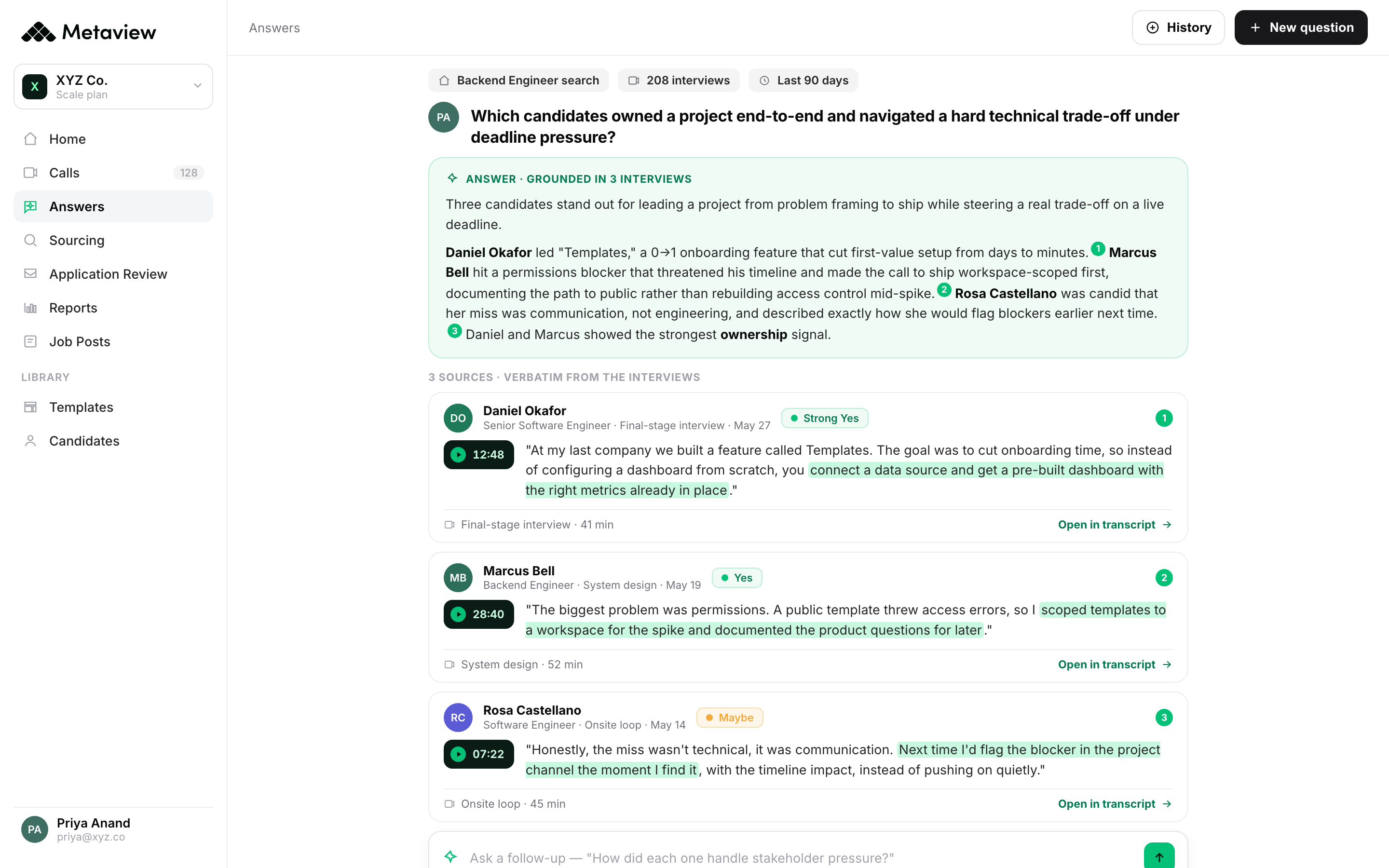
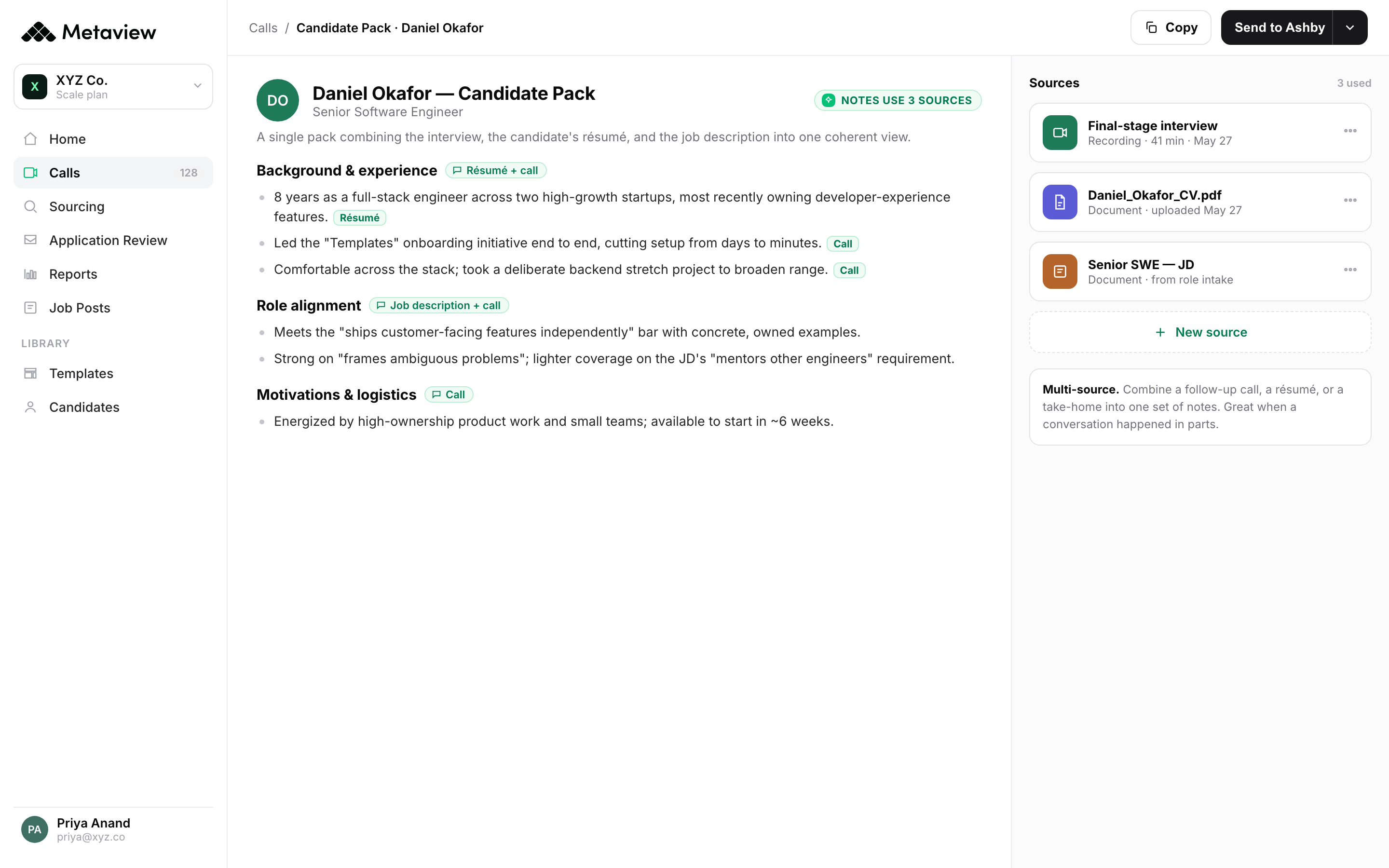
Across the 4,000+ organizations on the Metaview platform, founders running this play stop being the bottleneck in their own hiring. The structured AI notes feed the ATS scorecard. The intake brief feeds the panel kit. The captured panel signal feeds the offer-prep brief. The hand-off to the first recruiter, then to the first head of TA, then to the VP of People, happens against a captured brief, not against the founder’s recall.
Founder-led vs. recruiter-led vs. Metaview-augmented.
The same four disciplines, broken down by where the operating model is today. The Metaview-augmented column is the state where the interview-intelligence layer is wired in across every hire from the first one.
| Discipline | Founder-led, no system | First recruiter, no capture | Metaview-augmented |
|---|---|---|---|
| Calibration brief | Lives in the founder’s head. Paraphrased differently per panelist. | Lives in a Notion doc but goes stale. Recruiter inherits the founder’s memory. | Intake meeting captured. Must-haves, trade-offs, deal-breaker land in the panel kit automatically. |
| Panel design | Four people the founder trusts. Tests the wrong stakes. | Recruiter improvises the loop per role. No consistency across hires. | Panel kit pulls competency rubric from intake. Same rubric on every candidate, audited after each hire. |
| Signal capture | Founder writes notes in real time. Loses 60% by interview five. | Recruiter relays panel feedback verbally. Signal degrades round-to-round. | Notetaker captures every round, scores per-competency, surfaces the moment the read changed. |
| Offer prep | Founder reconstructs flexibility and equity cues from memory. | Recruiter writes the brief from panel debrief notes plus best guess. | Multi-Source Summaries synthesize flexibility, equity, and team-fit signal across every round into one brief. |
What founders running this play are seeing.
The numbers cluster the same way every time. The pattern: a calibration discipline that survives the hand-off from founder to first recruiter, an interview loop that converges in fewer rounds, and a debrief that lands in minutes instead of days. The lift is not from any one workflow getting faster in isolation. It is from the capture layer turning conversations into signal that the rest of the hiring stack can operate on.
At Catawiki, the engineering org hired 300 engineers in 12 months by running structured capture across every panel. The loop never had to reopen to recover signal that an earlier round had already produced. At Brex, Joel Baroody runs senior IC searches against the captured signal from every prior round, and variance between panelists on the same competency dropped 38% across the engineering hiring window. Same role, same panel, fewer judgment calls splitting the difference between two strong candidates on the wrong axis.
All of our hiring team said that Metaview saves them hours. We’re now getting feedback from hiring managers in 10 to 20 minutes, which is just ideal for a recruiting team that works with time-to-hire targets.”

At Quora, Hannah Wardle’s hiring team gets hiring-manager feedback in 10 to 20 minutes after the final round, not 2 days. For a founder, that is the difference between extending the offer Friday afternoon and watching the candidate accept a competing offer over the weekend.
How to start: the 30-day founder hiring plan.
A practical sequence for founders adding the four disciplines to a hiring loop that has been running on instinct. Same four disciplines, different starting point depending on where your team is today.
- Week 1. Pull your last five hires. For each one, write down whether you had a calibration brief in writing before the search opened. The hires where the answer is “no” tell you the discipline to fix first. Calibration is almost always the lift.
- Week 2. Run the intake meeting with yourself on the next open role. Three must-haves, two trade-offs, one deal-breaker, written down. Share the doc with every panelist on the calendar invite. This costs you 30 minutes and saves you a week later.
- Week 3. Set up the capture layer on every interview. Notetaker captures the screening call, the panel, and the offer-prep call. The structured signal lands in the doc with the rubric, not in the panelist’s memory.
- Week 4. Run your first offer-prep call on captured signal. Pull the moment the candidate flagged equity in screen. Pull the trade-off the panel surfaced in round three. The offer call runs against evidence, not recall. The founders who do this once stop running it the old way.
Bring Metaview into your hiring stack.
Live notes, structured scorecards, and ATS sync - set up in under 10 minutes.
Frequently asked.
When should I make my first non-founder hire?
When the founder is the bottleneck in two things that both matter: the customer conversation and the hiring conversation. If you are skipping intake meetings because investor updates are due, the next hire is the recruiter, not the engineer. If you are skipping product reviews because you are in five interviews a day, the next hire is the engineer, and a recruiter follows within the same quarter.
How do I hire for a startup without a recruiter on the team?
Treat the four disciplines above as the recruiter. Write the calibration brief, design the panel once, capture the signal across every round, run the offer call against captured signal. If you do those four things consistently, you can run 20 hires before the first recruiter joins, and the recruiter who joins inherits a system instead of a mess.
What is the right interview process for a 10-person startup?
Three to four panelists, one screen with the founder, one technical or functional deep-dive, one cross-functional check, one final with the founder. Same panel composition for every candidate in the same role. Same rubric the founder wrote in intake. The discipline is in running it the same way every time, not in adding more rounds.
How do I balance speed and quality when hiring fast?
You do not trade off speed for quality. You trade off improvisation for system. The fastest hiring teams are not the ones with the loosest process. They are the ones with the tightest calibration brief, the most consistent panel, and the shortest gap between final round and offer-prep call.
How does Metaview help a founder running their own hiring?
The intake brief, every panel round, and the offer-prep call are captured and structured into the same context layer. The calibration the founder committed to in week one is still visible in week four. The offer-prep brief opens with what the panel agreed on, not what the founder remembers under pressure.
What changes when the first recruiter joins?
The captured calibration brief becomes the recruiter’s onboarding doc. Instead of spending six weeks reverse-engineering the founder’s hiring taste from Slack threads, the recruiter inherits a structured brief per role, the panel kit the founder ran on the last five hires, and the offer-prep brief format the founder closed against. The hand-off compresses from a quarter to a sprint.
