

Hiring in a new country starts with legal questions, such as whether to set up a local entity.
The recruiting side gets less attention, and that’s where the first hires stall. A job goes up only on the boards you use at home. Or an offer can’t go out because no one has told recruiting who will employ the new hire.
A candidate kept waiting for an offer may accept another one.
My advice is to keep your hiring bar exactly as it is at home. That’s how strong a candidate has to be to get a “yes.” Adapt most other things to the new market, such as where you post jobs and who interviews.
Our guide is for recruiters and talent leads setting up hiring where the company has no team yet. It walks through the steps in the order you’ll meet them, from who employs your new hires to who interviews them.
You’ll come away with six questions for local counsel, an employment lawyer who practices in the new country. You’ll also get four checks to run once your first ten hires have joined.
Settle who employs your team when hiring in a new country.
Before anyone writes a job post, ask finance or legal whose contract new hires sign. That decides whose name is on the offer and how soon you can make one.
There are three usual ways to employ people in a new country:
- Your own local entity, a company you register in that country to employ people there yourself. Offers and contracts come from you.
- An employer of record, a company that legally employs people in that country on your behalf. The contract is theirs, and the person works for you day to day.
- Contractors, who invoice you rather than join a payroll. Whether you can fill a role this way depends on the country’s rules and how closely you direct the work. Ask local counsel.
If your own entity is months away, ask whether an employer of record can take on the first hires in the meantime. That way, you can make offers before your entity is ready.
Name the people who own each search.
Give every new-country search three named owners: the recruiter who runs it, the hiring manager, and the one person who makes the final call. The hiring manager often makes the final call too, so one person can hold two of these roles. When the hiring manager doesn’t, the country lead who runs the new office usually does.
Once the owners are named, hold an intake meeting. That’s where you and the hiring manager agree what the role needs.
Meet live, on video if the hiring manager is in another country. That way, neither of you has to guess what the other wants. Then write up what you agreed as a short intake summary.
We have a separate article on the recruiter intake meeting. It lists eight questions to ask the hiring manager. It also has a template you can copy.
Research the new market before the first job post.
Before any job goes up, learn the local market. The job board that fills roles at home may not be where people look in the new country.
These are the questions I’d want answered before posting:
- Which companies employ the talent you’re after, and which of them are hiring for the same roles.
- Where those people look for work, such as a local job board or referrals.
- What they expect on pay, working location, and notice period.
- Whether anyone there has heard of your company, since a name that sells itself at home may need explaining.
Once interviews begin, ask your first candidates what pay they expect, and write the answers down. Use their answers to check your pay research.
Ask local counsel how employment laws affect your hiring.
Consult local counsel on employment laws before the first role opens, while there’s time to act on the answers. If you use an employer of record, it can answer some of the questions below too.
I’d send counsel these questions:
- What notice periods are usual here, in law and in contracts? How do they change the hiring timeline?
- What can interviewers ask here, and what must they avoid?
- If you record interviews, what consent does that need here, and who obtains it?
- Is a local entity required before an offer goes out, or can the employer of record make it?
- What does a compliant offer have to state about pay, leave, and benefits?
- Are background and reference checks allowed, and with what consent?
Of these, I’d push hardest for two answers: who can make the offer, and the usual notice period. The legal notice period sets the earliest date a new hire can start. A candidate’s own contract may push that date later.
Fritz Singer, Vice President of Talent at Personio, talks about notice periods in his episode of 10x Recruiting, our podcast. The episode covers the long notice periods common across most of Europe and how to plan a hiring timeline for each country.
Keep the hiring bar and adapt the role profile.
Keep the same hiring bar: a “yes” on the scorecard in the new office should mean what a “yes” means at home. That bar is the one thing I wouldn’t adjust for a new market, however slow the first searches feel.
If your bar isn’t written down yet, write it down before you start hiring. The first hires set the pattern, because once they’re in, they start interviewing the people who come after them.
What can change is the role profile: the experience and skills a job asks for. If the job needs a different language or different experience in the new country, say so in that country’s profile. Then judge candidates against that profile as strictly as you would at home.
Split each interview loop between your home team and local hires.
An interview loop is the full set of interviews one candidate goes through. In a new country, every loop should pair home staff with locals.
Each loop then has people who know the hiring bar, along with locals who know the market and the language.
Your first hire is often the country lead. Run that role’s interviews with your home team, since no one local has joined yet. Then add local hires to later loops once they know the scorecard.
Write down which part of the role each interviewer assesses.
Have everyone score the role’s core skill, the main thing the person is hired to do. Give the local interviewer the questions only a local can judge, such as language fluency or knowledge of the local market. When interviewers from the two offices disagree, the search’s final decider makes the call.
Keep someone from your home team on every loop until the tenth hire starts. After that, local interviewers can run loops alone if they score candidates as strictly as the home team does.
Where Metaview fits.
We can help with market research and interview loops.
We aren’t an employer of record, and we don’t give legal advice.
Our AI agent for finding candidates, AI Sourcing, has a research mode called Deep Research. It answers one of the market questions earlier in this guide: which employers are recruiting for the roles you’re filling.
You ask it something like “which employers in a city are growing fastest for a role,” and it answers with charts, tables, reports, or candidate profiles.

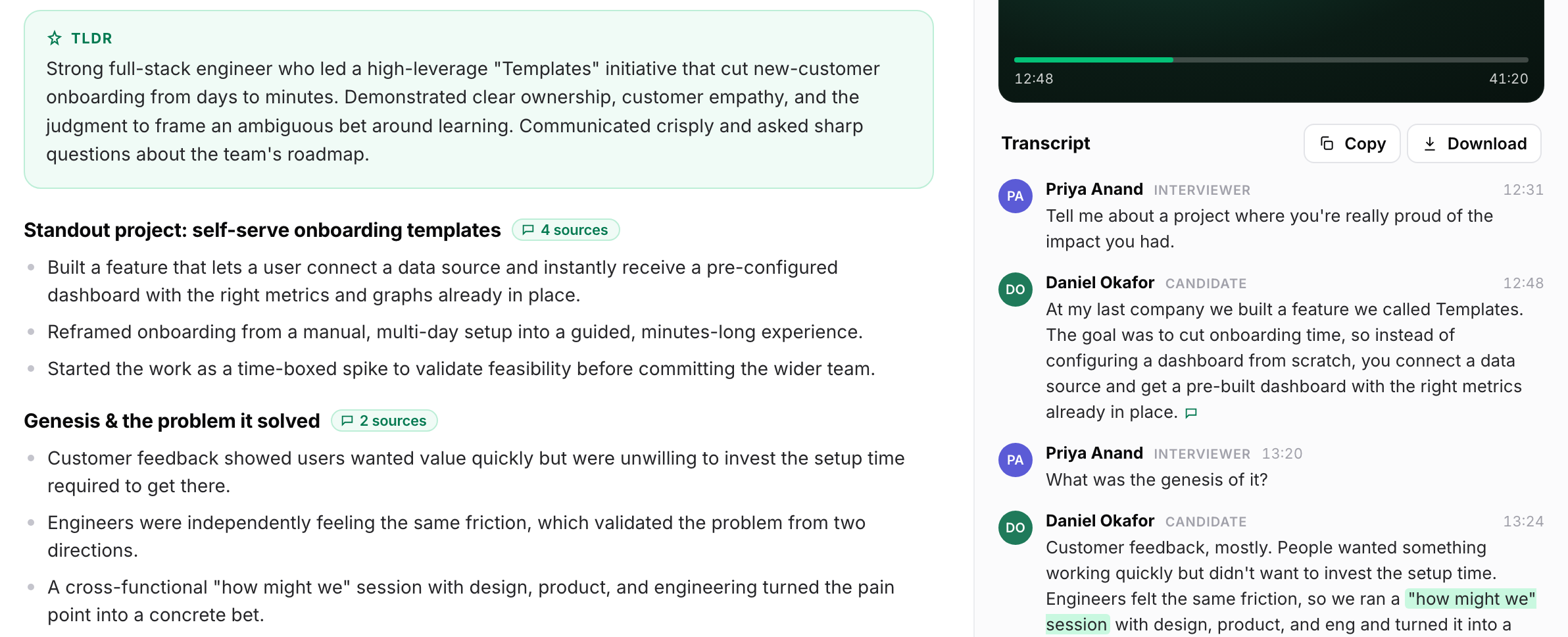
Our Notetaker turns recorded interviews into transcripts and structured notes. Interviewers in both offices then read the same account of what the candidate said. Getting consent to record is your team’s job, and it’s one of the questions for counsel above.
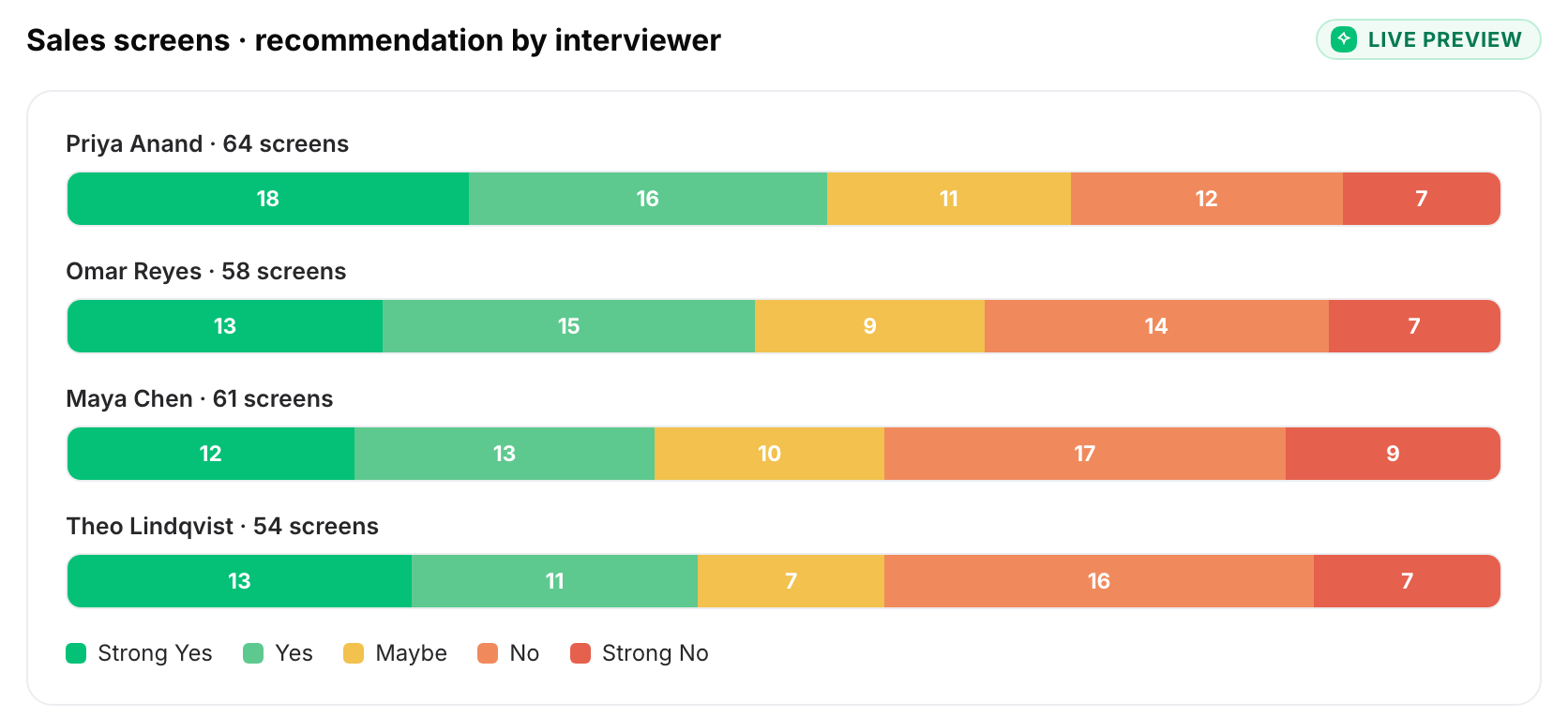
Metaview Reports builds reports from your own interview data, such as a breakdown of each interviewer’s recommendations.
Four checks after the first ten hires.
Once ten people have joined, review how they were hired and fix what each check below turns up:
- Find any search without its three named owners or a written intake summary. Fill the gaps for every open role now.
- Compare core-skill scores from each office’s interviewers. If a “yes” from one office reads like a “maybe” from the other, talk it through at the next debrief.
- Look for any offer that went out before counsel answered your questions about it. If one did, send counsel your questions before you post the next role.
- Check who sat on each loop. If any loop ran without a home-team interviewer, add one to new loops until the core-skill scores from both offices line up.
Hand hiring over to the new office.
Your home team’s part in all this should shrink over time. Once the new office has its own recruiter and managers who have interviewed alongside your home team, it can run searches without help from home.
Before you step back, write down what you learned: which job boards found good candidates and what counsel told you about notice periods and offers. The next country you open can start from those notes.
A new office hires well once it can hold your hiring bar on its own.
That’s the thinking behind our Notetaker and Reports: every recorded interview is kept in one place, so the new office can compare how its interviewers rate candidates with how your home team does.
Find your first hires in a market you’re still learning.
See how Metaview AI Sourcing maps the employers and talent in a new market before you post your first role.
Frequently asked.
Do you need a local entity before hiring in a new country?
Not always. An employer of record may let you make the first hires without your own entity. Local counsel can tell you whether that works in the country you’re entering.
Should the first hire in a new country be a recruiter?
Usually not. I’d hire the country lead first and run recruiting from home, with a named hiring manager for each role. A local recruiter makes sense once there are enough searches to fill their week.
How do you interview in a language your team doesn’t speak?
Let a local interviewer handle fluency and any questions that need the local language. Assess the core skill in a language both offices share. If the job itself is done in the local language, let the local interviewer score the core skill too.
Should you use a local recruiting agency in a new country?
A local agency can speed up the first hires if it knows the market. Before it sends anyone, agree in writing who owns a candidate who reaches you through both the agency and your own job post.
