
The hiring challenges that slow recruiting teams down day to day are these ten: too much manual sourcing, slow resume screening, recruiters buried in admin, inconsistent interview notes, slow interviewer feedback, recruiters and hiring managers out of step, unstructured interviews, hiring decisions that drag, no visibility into funnel data, and tools that don't share data. The table below shows where each one hurts and the first move to make.
The 10 challenges below are the ones we see across 4,000+ organizations running hiring on Metaview every day. Each one is operational, not strategic. Each one has a known fix.
All 10 challenges at a glance.
| # | Challenge | Where it hurts | First-move fix |
|---|---|---|---|
| 1 | Too much manual sourcing | Pipeline build time | AI sourcing agent on one role family |
| 2 | Resume screening takes too long | First-pass review consistency | Application-review AI on high-volume roles |
| 3 | Recruiters buried in admin | Time available for candidate conversations | Automate scheduling and reminders |
| 4 | Inconsistent interview notes | Candidate comparison and signal quality | AI notetaker across all interviews |
| 5 | Slow interviewer feedback | Time-to-hire, candidate experience | Pre-populated structured scorecards |
| 6 | Recruiter-HM misalignment | Wasted sourcing, re-runs | Captured intake call before sourcing |
| 7 | Unstructured interviews | Comparability and fairness | Standardize one stage at a time |
| 8 | Slow hiring decisions | Offer acceptance, candidate loss | Book debrief when you book final round |
| 9 | No pipeline visibility | Invisible bottlenecks | Monthly review of five funnel metrics |
| 10 | Tool sprawl | Data re-entry, fragmented signal | Audit tools quarterly; consolidate |
1. Too much manual sourcing.
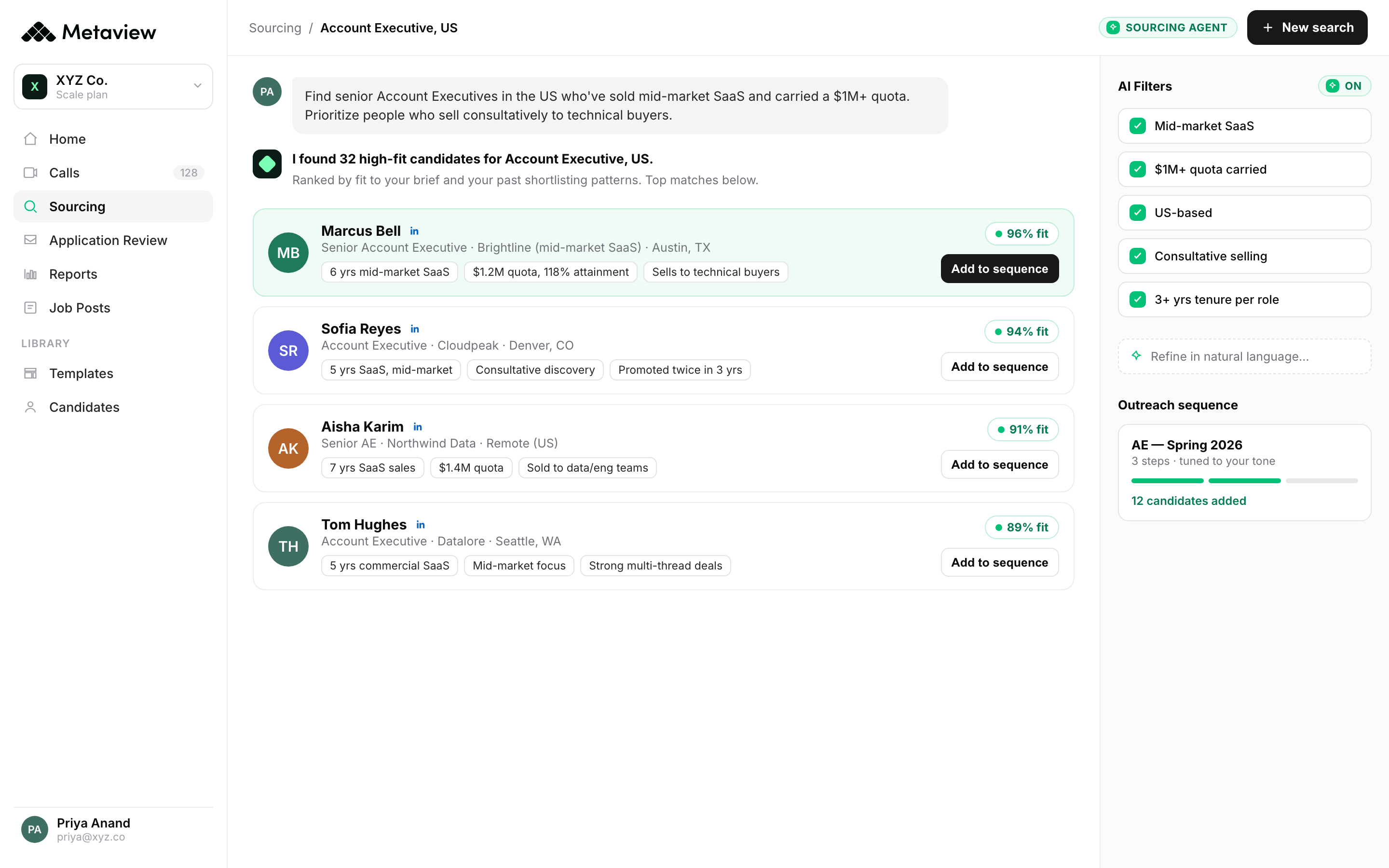
Building a Boolean string and then scrolling profiles one at a time is where recruiter hours go on a new req, and the shortlist at the end is only as good as the search terms. On Metaview, the median gap between the end of the intake call and the first shortlist is 17.6 minutes.
The fix: pilot AI sourcing on one role family before rolling it out, and measure recruiter time-to-shortlist before and after so the pilot has a number to beat.
This is the exact gap Metaview Sourcing closes, turning a role brief into a ranked shortlist in minutes instead of an afternoon of Boolean strings:
2. Resume screening takes too long.
Application volume is uneven. Across 784,361 jobs at 1,612 companies in public ATS data, the median role drew 11 applications while a small share of reqs drew hundreds, so the screening load sits in a minority of high-volume reqs. Those are the reqs where a manual first pass is slowest and least consistent, and where application-review AI pays off first.
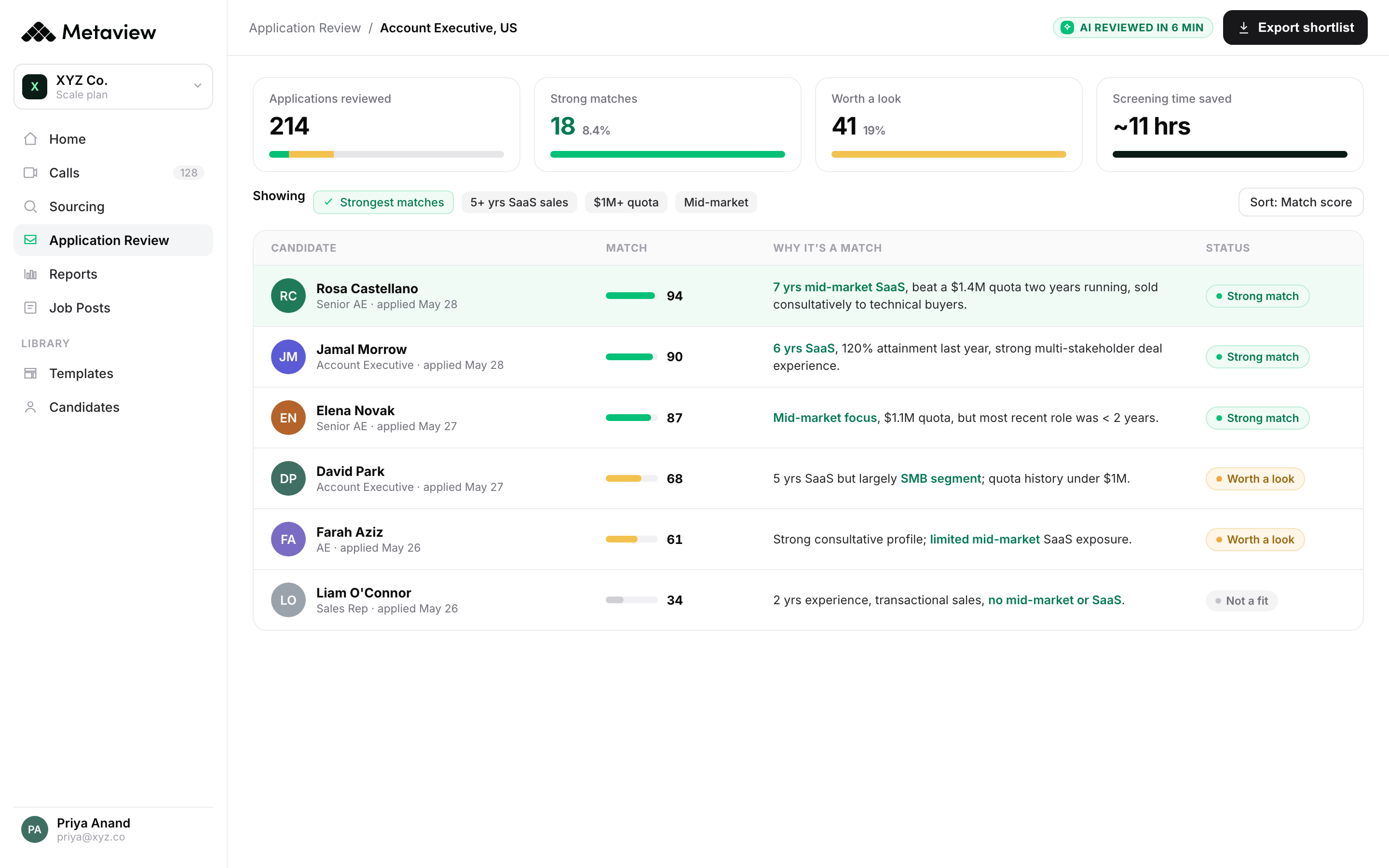
The fix: AI application review that doesn't just keyword-match but explains the reasoning behind each fit score. The reasoning is what makes the tool trustworthy enough to act on.
That reasoning is exactly what Metaview Application Review surfaces, scoring every inbound application and showing why it ranked where it did:
3. Recruiters buried in admin.
Scheduling, reminders, follow-ups, and ATS updates are necessary, and none of it moves an offer forward. The cost stays hidden because it arrives in five-minute pieces between calls, so nobody sees the hours it adds up to until a recruiter's req load slips.
The fix: automate the lowest-judgment tasks first. Scheduling, candidate reminders, and ATS updates are the safest entry points. The hours freed move to candidate conversations.
4. Inconsistent interview notes.
One interviewer types verbatim. Another writes three bullet points after the call. A third relies on memory two days later. The shortlist becomes uncomparable.
The fix: AI notetaking across every interview. Same structure per candidate, same competency map, same level of detail. The interviewer's job becomes the conversation, not the documentation.
Metaview has moved from a nice-to-have efficiency tool, to a truly foundational tool for our recruiting team. We can't imagine scaling the way we have without it.”
5. Feedback from interviewers is slow.
The hidden killer of time-to-hire. Days lost between interview and feedback compound into weeks lost between role open and offer signed. Candidates ghost. Hiring managers forget specifics. The recruiter spends the in-between time chasing instead of selling.
The fix: capture the interview structurally so the scorecard exists the moment the call ends. Hiring managers fill in faster when the rubric is pre-populated.
6. Recruiters and hiring managers misaligned.
The most expensive misalignment in recruiting is the one nobody surfaces until candidate three gets rejected at final round. By then the recruiter has burned two weeks sourcing the wrong shape.
The fix: run a structured intake call before sourcing starts. Capture it. Make must-haves vs. nice-to-haves, role outcomes, and evaluation criteria explicit. Reference the recording when the hiring manager changes their mind.
7. Interviews are unstructured.
One interviewer probes culture, another tests skills, a third improvises. The candidates end up evaluated on different dimensions. The hiring decision becomes coin-flip.
The fix: per-stage competency assignment plus a consistent question set per competency. Interviewer can probe; the core questions are the same across candidates.
8. Hiring decisions take too long.
Even after interviews finish, the decision drags. Conflicting feedback, missing context, async discussions across Slack and email. Strong candidates accept offers elsewhere while the team negotiates.
The fix: book the debrief slot the moment you book the final interview. Don't let it slip past 24 hours. A 20-minute synchronous discussion resolves more than three days of async.
9. No visibility into hiring data.
Most recruiting teams don't actually know where their funnel slows down. They have a guess. The data they need (time-to-feedback, interview-to-offer ratio, channel-quality by source) lives across two ATSs, three spreadsheets, and one recruiter's head.
The fix: instrument five metrics: time to launch, time between stages, time-to-feedback, interview-to-offer ratio, offer acceptance rate. Review monthly. Most teams discover their bottleneck isn't where they thought it was.
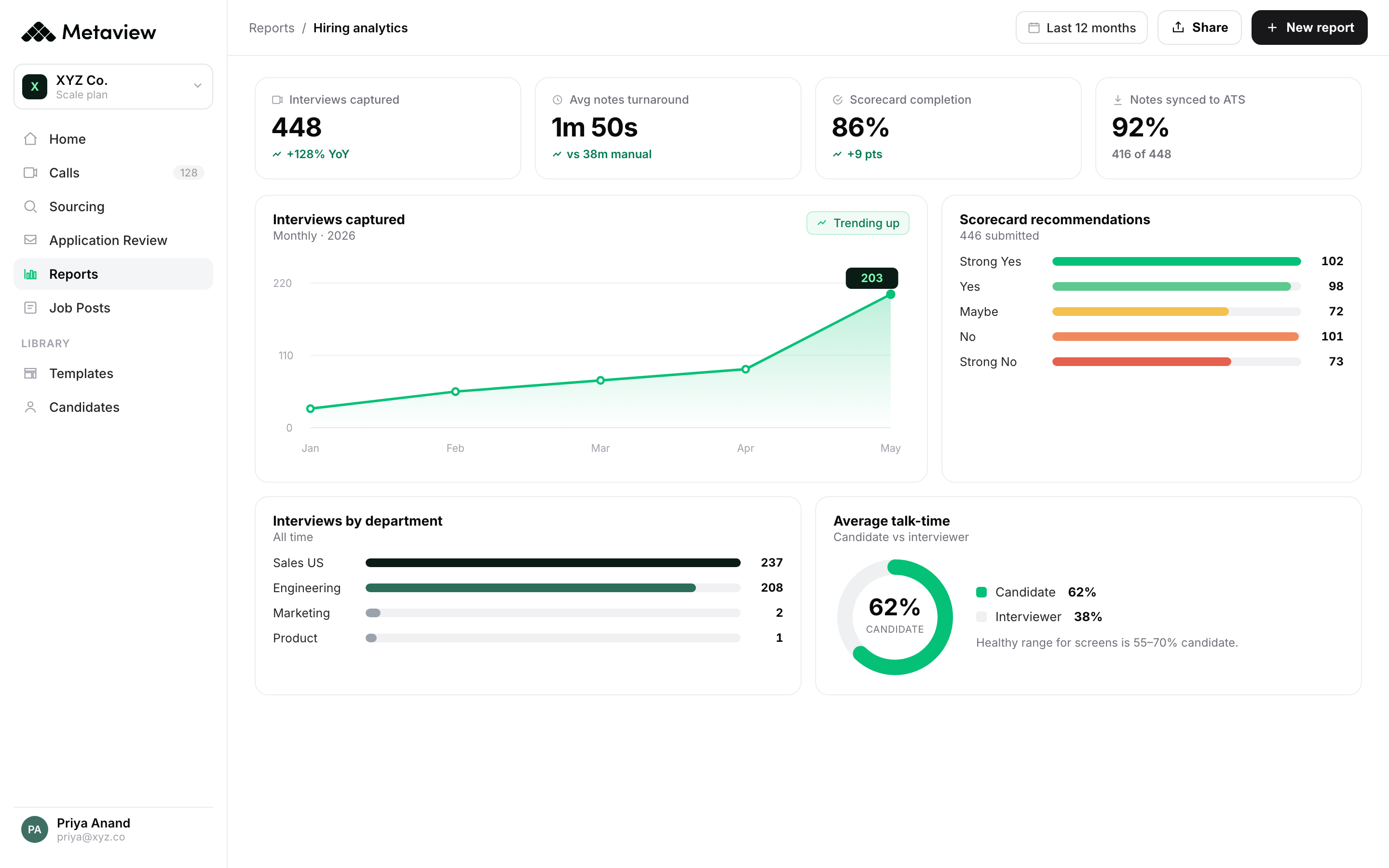
Metaview Reports tracks the interview side of that list, since the interviews are captured: interviews captured, notes turnaround, scorecard completion, and ATS sync in one view, with the same interview data queryable through the Metaview MCP. Funnel timing and offer acceptance still live in your ATS:
10. Recruiting tools don't talk to each other.
Sourcing in tool A, outreach in tool B, scheduling in tool C, capture in tool D, reporting in tool E. The recruiter spends their day in tab fatigue, re-entering the same candidate data, losing the signal that doesn't move between tools.
The fix: audit tools quarterly. The right question isn't "does this tool work?" but "does it write back to the ATS automatically?" Tools that don't are paying for themselves twice: once in the license, once in the re-entry cost.
How Metaview solves these problems.
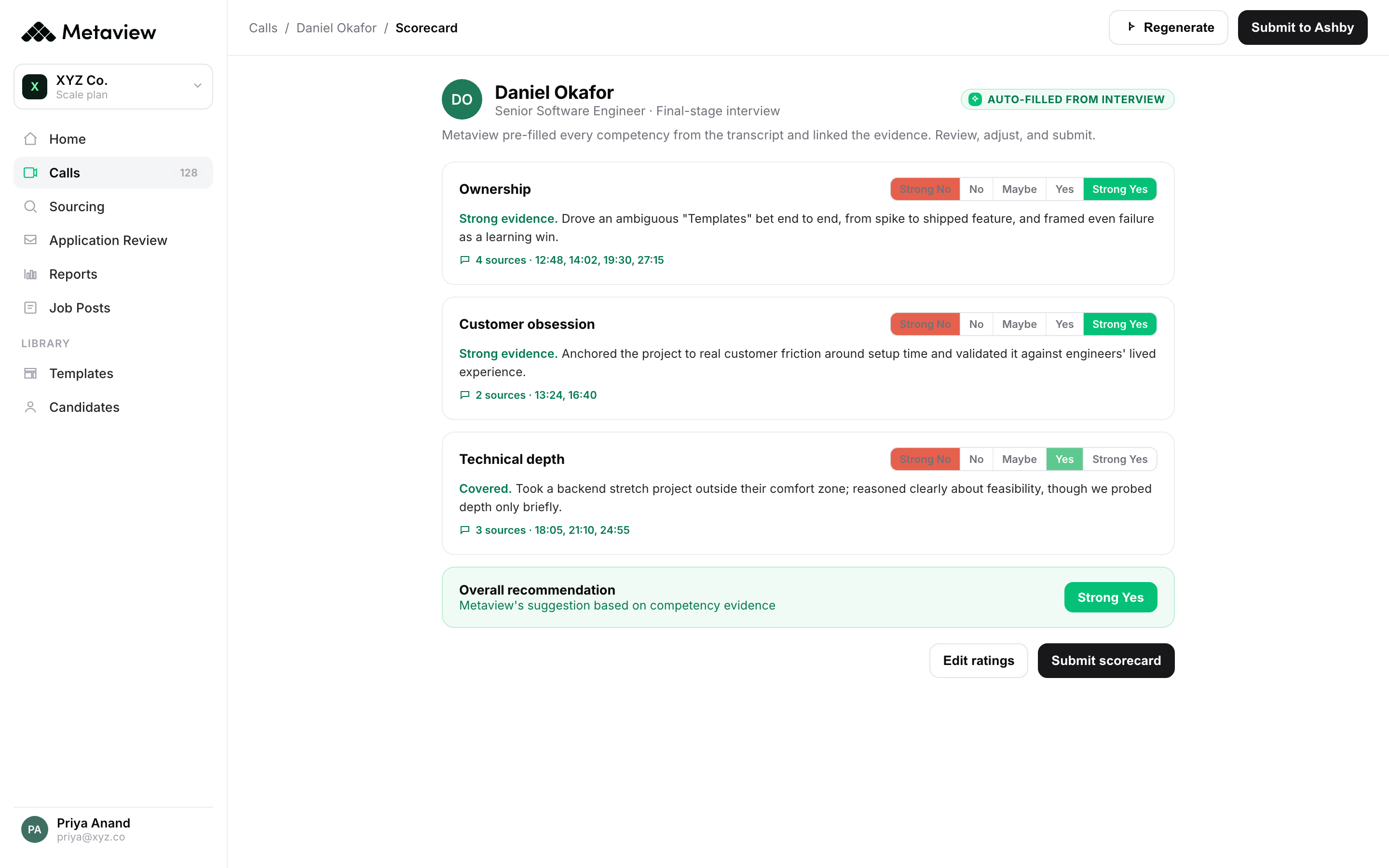
Six of the ten challenges above (4 through 9) share a cause: the interview is the richest source of evidence in the process, and when it isn't captured, notes, feedback, alignment, structure, debriefs, and reporting all run on memory. The other four are sourcing, screening, admin, and integration problems, and they need different tools.
The Metaview Notetaker joins the interview as a visible participant on Zoom, Google Meet, and Microsoft Teams, records and transcribes it, and turns the conversation into structured notes. It also drafts the scorecard from the conversation; you review it and submit it. Direct submission into the ATS works for Ashby and Lever, and the browser extension autofills the objective fields of Ashby and Greenhouse scorecards, so the scorecard exists before memory fades and the ATS still holds the record.
For the front of the funnel, AI Sourcing searches the web, your connected ATS, and your past Metaview conversations from one plain-language prompt, Application Review reads every application against the role's criteria and shows the reasoning behind each call, and Outreach runs personalized sequences with automatic follow-up. The human makes the call on every accept or reject, and Metaview does not make the hiring decision or auto-reject anyone.
4,000+ organizations now run hiring on Metaview, including Brex, emnify, Quora, Workleap, Cleo, Catawiki, Robinhood, and Automattic.
Bring Metaview into your hiring stack.
Live notes, structured scorecards, and ATS sync, set up in under 10 minutes.
Frequently asked.
What's the biggest hiring challenge in 2026?
It depends on where your own funnel stalls, and no ranked study sits behind this list. Slow interviewer feedback is the one to check first: it touches every candidate who reaches an interview, and it's the easiest to measure, as the time from interview end to scorecard submitted.
Are these hiring challenges different for small teams?
The list is the same; the exposure is different. A two-recruiter team has no slack to absorb admin or a late debrief, so each problem shows up in req coverage sooner. The upside is a shorter tool stack, which makes challenges 3 and 10 faster to fix.
How long before a fix shows up in the numbers?
Per-stage numbers such as time-to-feedback move first, because every interview adds a data point. Time-to-hire and offer acceptance move slowly, since each open role produces only one of each, so judge them over a quarter or more rather than week to week.
Does adding AI tools fix recruiting bottlenecks?
Only where the tool replaces a manual step and writes its output where the team already works, usually the ATS. A tool that creates a second place to look adds a re-entry step and makes challenge 10 worse. Before buying anything, list what the recruiter currently enters twice.
What's a reasonable time-to-feedback target?
Across the interviews captured on Metaview, the median scorecard is submitted 2.3 hours after the interview ends, 74.7% of submitted scorecards arrive within 24 hours, and 95.5% within seven days. Set the target at 24 hours and spend the chasing effort on the tail.
