
Your ATS tracks who applied. Your CRM tracks who you wish would apply.
The question most recruiting teams ask is which to invest in first.
The better question is what connects them, because the highest-value data you produce, the interview itself, rarely flows between systems on its own.
Hudl cut interviewer prep time by 40% the year they got candidate context flowing automatically into the ATS. Brex cut Values-Interview variance 38% using the same shift.
Here’s where each system fits, where they overlap, and what to do about the interview signal that gets lost between them.
The two platforms at a glance.
An ATS manages active applications. A CRM nurtures the candidates who haven’t applied yet.
Both are essential at any meaningful hiring scale.
| CRM | ATS | |
|---|---|---|
| Primary purpose | Build and nurture long-term relationships with potential candidates | Manage and track applicants through open requisitions |
| Stage | Before a role opens. Pipeline building. | After a role opens. Active workflow. |
| Candidate type | Passive, prospects, silver medalists | Active applicants in a live req |
| Data managed | Contact details, engagement history, campaign activity | Resumes, interview feedback, hiring status |
| User goal | Keep passive candidates engaged until you need them | Move qualified candidates through screening, interviews, offers |
| Best for | Proactive sourcing and employer-brand-led pipeline work | Workflow automation and hiring compliance on open roles |
Where CRM and ATS overlap.
Both store candidate records. Both feed reporting.
The lines have genuinely blurred at the data layer, and most modern platforms now bundle ATS and CRM features into one product. ATZ CRM, for example, is an ATS plus CRM built for recruitment agencies, with candidates, clients, and jobs managed in one system.
So the integration story usually focuses on syncing fields. Engagement history from the CRM lands in the ATS record. Hiring outcomes from the ATS flow back into the CRM.
That’s the easy part.
The harder part is what neither system actually captures: the interview itself.
The 30-minute conversation that decided whether the candidate moves forward, the specific concern the hiring manager raised, the rubric row that was barely probed.
That signal is the highest-value data your team produces, and it doesn’t move between the two systems by default.
How to choose between ATS vs CRM.
You’re hiring 1-2 roles a month (early-stage team, single function, lean ops). Start with an ATS only.
A CRM adds overhead you don’t have the volume to justify yet.
You’re hiring 10+ per quarter with pipeline pressure (scaling team, multiple functions, talent leader in seat). Add a CRM.
Integrate it with the ATS so candidates move between the two without anyone re-keying notes.
You already run both and your interview notes are still scattered (mid-market or enterprise, multiple recruiters, hiring managers spread across timezones).
Don’t add a third system. Add an intelligence layer that sits on top of both and structures the interview signal automatically.
How Metaview adds to your CRM and ATS.
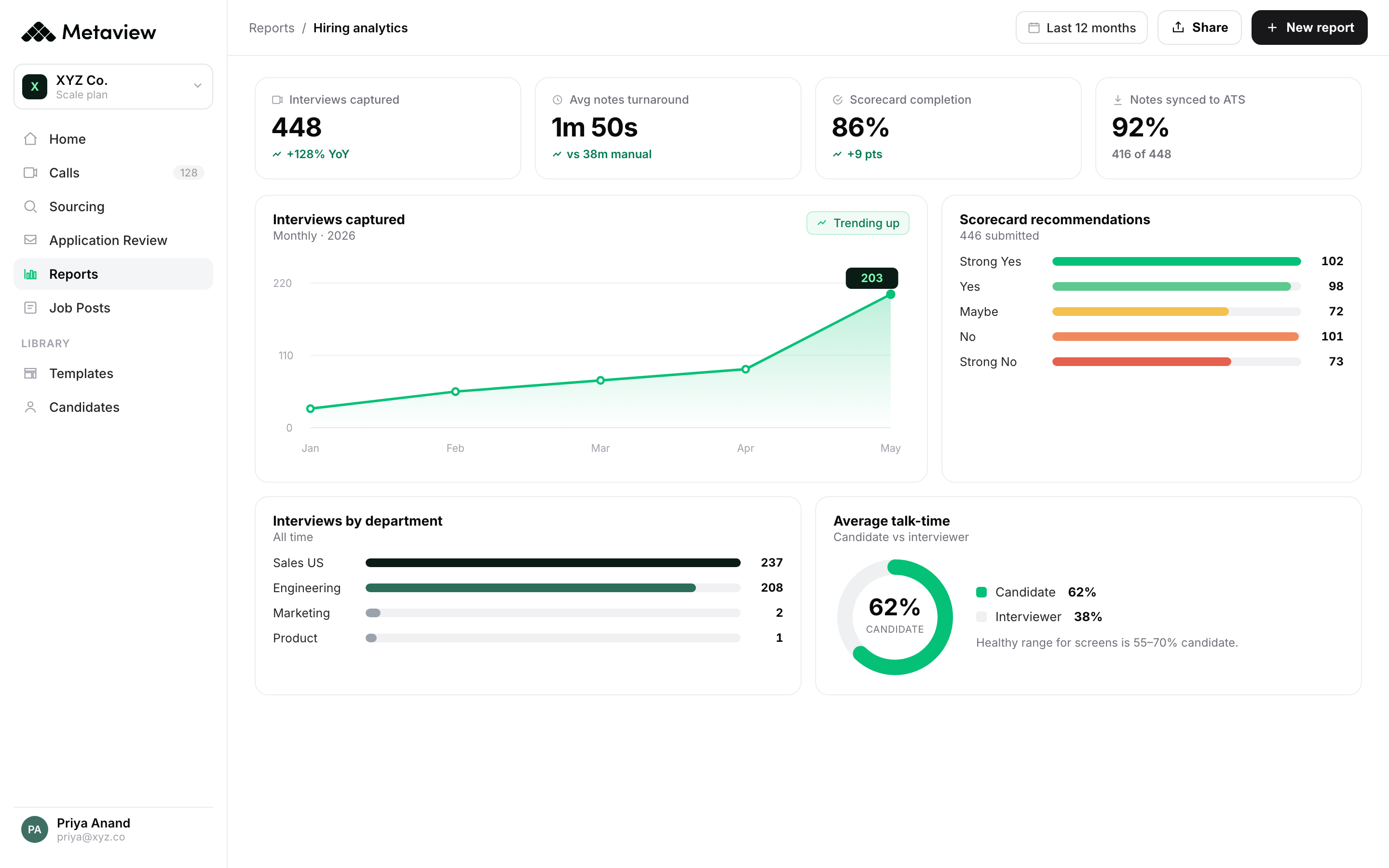
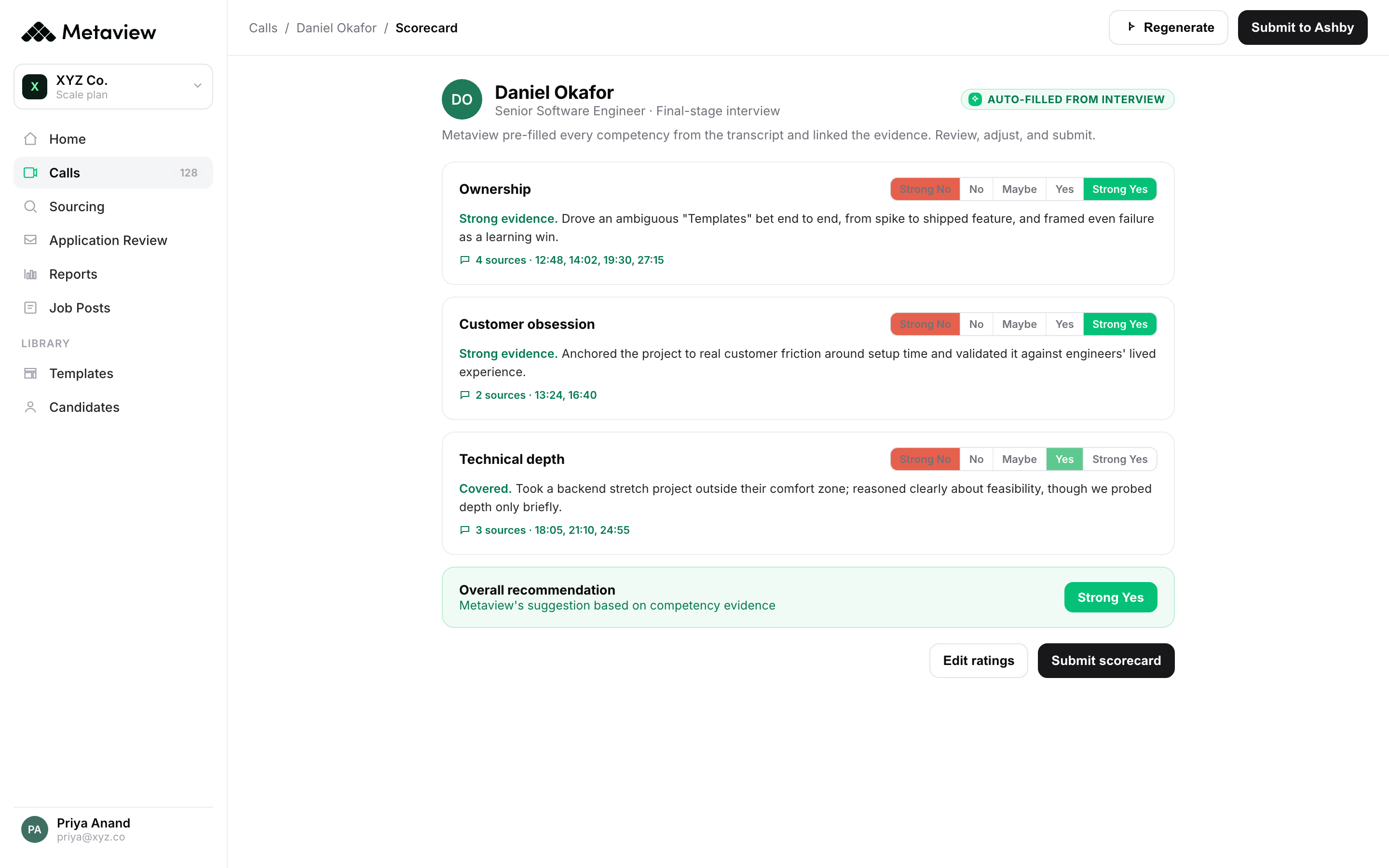
Metaview isn’t a replacement for either system. It’s the intelligence layer above both.
Every interview, screen, and intake call gets captured, structured, and pushed into the right fields on both sides.
The recruiter walks out of the room with the candidate record already updated. The hiring manager walks into the next debrief with the actual transcript, not a memory.
- Notes get re-keyed from screen calls into the ATS, often wrong
- Hiring manager context never makes it back to the CRM
- CRM nurture goes out generic, with no reference to the actual conversation
- Debriefs depend on what the recruiter remembered, not what was said
- Interview captured once, structured automatically, synced both ways
- CRM record carries the hiring manager’s actual signal forward
- Nurture campaigns reference the candidate’s own words, not a template
- Every debrief lands on artifacts, not on memory
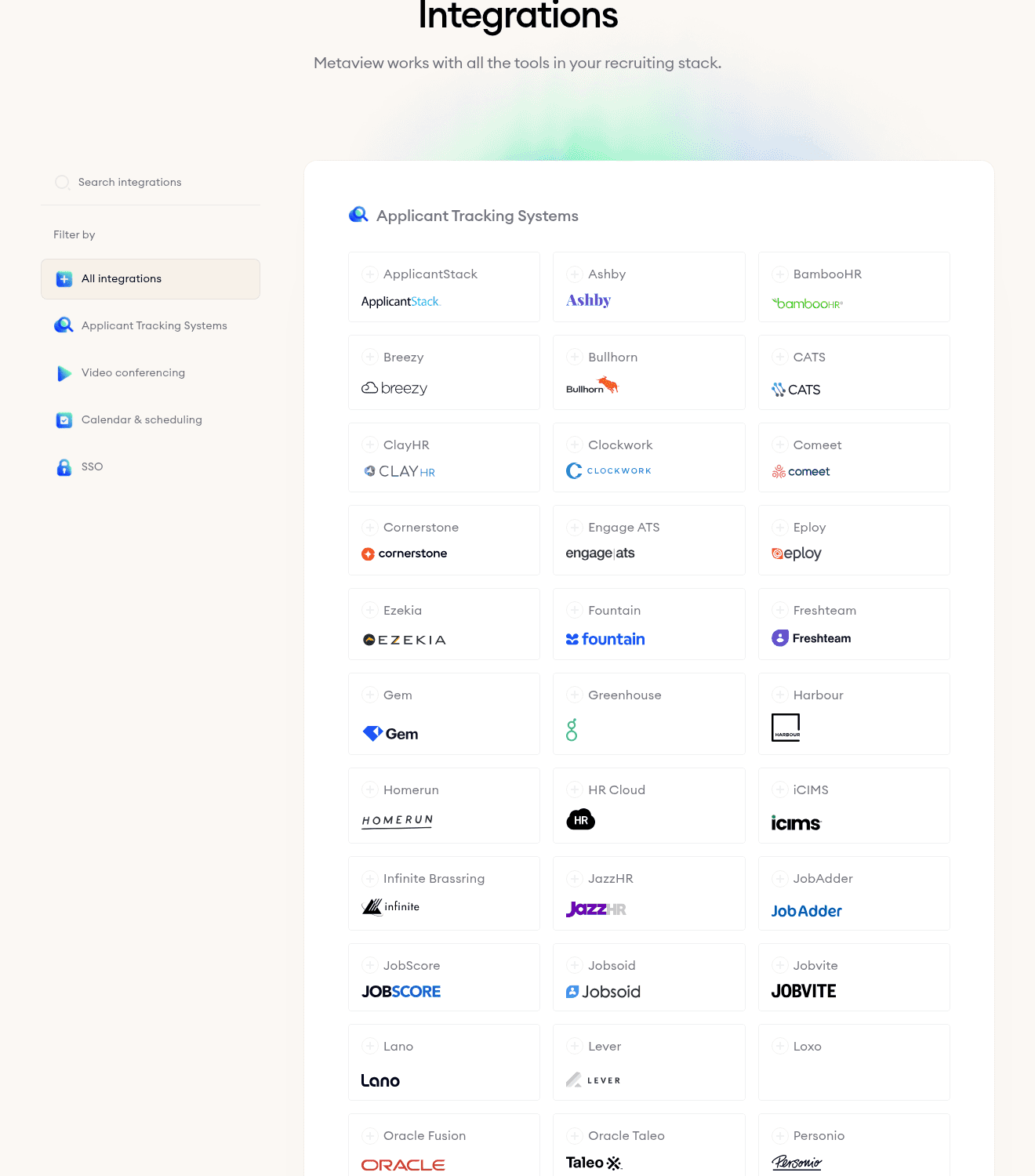
Keep your ATS, keep your CRM, integrate them.
Then layer Metaview on top so the interview itself, the highest-value data your team produces, actually moves between the two.
For the full integration list, see Metaview integrations.
For the broader read on AI-first recruiting stacks, our Lever alternatives guide walks through where the intelligence layer slots in.
Every time the AI presents a candidate, the recruiter says fit or not. That feedback flows into the ideal-candidate profile. Over time, it becomes a company-wide read on what good looks like.”

Bring Metaview into your hiring stack.
Live notes, structured scorecards, and ATS sync - set up in under 10 minutes.
Frequently asked.
Do I need both an ATS and a CRM?
If you’re hiring more than a handful of roles a quarter, yes. The ATS handles the logistics of live hiring; the CRM keeps the pipeline warm between requisitions. Without both, you’re always starting cold when a role opens.
What’s the difference between a CRM and an ATS, in one sentence?
The ATS tracks applications for open roles. The CRM nurtures relationships with people who haven’t applied yet but probably will.
Can a small recruiting team get away with just one?
For 1-2 hires a month, an ATS alone is usually enough. The CRM earns its keep once your pipeline starts feeling cold every time a new role opens, or when hiring volume crosses 10+ per quarter.
How does the ATS and CRM integration actually work?
Most modern ATSs (Greenhouse, Ashby, Lever, Workday) sync engagement and sourcing data from the CRM, and feed interview and hiring outcomes back. The integration prevents data silos but doesn’t solve the deeper problem: the interview signal itself isn’t structured by default.
Where does Metaview fit in?
Metaview is the intelligence layer above the stack. It captures every interview, structures the signal, and pushes the right context into both your ATS and CRM. The candidate record stays current; the nurture campaigns get sharper; the debriefs land on artifacts.
