
Greenhouse is the applicant tracking system behind hiring at more than 7,500 companies. It holds the record: the job, the candidate, the interview plan, the scorecard. But the work happens elsewhere: in Slack, in a scheduling tool, in a notetaker, at a background-check vendor, in payroll. An integration moves the record to where the work happens and brings the result back.
The 10 integrations below each close one of those gaps: interview notes and scorecards, notifications, scheduling, background checks, payroll, onboarding training, offer letters, reporting, custom automation, and documentation. For each one you get what it does, where it falls short, and which kind of team it fits. If your team runs on another ATS, the same roundup exists for Ashby integrations, Lever integrations, and Workday integrations.
All 10 integrations at a glance.
| Integration | Workflow gap it closes | Best for |
|---|---|---|
| Metaview | AI interview notes + structured candidate reports | Any team running live or phone interviews |
| Slack | Pipeline notifications + hiring-team approvals | Distributed teams running async approvals |
| Calendly | Candidate self-scheduling for early stages | Solo recruiters and small teams |
| Checkr | Background checks triggered from Greenhouse | Frontline, healthcare, and hourly hiring |
| Gusto | New-hire payroll + onboarding handoff | SMBs that use Gusto as the HRIS |
| Kallidus | Onboarding training + compliance content | UK and EMEA teams running regulated industries |
| DocuSign | Offer letters + e-signatures | Any team where the offer is the bottleneck |
| Airtable | Custom reporting + pipeline views | Recruiters who want flexibility beyond Greenhouse dashboards |
| Zapier | Custom workflows across 9,000+ apps | Ops-savvy recruiters with no engineering support |
| Notion | Hiring playbooks + interview kit documentation | Teams already running their internal docs in Notion |
1. Metaview.
Best for: any Greenhouse team running live or phone interviews.
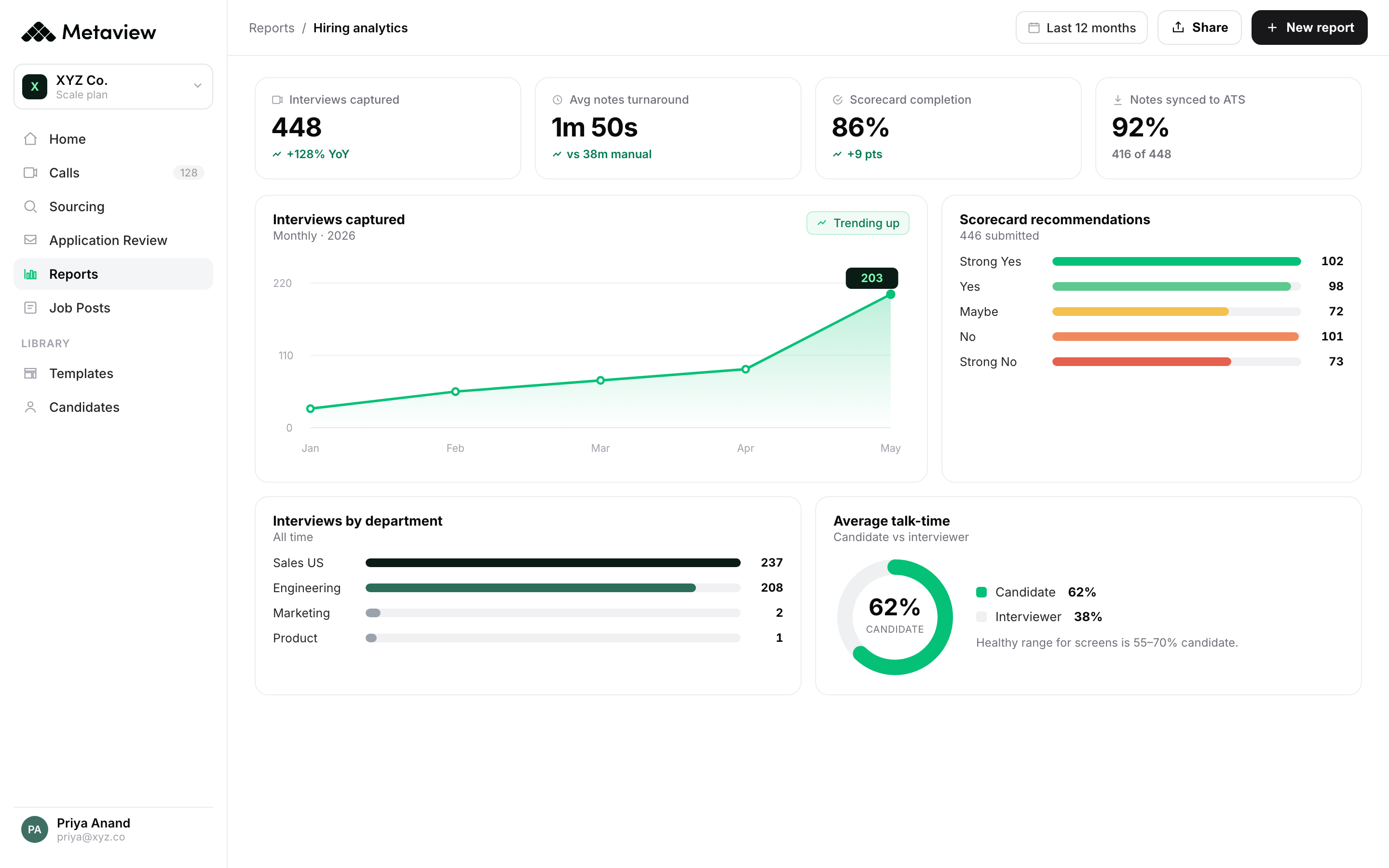
Metaview is an agentic recruiting platform that works alongside Greenhouse. This entry is mostly about the Notetaker, because scorecards so often never get written: across the interviews captured on Metaview, only 31% received a scorecard at all.
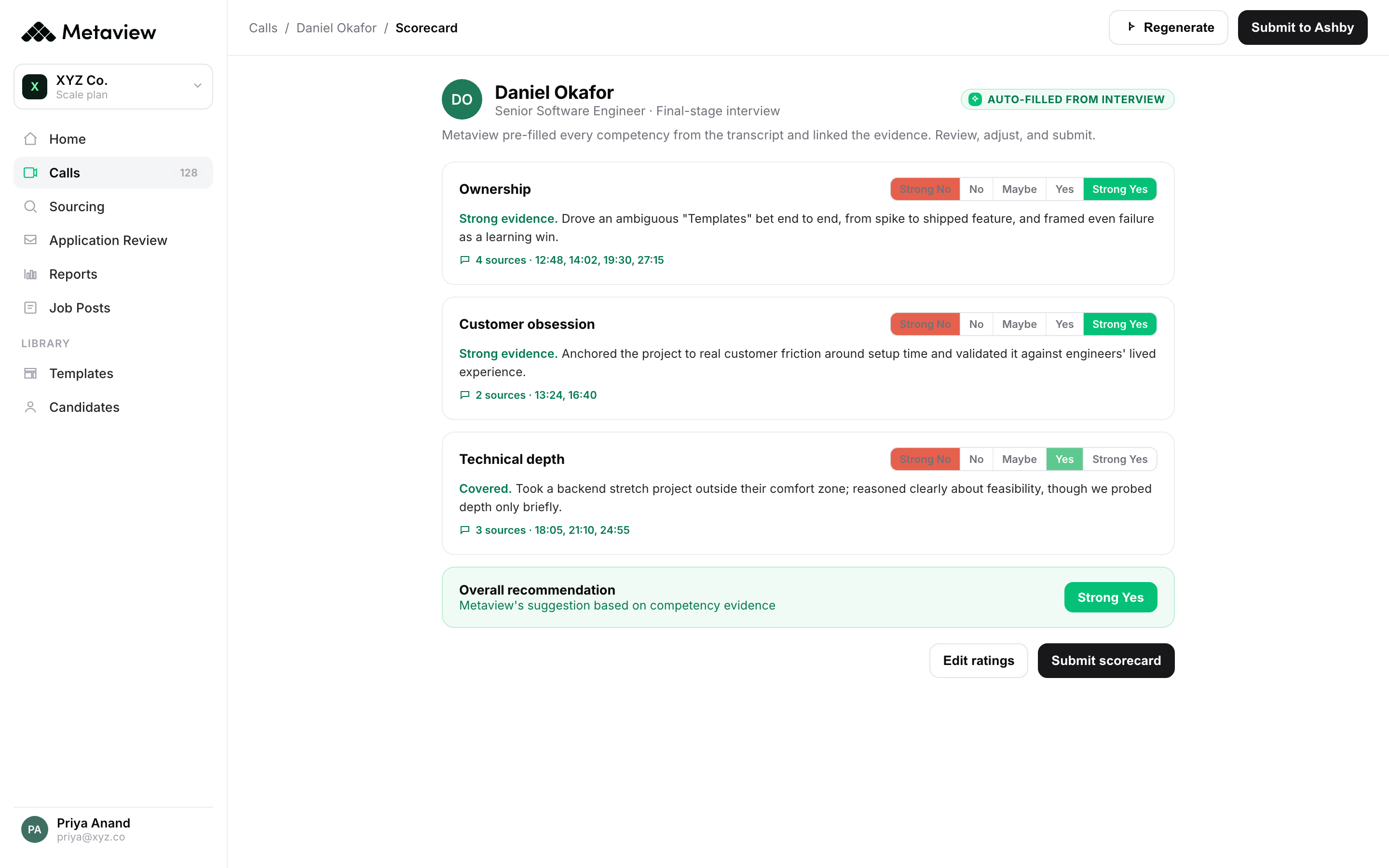
Metaview joins the interview as a visible participant, records and transcribes it, and drafts the notes and scorecard content from what was said. The notes and a short summary appear on the Greenhouse candidate record, and the browser extension autofills the objective sections of the Greenhouse scorecard. The interviewer fills the subjective fields and the recommendation, then submits.
The same connection feeds Application Review, which reads every Greenhouse applicant against the role's criteria, and AI Sourcing, which searches the web and the candidates already in Greenhouse from one plain-language brief. Metaview never auto-rejects: every accept or reject decision is yours, and it is sent back to the Greenhouse candidate record. Setup is three steps: open “Integrations”, authorize as a Greenhouse Site Admin, and review the permissions.
What you get on day one:
- Recording and transcription across Zoom, Google Meet, Microsoft Teams, and Webex, with the Notetaker joining as a visible participant.
- Notes and a short summary on the Greenhouse candidate record, with scorecard content drafted for the interviewer to review.
- A browser extension that autofills the objective sections of the Greenhouse scorecard.
- Accept and reject decisions from Application Review sent back to the Greenhouse candidate record.
- New sourced profiles sent back to Greenhouse with their source attached.
- SOC 2 Type II, GDPR, and CCPA controls.
- A free tier, with paid plans priced per agent (see pricing).
We took our intake form for the account executive role and then used Metaview to parse out what these hiring managers should look for: coachability, grit, sales process, top of funnel, and more. Now every manager uses the same structured process. No one's guessing what 'good' looks like anymore.”

Our pick: any Greenhouse team where the interview is the hiring decision, not just a meeting recap.
2. Slack.
Best for: distributed teams running async approvals.
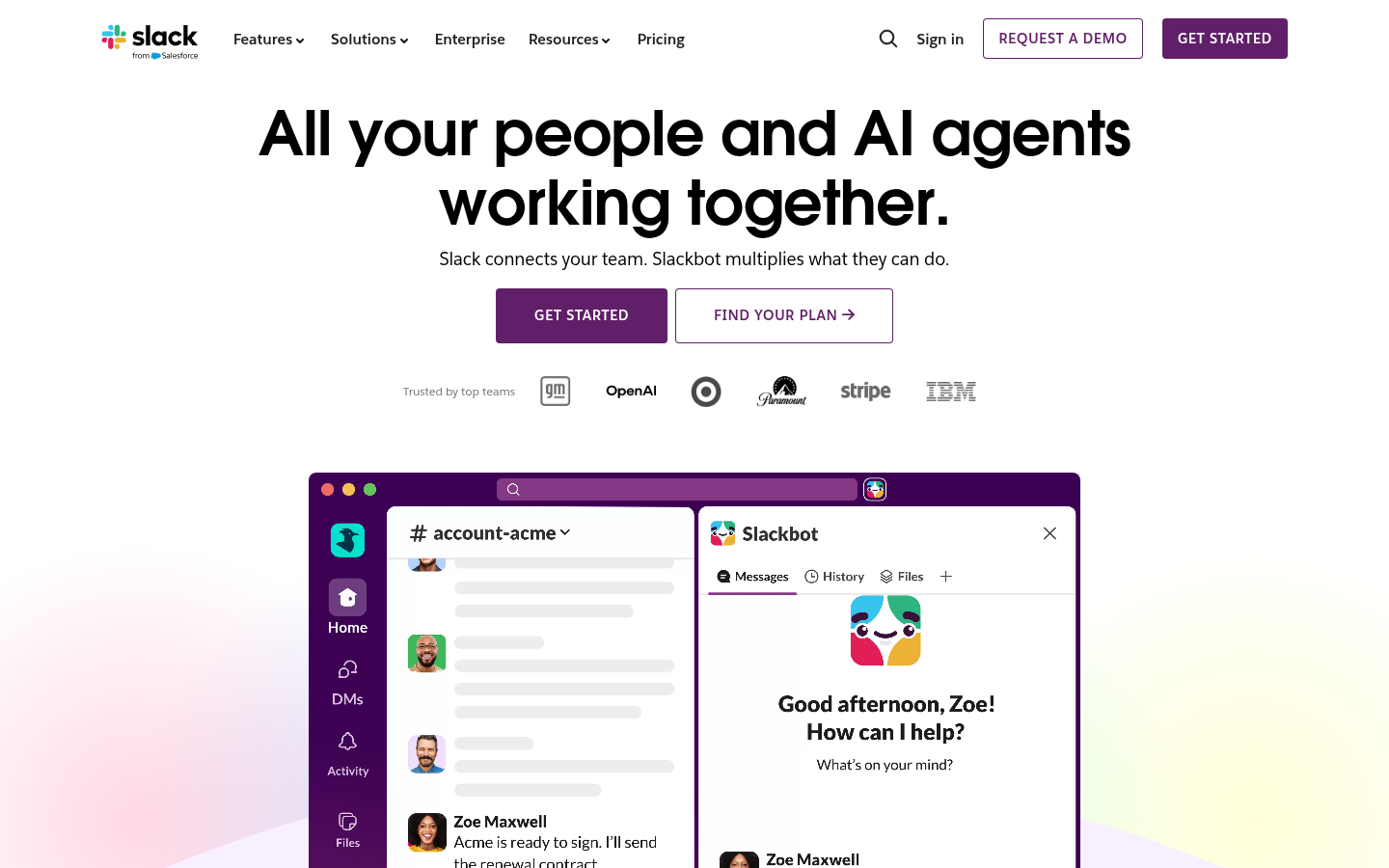
The Slack integration turns Greenhouse pipeline events into Slack notifications. New applications hit a channel. Interview feedback requests ping the hiring manager. Approvals get a button to click.
What you get:
- Channel notifications for new applications, stage moves, and offers.
- Direct-message reminders for scorecard submission.
- Approval workflows that don't require opening Greenhouse.
- Custom channel routing per role or department.
Where it falls short: Heavy on notification noise if it's not configured carefully. Set up channels per req or use threaded updates to avoid overwhelming the team.
Our pick: any recruiting team where hiring managers spend their day in Slack and rarely open the ATS.
3. Calendly.
Best for: solo recruiters and small teams running single-stage screens.
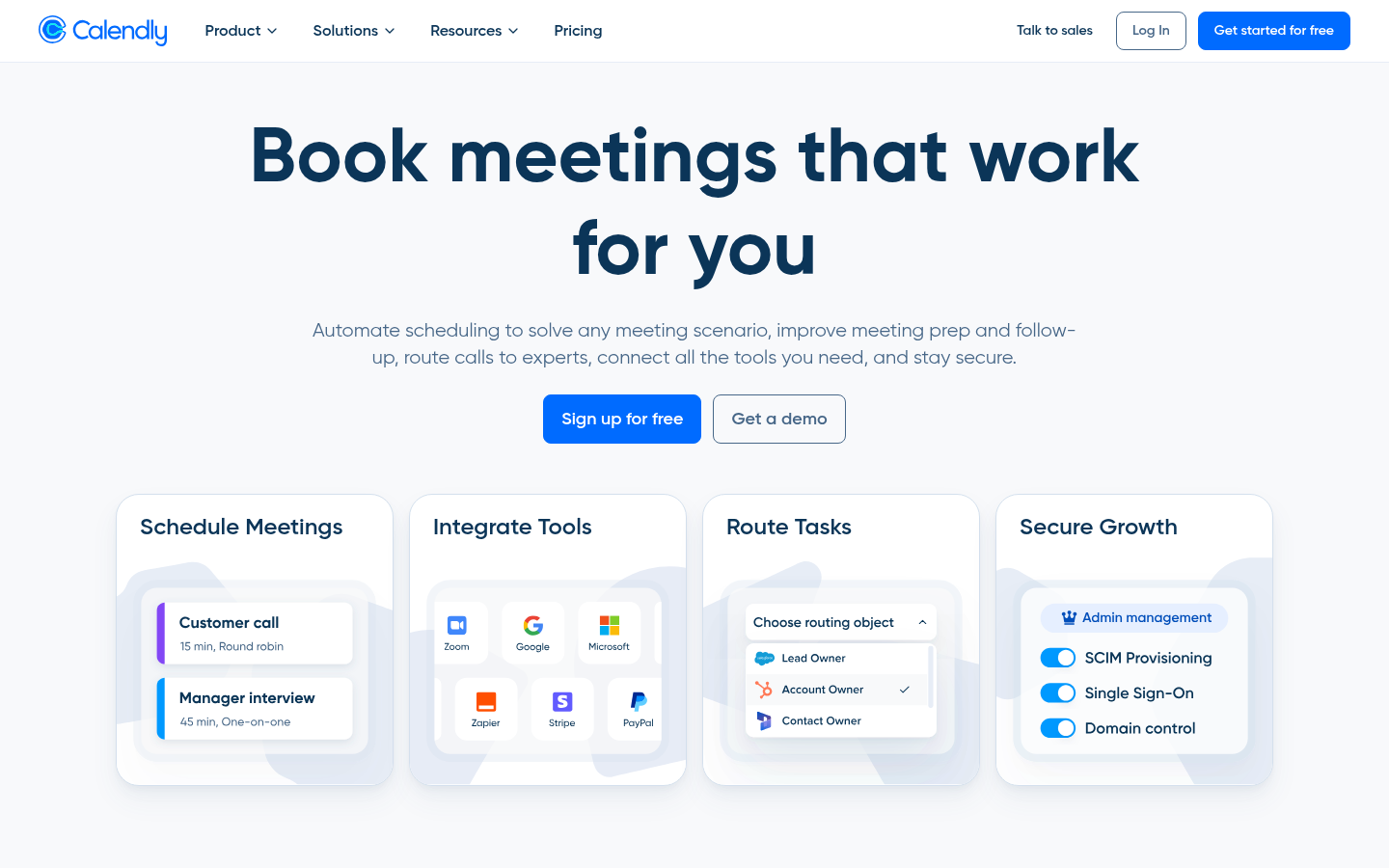
Calendly's Greenhouse integration auto-schedules candidate interviews based on the stage they're in. Send a candidate to "Recruiter Screen" in Greenhouse, and they get a Calendly link to book a 30-minute call.
What you get:
- Auto-scheduling on candidate stage moves.
- Two-way calendar sync with Google, Outlook, and iCloud.
- Round-robin scheduling for team-based screens (paid plan).
- Automatic time-zone handling for global candidates.
Where it falls short: Multi-stage panel interviews need round-robin and load balancing that Calendly's free tier doesn't offer. See our automated interview scheduling tools roundup for the panel-scheduling category.
Our pick: solo recruiters and lean teams running single-stage self-scheduled candidate calls.
4. Checkr.
Best for: frontline, healthcare, and hourly hiring.
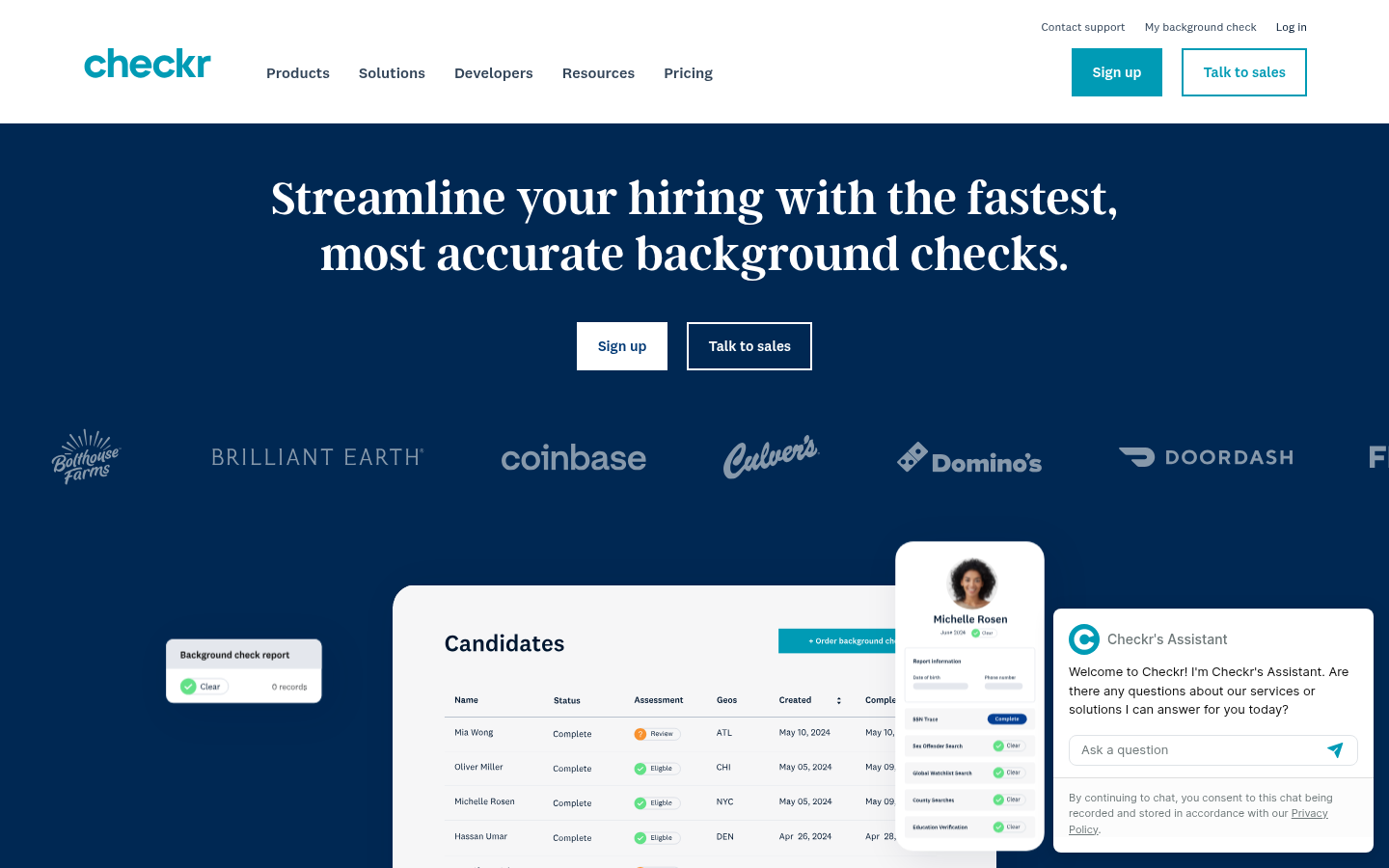
The Checkr integration triggers a background check the moment a candidate hits the "Offer" stage in Greenhouse. Results land back in the candidate profile, and the recruiter doesn't have to leave the ATS.
What you get:
- Background check triggered automatically on Greenhouse stage move.
- Results returned to the Greenhouse candidate profile.
- Adverse-action workflow for compliance-heavy roles.
- AI-powered review for faster turnaround.
Where it falls short: Pricing scales with volume. Worth verifying check coverage in your target geographies before rollout, especially outside the US.
Our pick: volume-heavy hiring teams in regulated industries where the background check is a gating step.
5. Gusto.
Best for: SMBs that use Gusto as their HRIS.
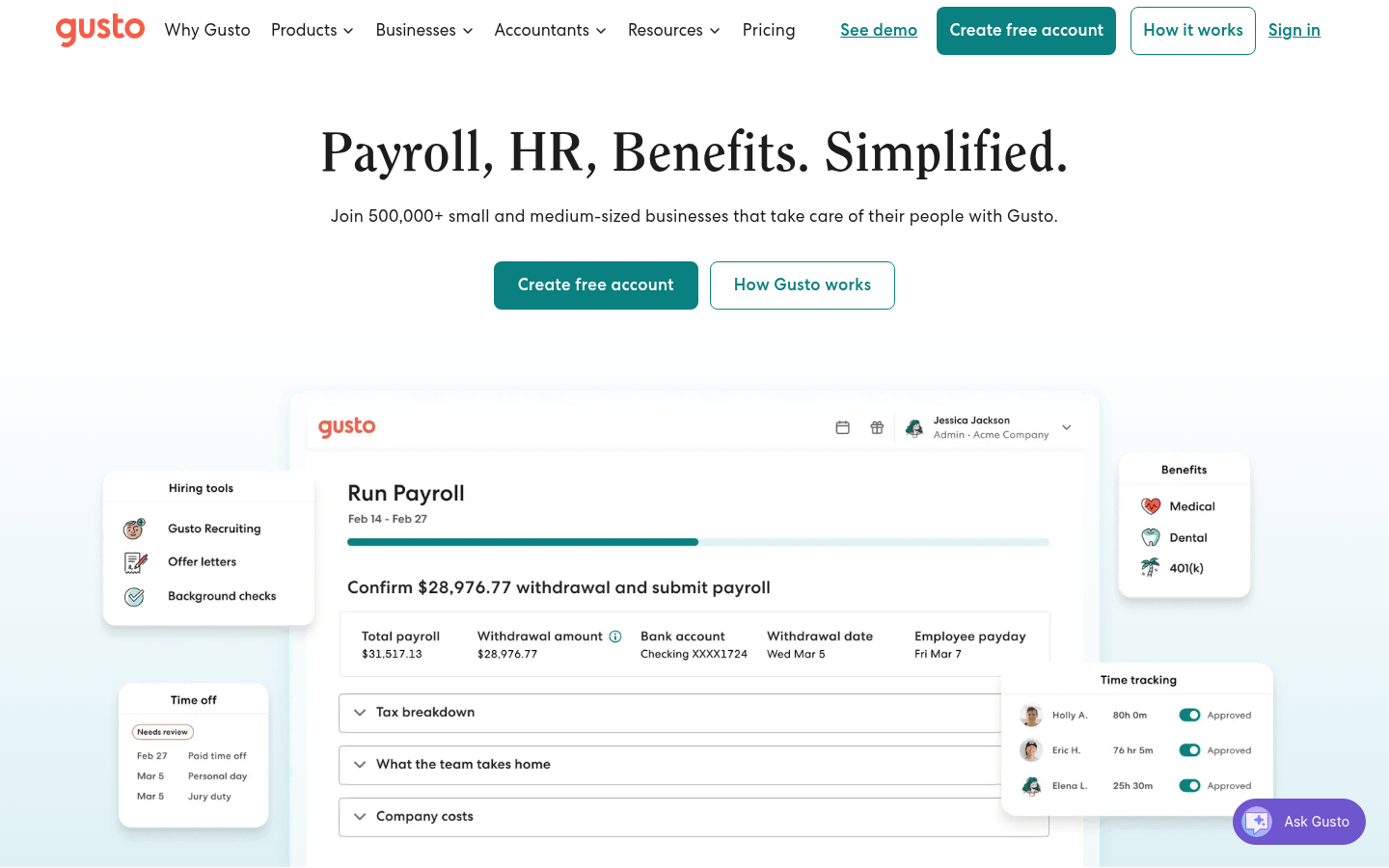
The Gusto integration pushes new-hire data from Greenhouse straight into Gusto the moment an offer is accepted. Payroll, benefits, and onboarding paperwork are pre-populated.
What you get:
- Automatic new-hire data transfer from Greenhouse to Gusto.
- Pre-filled onboarding paperwork.
- Payroll and benefits enrollment workflow.
- HR document handling and e-signature trigger.
Where it falls short: Gusto serves the US SMB market well; international payroll teams typically need a different HRIS. Field mapping needs care for non-standard hiring entities.
Our pick: US-based SMBs that already run on Gusto for payroll.
6. Kallidus.
Best for: UK and EMEA teams running regulated industries.
Kallidus is the learning-management piece of the onboarding journey. New hires from Greenhouse get auto-enrolled in onboarding training, compliance content, and role-specific learning paths.
What you get:
- Automated enrollment in onboarding courses on hire.
- Compliance training pathways for regulated roles.
- Performance and learning analytics tied to the new hire.
- 2M+ users worldwide, strongest in UK and EMEA markets.
Where it falls short: US adoption is lighter than in the UK. If most of your new hires are in North America, check whether your HRIS already covers onboarding training before adding a second system.
Our pick: UK and EMEA recruiting teams in regulated industries (healthcare, finance, public sector).
7. DocuSign.
Best for: any team where offer signature is the bottleneck.
The DocuSign integration sends the offer letter from Greenhouse to DocuSign for signature, then writes the signed agreement back to the candidate profile. End-to-end offer flow without leaving the ATS.
What you get:
- Offer letter templates with merge fields from Greenhouse.
- Automatic e-signature request on offer stage move.
- Signed agreement stored back in the candidate profile.
- Audit trail for compliance and legal review.
Where it falls short: Setup requires legal-template review and testing across hiring entities. Worth investing the upfront time; the offer-stage time savings compound.
Our pick: mid-market and enterprise teams where offer-letter delays add days to time-to-fill.
8. Airtable.
Best for: recruiters who want reporting flexibility beyond Greenhouse dashboards.
Airtable's Greenhouse sync pulls candidate, job, and pipeline data into Airtable bases. From there, recruiters build custom dashboards, kanban views, and reporting that Greenhouse's native dashboards don't easily support.
What you get:
- Two-way data sync between Greenhouse and Airtable.
- Custom views: kanban, calendar, gallery, gantt.
- Automations that trigger on Greenhouse stage changes.
- Shareable read-only dashboards for hiring managers.
Where it falls short: The sync requires careful field mapping. Without discipline, Airtable becomes a parallel system of record that drifts out of sync.
Our pick: ops-savvy recruiting teams that need reporting flexibility their ATS doesn't natively provide.
9. Zapier.
Best for: ops-savvy recruiters with no engineering support.
Zapier is the catch-all integration layer when a native one doesn't exist. If you can describe the workflow ("when a candidate hits offer stage, post to this Slack channel and create a Notion page"), Zapier can probably build it without engineering involvement.
What you get:
- Drag-and-drop automation builder.
- 9,000+ app integrations, including most niche recruiting tools.
- Multi-step workflows with conditional logic.
- Pre-built Greenhouse Zaps for common workflows.
Where it falls short: Zaps break silently when API contracts change. Native integrations are more reliable for mission-critical workflows. Use Zapier for nice-to-haves, not the offer-letter flow.
Our pick: small to mid-market recruiting teams that need automation across niche tools without engineering bandwidth.
10. Notion.
Best for: teams already running their internal docs in Notion.
Notion is where most modern teams keep their hiring playbooks, interview kits, and rubrics. The Greenhouse-Notion integration links candidate profiles to the relevant Notion page so hiring managers don't have to dig for the rubric mid-interview.
What you get:
- Link Greenhouse candidate profiles to Notion pages.
- Sync interview kit content from Notion to Greenhouse.
- Custom databases for role-specific competency frameworks.
- Free tier for small teams.
Where it falls short: Notion doesn't replace structured interview tools. The pages it hosts are reference content, not evaluable signal.
Our pick: recruiting teams whose internal hiring documentation already lives in Notion.
How to choose the right integrations.
Start with the stage where candidates wait or where someone retypes data. Candidates waiting for a slot means scheduling. Offers stalling on a signature or a check means DocuSign or Checkr. The interview gap is harder to see: a late or missing scorecard reads as a busy interviewer, and the record in Greenhouse ends up thinner than the conversation was.
Without structured interview data writing back into Greenhouse, the ATS becomes a record-keeping tool rather than a hiring system.
The other integrations fit specific gaps. Slack closes the hiring-manager notification gap.
Calendly handles single-stage scheduling. Checkr automates background checks. Gusto bridges to payroll for US SMBs.
DocuSign closes the offer-letter loop. Kallidus handles onboarding training. Airtable adds reporting flexibility.
Zapier and Notion fill the long tail of custom workflows and documentation. For broader context on the surrounding stack, see our best applicant tracking software and ATS integrations roundups.
Bring Metaview into your hiring stack.
Live notes, structured scorecards, and ATS sync - set up in under 10 minutes.
Frequently asked.
Is Greenhouse an ATS?
Yes. Greenhouse is an applicant tracking system: it holds the job, the candidate record, the interview plan, and the scorecards, and the rest of the recruiting stack reads from it and writes back to it. The tools above connect to it through the Partner Marketplace or the Harvest API.
What is the Greenhouse Partner Marketplace?
The catalog of pre-built integrations with third-party tools, covering sourcing, scheduling, assessments, background checks, payroll, and other adjacent recruiting workflows. Greenhouse lists 250+ partners there. Anything the Marketplace does not cover can be built against the Harvest API.
Can Greenhouse integrate with HR systems?
Yes. Gusto, Workday, BambooHR, Rippling, ADP, and SAP SuccessFactors all have Greenhouse integrations. The usual flow pushes new-hire data from Greenhouse to the HRIS when an offer is accepted, so payroll and onboarding start from the record the recruiter already built.
What types of tools typically integrate with Greenhouse?
Interview notes and scorecards (Metaview), scheduling (Calendly, GoodTime), sourcing (LinkedIn Recruiter, HireEZ, Metaview), background checks (Checkr), e-signature (DocuSign), HRIS (Gusto, Workday), notifications (Slack), and workflow automation (Zapier).
Do Greenhouse integrations require engineering resources?
Not for Marketplace integrations, which a Greenhouse admin can connect without a developer. Custom integrations built on the Harvest API need developer time to build, and someone to maintain them when the API changes.
Does Metaview replace Greenhouse?
No. Metaview is a separate working surface that works alongside Greenhouse. Candidates sync from Greenhouse into Metaview, and notes, summaries, your accept or reject decisions, and sourced profiles go back to the Greenhouse candidate record. Greenhouse stays the system of record.
