
Metaview's 2026 AI and Hiring Alignment Report closes on a recommendation it calls coordinated AI. The idea is one central source of truth for the whole team, so the gain shows up in how people work together instead of how fast each person works alone.
That recommendation is sound. It's also the authors reading their own findings, because the survey underneath it never asked anyone how many AI tools they run, or whether those tools share anything with each other.
One piece of coordination does leave a trace. Somebody writes an interview up in a form the next person can open, or nobody does. You can count that. It's a far more useful thing to argue about than architecture.
What the 2026 survey measured.
The report surveyed 505 people, split almost evenly between 252 recruiting leaders and 253 hiring managers, all at companies with 200 or more employees across North America and EMEA. It ran with Cint as a 19-question study, analyzed by cross-tabulation and correlation.
Four of its findings do most of the talking.
85% of the companies that exceeded their hiring goals use AI in hiring. The base there is companies already beating their goals, and AI use is what got counted inside that group.
Teams where AI is core to hiring were 3.8x more likely to call the recruiter and hiring manager relationship excellent than teams that use no AI. That number is the 55% and 14% ends of one question turned into a ratio.
Alignment at the start of a search moves with it. 68% of searches begin with both sides agreed on requirements where AI is core to hiring, against 49% of searches at teams that use no AI. The unit there is searches, so those percentages say nothing about how many teams are aligned.
The last of the four stacks two conditions on top of each other. 79% of teams with an excellent relationship and high alignment exceeded their business goals last year, against 36% of teams whose relationship is fair or poor and whose alignment is low. Both halves of each condition are doing work here, and the outcome measured is business goals, which is a wider thing than hiring goals.
Underneath all of it, 58% of the same group say they sometimes wish they could work around their counterpart. The survey didn't ask why.
This data shows that hiring managers and recruiters don't fully trust each other's judgment. This creates friction that tools alone cannot solve. The orgs that recognize this and help individuals collaborate more effectively will see dramatically better outcomes.

That's an interpretation, and a plausible one. The survey recorded the wish and never asked what sits behind it, so the trust reading belongs to Wickman, and the data stops at the wish.
The variable the survey never had.
Read those four numbers quickly and they say AI use and team alignment travel together. They do. What they can't say is which way the arrow points, or which part of AI use is doing the work.
A team where AI is core to hiring decided on AI centrally, paid for it, and rolled it out to both sides of the process. Teams that can pull that off can usually pull off other things, like running a real intake meeting and agreeing on a scorecard before the first screen. The survey measured the tools and the relationship in the same questionnaire on the same day, so it can't pull one apart from the other.
It also has no column for the thing the closing section recommends. There's no item asking how many AI tools a team runs. Nothing asks whether a notetaker passes anything to a sourcing tool, or whether two recruiters on the same requisition see the same notes.
The report closes with a do and do not list, shared systems on one side and individual copilots on the other. That's the authors saying what they think follows from what they found. Practitioners quoted in the report land in the same place.
The real competitive advantage is effective AI adoption vs. everyone else. The teams doing this well are building alignment at every stage. AI earns its keep when it both strips out the mechanical work and surfaces the signal that helps recruiters actually close. Alignment isn't just a kickoff, it's infrastructure.

Gill's describing what he's watched work, which is a different kind of evidence and worth having. It's practitioner experience, and the survey is a separate exhibit. Nothing in the 505 responses tests whether a team running five connected tools does better than a team running five disconnected ones.
You can still describe how the two setups differ without measuring anything. It comes down to where the information ends up.
- An interviewer's notes stay in the app that produced them
- The next interviewer starts again from the resume
- Nothing written down explains why a candidate advanced
- The transcript and the notes sit on the candidate record
- The next interviewer can read what was already covered
- The reason a candidate advanced is written where the team can read it
Which of those two you end up with is a choice about software. Whether that choice shows up in results is a separate question, and this survey didn't answer it.
Where the handoff leaves a trace.
Coordination has one part that shows up in a database. The evidence goes into a scorecard the next person can open when the interview ends, or it doesn't.
31.2% of around 5.2 million candidate interviews carry at least one scorecard, which is the industry's normal state. The gap bites hardest at the point where it counts for most. 41.9% of the 296,555 candidates who moved to a further round advanced with no submitted scorecard behind them. Another 11.8% advanced off a loop where several people interviewed and only one of them wrote anything up.
Those rates aren't fixed, though. Scorecards that interviewers start from an empty form get submitted 28.6% of the time. Scorecards where Metaview generates the first draft get submitted 50.3% of the time, on a capped sample of 120,000 scorecards, 26,498 started by hand and 93,502 generated. The generated ones came back fuller too, at 7.85 fields filled on average against 2.61, on a separate capped sample of 80,000. Nobody randomized which scorecards got a draft, so read both figures as a comparison between two groups, with none of the strength of a controlled test.
The convenient reading is that those missing scorecards are why recruiters and hiring managers end up disagreeing about candidates. The panel data says otherwise. People who do score the same candidate land on the same verdict 85.0% of the time across 72,753 panels, and split 15.0% of the time. The quieter failure is the common one: people agree, nobody writes it down, and the next interviewer either takes it on trust or asks the same questions over again.
In Metaview, that written record is the captured interview. The Notetaker joins the call as a visible participant, with consent, and records the conversation. Metaview turns the recording into structured notes, and every note section links back to the moment in the transcript it came from.
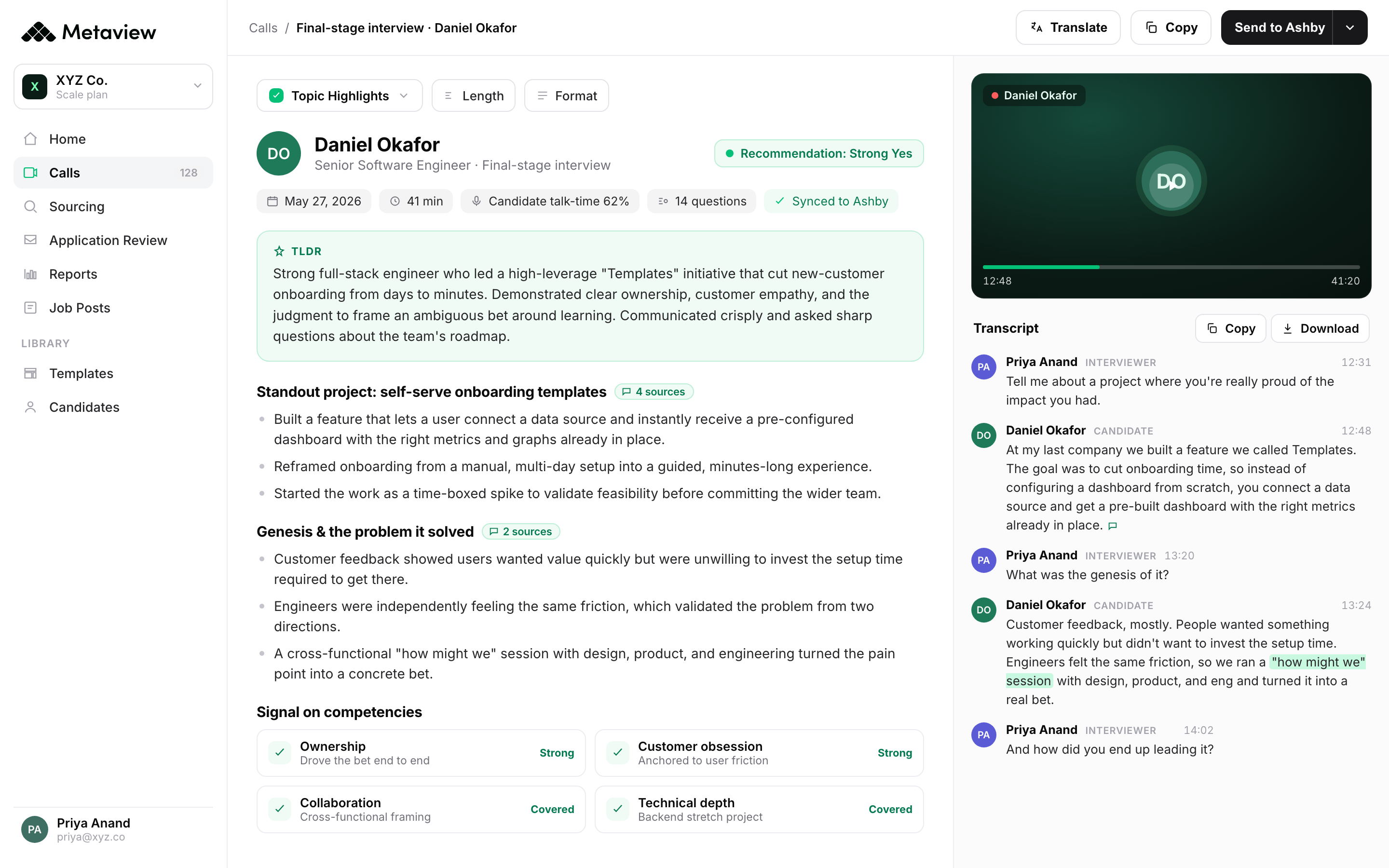
Metaview drafts the scorecard from that conversation, and the interviewer reviews, rates and submits it. Metaview Reports can query the same interview data across a whole team.
Where that record stops matters as much as where it starts. Candidates are synced from your ATS into Metaview, and Metaview is a separate system. The interview work happens there, in its own interface.
Application Review reads inbound applications against the criteria the team approved, and it supports eight ATS integrations: Ashby, Gem, Greenhouse, Lever, Pinpoint, SmartRecruiters, Teamtailor and Workable. On Ashby, Greenhouse, Lever and SmartRecruiters, accept and reject decisions made in Metaview are pushed back to the ATS. Gem does not currently support syncing rejections back, and Pinpoint, Teamtailor and Workable sync candidates in with no documented decision writeback.
Scorecards submit directly from Metaview into Ashby and Lever. With Greenhouse, you paste from the Metaview scorecard into the Greenhouse interface.
So the shared record you get here is the interview evidence. The candidate record itself stays in the ATS, and for several systems on that list the connection runs one way. Any vendor promising one system that holds everything is promising more than these integrations deliver.
What to check before the next tool.
None of this settles which stack architecture wins. It narrows the question to something you can answer on your own data this quarter, without waiting for a study that doesn't exist.
- Open the last ten candidates who advanced. For how many of them can you read why, without going and asking the person who made the call?
- Count the places where somebody moves the same information between two systems by hand. Every one of them is a handoff that fails quietly in a busy week.
- Work out what share of your advancing candidates have a submitted scorecard behind them. Metaview Reports can measure that across your own interviews.
- Ask of the next tool whether it makes one person faster or puts something where a second person will find it. Both are worth buying, and only the second changes what your counterpart sees.
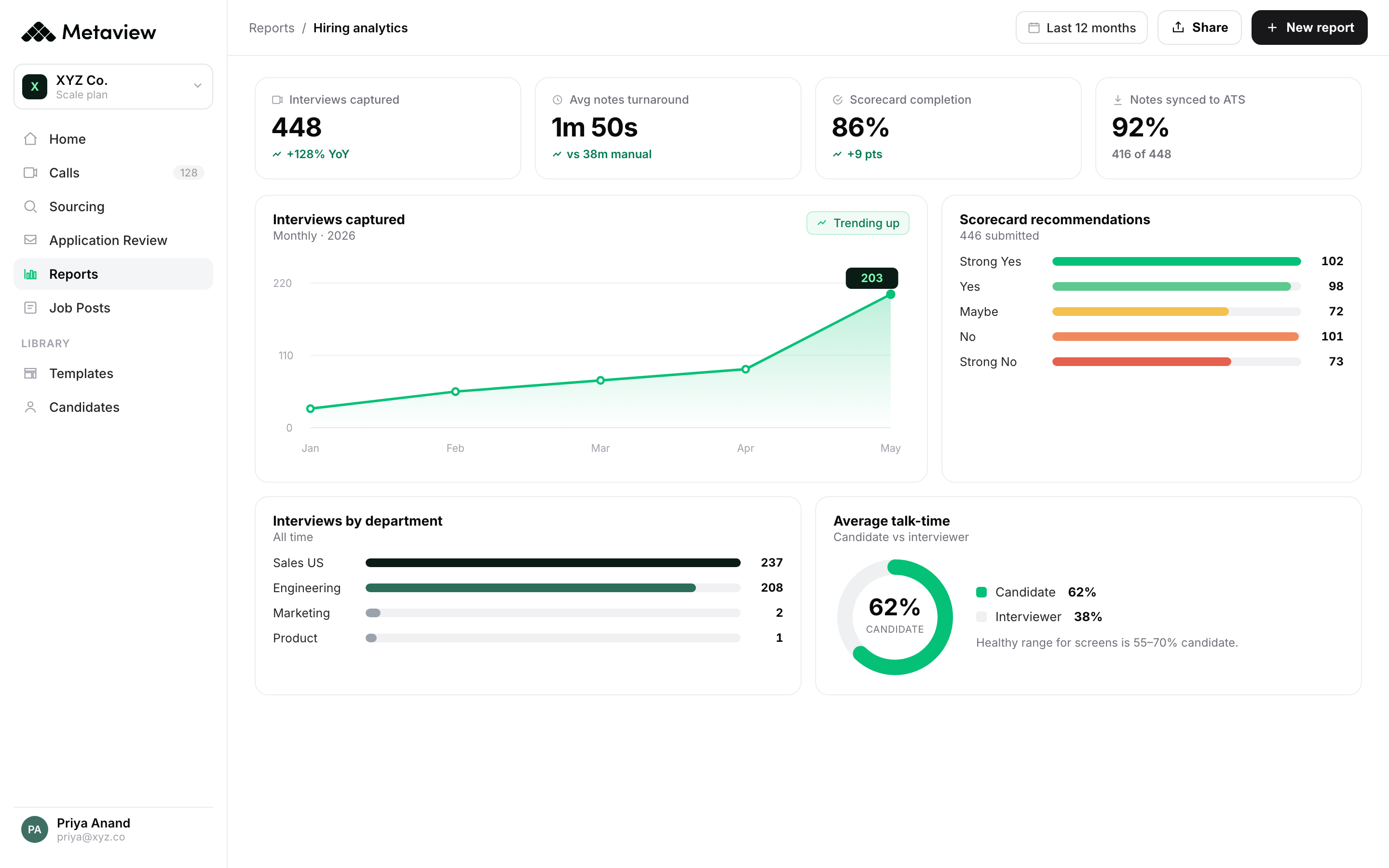
The recommendation and the numbers arrive in the same place from different directions. The recommendation says put AI on one source of truth. The numbers say the written record that would make one source of truth worth having is missing from most interviews. They also say the submitted share runs about 1.76 times as high when a draft is already waiting as the call ends.
Getting that record written is a smaller job than replacing a stack, and unlike the architecture argument, it's one you can check by the end of the quarter.
Measure the part of your stack that leaves a record.
See how Metaview captures the interview, drafts the scorecard, and reports on what your team submitted.
Frequently asked.
What is a coordinated AI recruiting stack?
It's a set of AI tools chosen so that what one of them produces can be read by the next person in the process. The term comes from the closing section of Metaview's 2026 AI and Hiring Alignment Report, where it describes an operating principle rather than a category the survey measured.
Did the 2026 survey compare coordinated stacks with scattered ones?
No. The questionnaire covered how central AI is to hiring, how counterparts rate their working relationship, how often searches start aligned, and whether teams met their goals. It carried no question about tool count, integration, or whether tools share data.
Does running more AI tools make a hiring team more aligned?
The survey can't answer that. It recorded associations at a single point in time and had no way to separate the tools from the operating habits of the teams that bought them. Any claim that one produced the other goes further than the study was built to go.
Does Metaview replace the ATS?
No. Candidates are synced from your ATS into Metaview, and the candidate record stays in the ATS. What Metaview holds is the interview evidence: the recording, the notes, and the scorecard drafted from the conversation.
What can Metaview's data show about how a hire worked out?
Nothing after the hire. The corpus covers what happened inside the recruiting process, which is conversations captured, scorecards created and submitted, and decisions recorded. It contains no retention, tenure, or job performance data, so no claim about life after the start date can come from it.
