
Ninety percent of recruiting leaders and hiring managers say their working relationship is good or excellent. Fifty-eight percent admit, on the same survey, that they sometimes wish they could work around their counterpart. That gap, between what the relationship looks like in a status meeting and what it feels like inside an actual search, is most of what makes a hiring manager hard to work with, or easy.
If you're a recruiter, the hiring manager is the single person whose engagement most affects whether a search ships on time, with the right candidate, and a debrief everyone can defend. Yet most articles about hiring managers either define the role at arm's length or hand them a generic best-practices checklist. Neither helps the recruiter sitting across from one on Monday morning.
This guide does the opposite. It defines what a hiring manager actually owns (and what they don't), shows where the recruiter-HM partnership reliably breaks down using fresh data from 505 hiring leaders, and lays out the concrete moves recruiters can use to make a hiring manager easier to work with, whether they've hired ten people or this is their first req.
What hiring managers actually own.
A hiring manager is the person who will manage the new hire after they start. They own the requisition, the decision, and the outcome. Everything else, sourcing strategy, scheduling, screening, comp benchmarking, candidate experience, belongs to recruiting.
Most hiring managers are not hiring full-time. They are team leads, engineering managers, sales directors, heads of design, who are running their team and trying to grow it in parallel. The role sits on top of their actual job. That single fact explains most of the friction recruiters experience: hiring rarely shows up at the top of an HM's calendar, and the hiring system has to make it easy for them to show up well anyway.
A clean way to think about ownership: recruiters are responsible for how the search runs. Hiring managers are responsible for whether the person they hire works out and contributes to quality of hire over time. When that split is clear, the partnership tends to function. When it isn't, recruiters end up doing decision work they don't have the context for, and hiring managers end up doing process work they don't have time for.
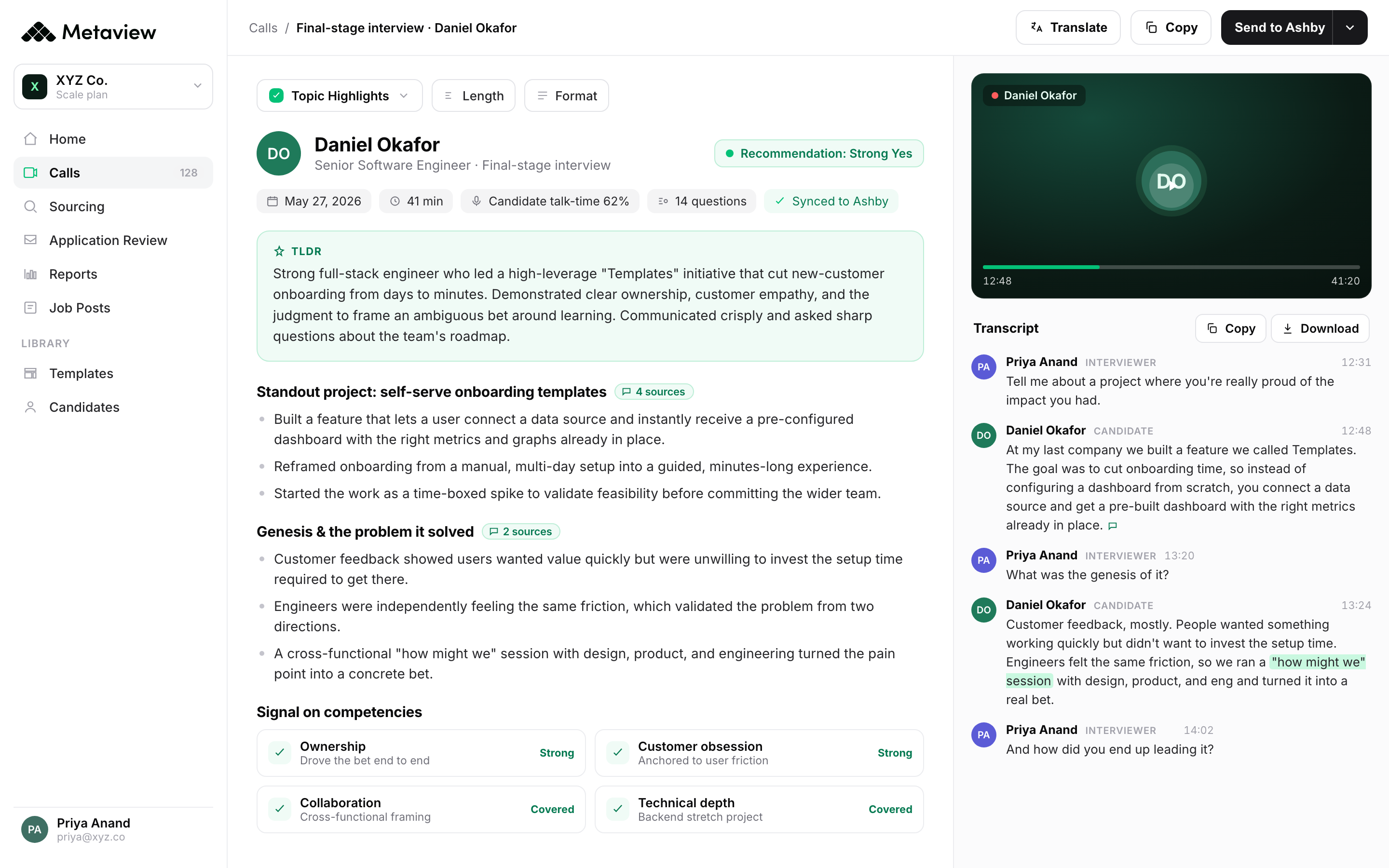
All four figures are from Metaview's 2026 AI & Hiring Alignment Report, surveying 505 recruiting leaders and hiring managers across North America and EMEA. They sit underneath every section in this guide, because the experience of being a recruiter working with a hiring manager (or a hiring manager working with a recruiter) is now measurable, not vibes-based.
Why the recruiter-HM relationship breaks down.
The 58% / 90% paradox is the cleanest diagnosis the 2026 report gives. Everyone is professionally cordial. Most people are quietly working around each other. The reasons are mundane and consistent across companies of every size.
The hiring manager doesn't fully trust that the recruiter understands the bar for the role. The recruiter doesn't fully trust that the hiring manager will move fast enough to keep candidates warm. Both are partly right. Both are reading the other side through fragments: a few Slack messages, a half-remembered intake call, a debrief that drifted off the scorecard. Neither has the full picture the other one is operating from.
That information gap is what tools like Application Review and AI Notes are actually for. Not "AI for recruiting" as a slogan, but the specific job of making sure the recruiter and the hiring manager are looking at the same conversation, the same scorecard, the same context, before either of them makes a call. The teams that get this right report 3.8x higher relationship quality, and the difference shows up in close rates, not just survey scores.
How many times have we heard hiring managers say there's not enough activity? Being able to articulate, here's the process, here's the role, here's the time-in-step, closes the absence of communication. Hiring managers conflate activity with progress.”
What separates great hiring managers from average ones.
Great hiring managers do four things average ones don't. Each is unglamorous on its own. Together they're the difference between a search that closes in six weeks and one that drags into the next quarter.
None of these are personality traits. They're habits. Which means recruiters can reinforce them by designing the process so they're easier to do than skip.
The recruiter-HM partnership, mapped.
When recruiters and hiring managers describe the recruiter-HM partnership in interviews, the same two-track pattern shows up. Recruiters want clarity, speed, and a decision. Hiring managers want market context, prep work taken off their plate, and to feel like the recruiter actually understands the role.
The table below maps both directions against how the work gets done today (manually, with email and Slack) versus what a Metaview-augmented workflow looks like. The Metaview column isn't a feature list; it's a description of what happens in the actual workflow.
| What's needed | Why it matters | Manual workflow | Metaview-augmented |
|---|---|---|---|
| Clear role requirements | Bad reqs surface as a calibration loop two weeks in | HM writes the JD; recruiter sources off it; signals diverge in week two | Intake call captured by AI Notes; rubric and JD generated from the actual conversation, not the HM's first draft |
| Timely feedback on candidates | Slow feedback loses candidates to faster-moving competitors (67% of teams) | Recruiter chases the HM in Slack; HM writes the scorecard while context fades | Auto-summary delivered minutes after the interview; HM submits the scorecard from the structured notes |
| Market and comp context | HMs ask for unicorns until they see the market; recruiters need data to push back | Recruiter pulls a one-off Levels.fyi report; HM half-trusts it | AI Reports surfaces what comparable candidates in this funnel actually expect, drawn from the team's own conversation data |
| Shared evaluation criteria | When recruiters and HMs interpret the rubric differently, every debrief is a re-argument | Recruiter sends the rubric; HMs use it inconsistently | Same structured scorecard auto-populated from the interview transcript across every panelist, every round |
How AI interview intelligence shifts the workflow.
Most attempts to fix the recruiter-HM partnership in the last decade have been process fixes. Better intake templates. Tighter interview scorecards. Stricter SLAs on feedback. They help around the edges. They don't close the trust gap because they don't solve the underlying information problem: the recruiter and the HM are still working from different fragments of the same conversation.
AI interview intelligence (the category Metaview built; see our round-up of AI recruiting tools for the broader landscape) solves a narrower thing. It captures the conversation, structures it against the rubric, and gives both sides the same picture in the same place. The recruiter sees what the HM heard. The HM sees what the panelist asked. The panelist sees the comp context the recruiter already surfaced. Nobody is re-explaining anything.
The downstream effect shows up in two specific places. First, the debrief is no longer a recovery exercise where each person reconstructs the interview from memory, which is also where most interviewer bias creeps in. Second, the HM is freed from the admin tail of hiring (note-taking, write-ups, scorecard hygiene) and can spend their hiring time on the part of the job only they can do: making the call.
- HM writes the scorecard from memory two days after the interview
- Recruiter chases feedback in Slack; candidate cools
- Debrief is a re-argument; nobody agrees what was said
- Scorecard auto-populates from the interview transcript; HM edits, doesn't write
- Summary lands minutes after the call; recruiter moves the candidate forward
- Debrief works from one shared structured record; decision actually gets made
A 30-day recruiter checklist to enable hiring managers.
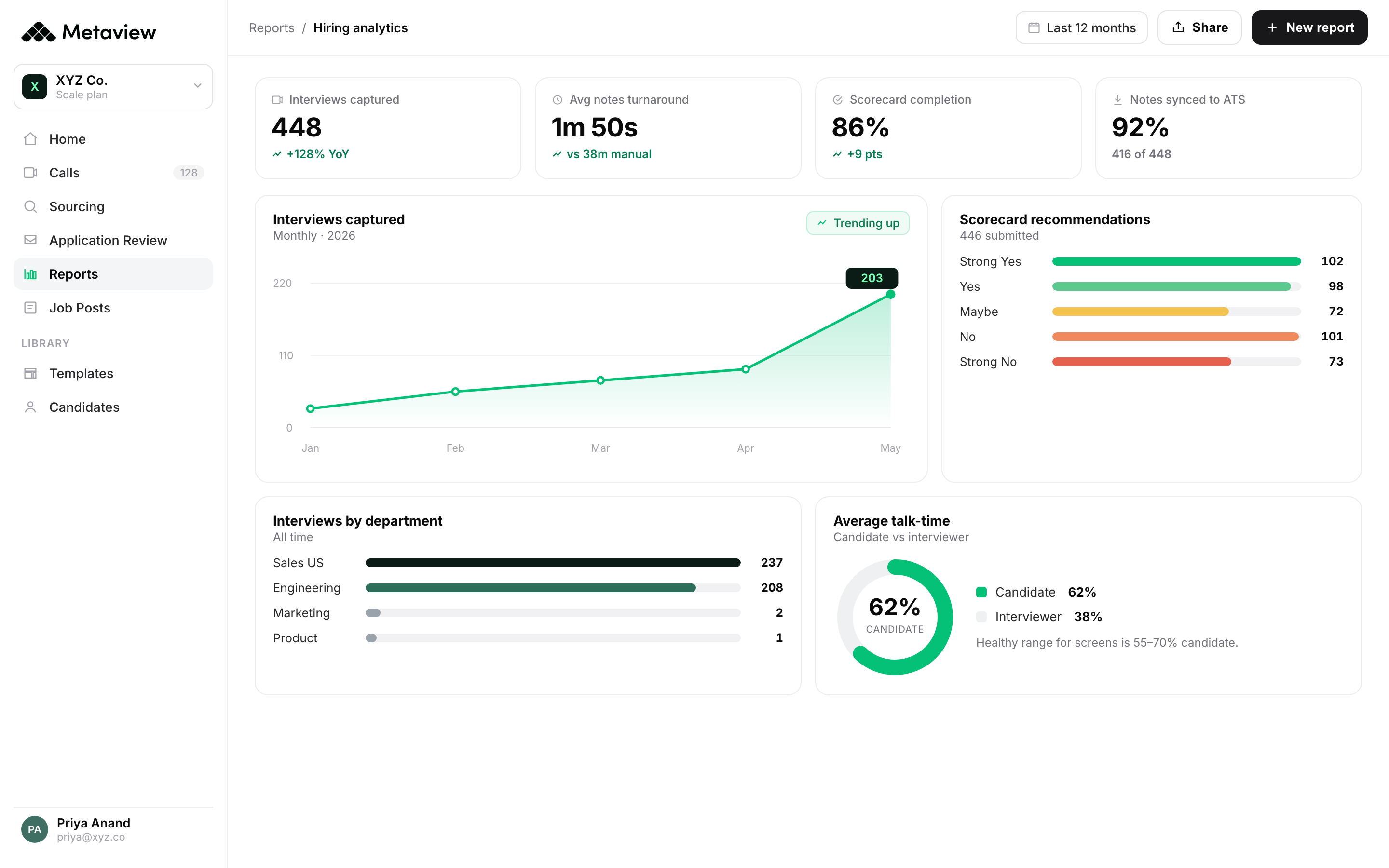
Most hiring managers want to be good at hiring. They just don't have the cycles to design the system themselves. That's the recruiter's job. The list below is the 30-day version: the steps that quietly compound into a hiring manager who is genuinely easier to work with.
- Send a 90-second voice note before the intake call. State what you'll ask, why, and what they'll get back. Sets the bar that this is structured work.
- Record the intake call with AI note-taking. Use the captured transcript as the source for the JD and the rubric, not the HM's first draft.
- Lock the rubric in writing before sourcing starts. One artifact, named, dated, linked in the req.
- Pre-book the debrief at calendar-invite stage. Don't ask the HM for time on day 25 of a 30-day sprint.
- Send candidate summaries the same day the screen happens. Five bullets, the rubric verdict, the strongest quote. Not a full transcript.
- Use the same structured scorecard for every interviewer in every round. No free-text dump. No exceptions.
- Surface comp signal early. If candidates are expecting 15% over the band, the HM needs to know in week one, not week four.
- Run a 10-minute pulse check at the end of week two. Two questions: do we have the right rubric, are we seeing the right candidates.
- Make the final-round debrief 30 minutes max, run from the shared scorecard, decision required at the end. No "let's sleep on it" without a follow-up time on the calendar.
- Send a 5-minute retro 48 hours after the offer is accepted. Two things that worked, one thing to change next time. Ship the change into the next req.
Hiring managers now see our recruiting team as strategic partners rather than people filling roles. When a hire takes longer than expected, everyone understands why, based on the data, which builds trust and sets appropriate expectations.”

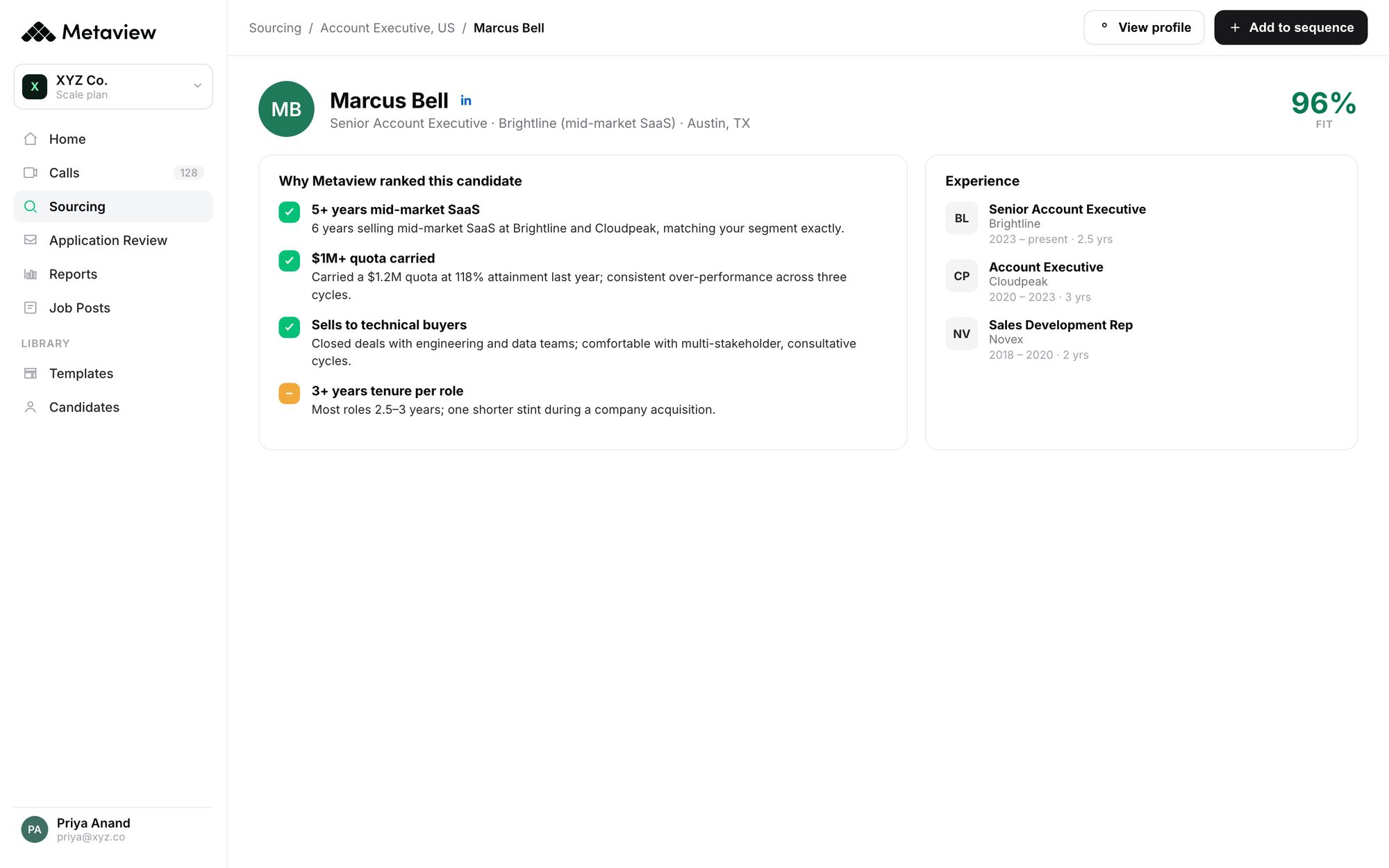
Bring Metaview into your hiring stack.
Live notes, structured scorecards, and ATS sync - set up in under 10 minutes.
Hiring manager FAQs.
Frequently asked.
Is a hiring manager the same as a recruiter?
No. The hiring manager owns the open role and the decision; they're usually the person the new hire will report to. The recruiter owns the process: sourcing, scheduling, screening, coordinating panels, managing the candidate through to offer. Most weeks, a recruiter is running 10+ reqs; the hiring manager is running one.
What does a hiring manager actually do?
Defines what success looks like in the role, partners with the recruiter on the JD and rubric, runs the hiring-manager-stage interview, gives same-day feedback on every candidate, and makes the final call. They also own onboarding and are accountable for whether the hire works out, which is the part that makes the rest matter.
What's the difference between a hiring manager and a recruiting manager?
A hiring manager owns the outcome of one specific hire (their next direct report). A recruiting manager runs the recruiting team: capacity planning, recruiter coaching, process design, vendor relationships. They're the recruiter's manager, not the candidate's future boss.
How fast should a hiring manager give feedback after an interview?
Same day. Metaview's 2026 AI & Hiring Alignment Report found 67% of teams lose qualified candidates to faster-moving competitors every month. Same-day feedback is the single biggest lever inside the recruiter's control to keep that number down, and the easiest one for the HM to commit to when notes write themselves.
How can recruiters get more out of hiring managers without micromanaging?
Design the system so showing up well is easier than not. Record the intake call so the rubric writes itself. Pre-book the debrief at calendar-invite stage. Use the same structured scorecard for every interviewer. Send same-day candidate summaries the HM can actually skim. Most "bad hiring managers" are good people stuck in a bad workflow.
How does AI help hiring managers specifically?
By taking the parts of hiring nobody chose for being good at, and leaving the parts only they can do. AI Notes captures the interview and structures the notes against the rubric. AI Reports surfaces what's actually happening in the funnel. The HM spends their hiring time on the decision, not on writing it up. That's where the 3.8x relationship-quality lift in the 2026 report comes from.
