
Six days vanish from the median hiring loop and nobody can point to where they went. They aren’t in sourcing. They aren’t in scheduling. They sit between the final round and the offer being made, in the soft tissue of the process: scorecard write-ups, debrief coordination, recruiter context-switching, and the slow drift from what the hiring manager committed to in week one to what the panel actually evaluated in week four.
At Quora, the gap between the final round and a synthesized debrief used to take two business days. After they put Metaview in the loop, it dropped to ten minutes. That isn’t a sourcing win or a scheduling automation. It’s a write-up step that stopped existing.
This post is for the recruiter or TA leader who has hit their time-to-hire ceiling and wants to know which days are actually movable. We map the six bottlenecks, the four Metaview removes, and the metric that matters more than time-to-hire itself.
Where six days actually vanish.
Time-to-hire is one number, but the loop has six segments where the time actually leaks. Tracking each one separately changes the conversation from “we’re too slow” to “we’re slow at debriefs.”
According to Metaview’s 2026 AI & Hiring Alignment Report (surveying 505 recruiting leaders and hiring managers across North America and EMEA), 67% of teams lose qualified candidates to competitors who move faster every month. The teams that don’t lose them are the ones who know where the six days go.
Here are the six places they hide:
- Final round to offer prep. The recruiter waits on the hiring manager. The hiring manager waits on a debrief. The debrief waits on calendars. Median 2 to 5 business days.
- Scorecard write-up. Each interviewer takes 20 to 30 minutes to translate notes into the ATS. Multiply by 5 panelists.
- Calibration drift. The brief from the intake call is in someone’s notebook. Week four panelists are evaluating against their own version. Add a re-calibration meeting.
- Cross-team coordination. Recruiter Slacks the manager. Manager waits to respond between meetings. Days of latency for asynchronous decisions.
- Recruiter context-switching. Pulling up a candidate’s notes from three weeks ago. Re-reading the resume. Re-watching a recording. 15 to 45 minutes per touchpoint.
- Covering-recruiter onboarding. Lead recruiter goes on PTO. Coverage has zero context. They re-run interviews to recover signal.
Sourcing and scheduling are the headline complaints, but they aren’t the actual bottleneck for most teams. The four post-interview leaks are.
Time to hire vs. time to fill (and the metric that matters more).
Time to hire measures the days between a candidate entering the pipeline and accepting an offer. Time to fill measures the days from the job opening to the start date. Same loop, different start lines. Time-to-hire is the recruiter’s metric; time-to-fill is the business’s.
Both are useful. Neither is the metric that actually decides win rate.
Everyone is trying to go faster on time-to-hire. Great. You’re probably also fastest to attrition. Probably not great.”

The metric that decides win rate is days between final round and offer being made. It’s the segment where speed compounds with signal quality. Move too fast and you lose calibration; move too slow and the candidate signs somewhere else. Tracked separately, it’s the highest-leverage benchmark in the loop. Most teams don’t track it at all.
Internal cross-link: see also our take on quality of hire, which is the metric time-to-hire is supposed to serve.
The four bottlenecks Metaview removes.
Of the six segments, four are the ones Metaview was built to collapse. Each maps to a product surface that was shipped specifically because customers were losing days to it.
Recruiter context-switching between rounds.
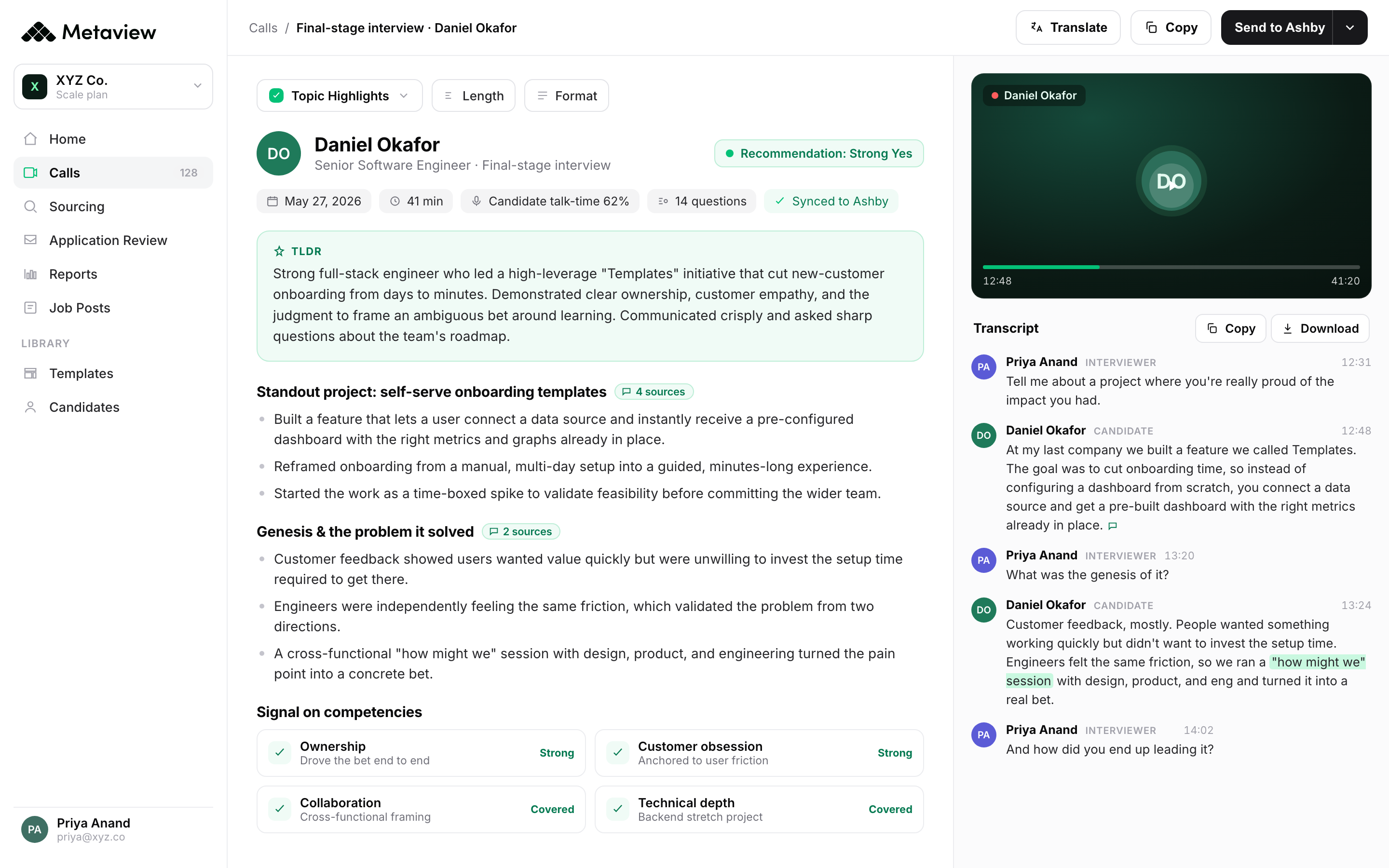
Notetaker captures the live interview audio and produces a per-competency note the moment the meeting ends. No re-listening, no re-reading the transcript, no five-minute warm-up before the next call. The recruiter sees a structured brief instead of a wall of text.
Post-interview scorecard write-up.
AI Notes with Scorecard Autofill collapses the 20 to 30 minutes each interviewer used to spend on the ATS field. The structured note from Notetaker populates the scorecard fields the team agreed on at intake. The interviewer reviews and submits.
Calibration drift across the loop.
Intake and debrief notes capture what the hiring panel actually committed to in week one and carry that brief into every subsequent round. Week four panelists evaluate against the same calibration the recruiter heard, not a verbal summary that’s drifted through three forwards.
Decision hand-off lag at offer prep.
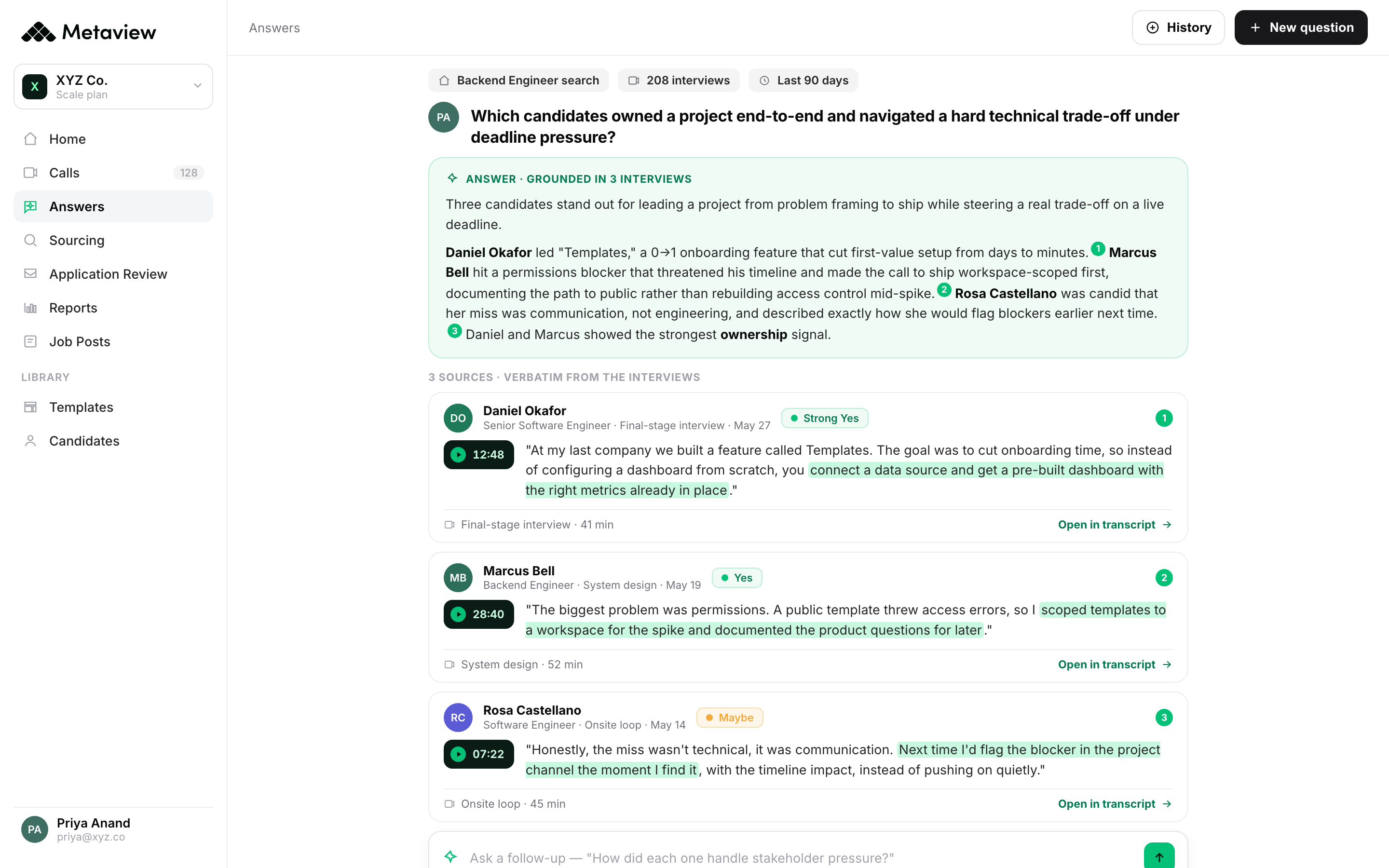
AI Filters lets the recruiter query the captured corpus before the offer-prep call. “Show me every line where the candidate talked about relocation.” The recruiter walks into the offer call with the levers already named, not with a mental refresh of three weeks of conversation.
Eight lifts in priority order (with the surface that does each one).
The eight strategies most teams reach for, ranked by impact on actual days saved, paired with the Metaview surface that operationalizes each one. Start at the top.
- Close the final-round-to-offer gap. Treat days-between-final-and-offer as a separate KPI. Use AI Filters to surface the levers the candidate cares about, before the offer-prep call. Highest leverage of any single change.
- Auto-generate scorecards. Stop asking interviewers to type up their own notes. AI Notes with Scorecard Autofill reads the captured interview and fills the structured fields. 20 minutes per interviewer per round, recovered.
- Capture the intake commitment. Run the intake call on Notetaker. The calibration brief lands in the panel kit; week-four panelists evaluate against the same must-haves the hiring manager named in week one.
- Make the debrief synthesize, not summarize. Intake and debrief notes produce a decision artifact, not a transcript. Per-competency agreement, disagreement, and the consensus call live in one place. Skips the manual write-up.
- Triage inbound at the front of the funnel. Application Review sorts inbound applications against the intake-call must-haves and flags fraud and AI-generated patterns. Recruiter attention spends on the strong-match bucket inside 48 hours.
- Search the panel corpus, not the recruiter’s memory. AI Filters runs against the structured per-competency signal. Cross-candidate questions like “which finalists mentioned willingness to relocate” return the exact moment with speaker attribution, not a guess.
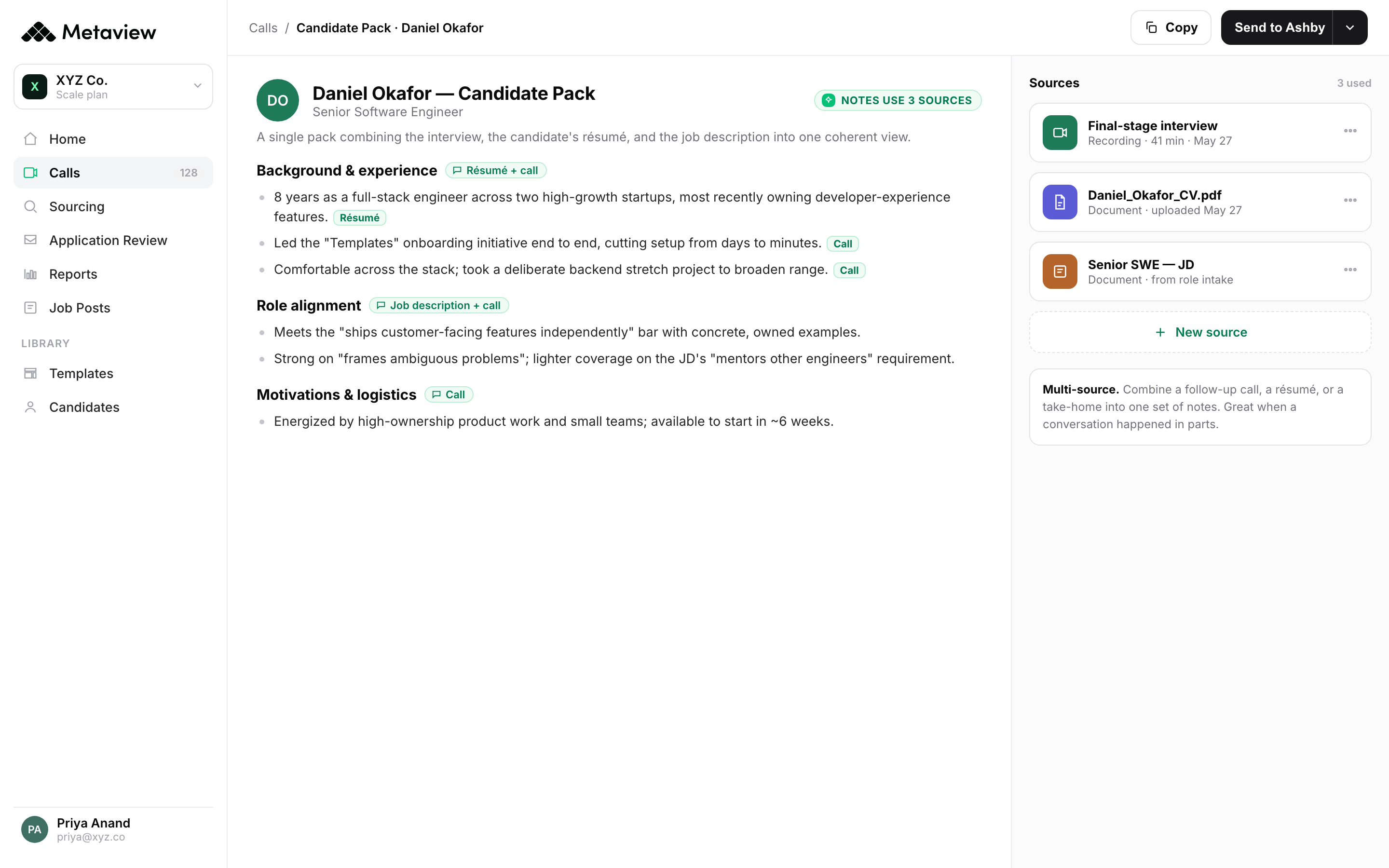
- Cross-link the artifact chain. Multi-Source Summaries pulls intake, every round, and the debrief into one offer-prep brief. The recruiter walks into the offer call with the full search context already lined up.
- Make panel context portable. Metaview’s integration layer keeps the structured signal accessible from the recruiter’s existing tools. Covering recruiters inherit the context instead of re-running interviews to recover it.
What customers running this play are seeing.
The teams that move first on this pattern are the ones with senior IC searches, debriefs that span time zones, and a hiring manager who keeps asking for “the conversation again.” The numbers that come out of those teams are not subtle.
| Phase | Manual | Generic AI tool | Metaview |
|---|---|---|---|
| Post-interview scorecard | 2 days for the recruiter to write up. 20 min per interviewer to translate notes into ATS fields. | Generic auto-summary. Recruiter still rewrites for the ATS template. | Per-competency notes generated in the room. Scorecard autofill populates the ATS template directly. |
| Calibration recall | Recruiter’s notes from the intake call. Drifts by week four. | Transcript only. No structured commitment. | Captured intake brief surfaced in every panel kit. Same calibration the hiring manager named in week one. |
| Cross-round signal | Recruiter’s memory under pressure. Re-runs interviews to recover gaps. | Searchable transcripts per role. | Per-competency signal across every panel. AI Filters returns the exact moment with speaker attribution. |
| Decision hand-off | Slack threads + email. Asynchronous decisions wait days. | Generic summary, not tied to the offer-prep workflow. | Multi-Source Summaries pulls intake, every round, and the debrief into one offer-prep brief. |
It took us a long time to write feedback to our hiring managers, for hiring managers to share their feedback with recruiting, and then for that feedback to reach candidates. So it was slowing down our time to hire quite a lot.”

At Quora, the debrief synthesis time went from two business days to ten minutes. The recruiter who used to spend an afternoon writing up the panel’s feedback now spends that afternoon in the next intake call. The math is per recruiter, per week, every week.
See the full Quora case study for the operational detail of how this rolled out.
How to know if this is your problem (the 7-day audit).
A practical self-check. Run it on three searches that closed in the last 60 days; the answer pattern is usually obvious within ten minutes.
- How many business days passed between the final round and the offer being made? (If the answer is “more than two,” the post-interview leak is your bottleneck.)
- Who wrote the scorecard for each interviewer? When did they write it? (If the answer involves the recruiter chasing panelists for two days, the write-up step is the leak.)
- What single artifact survives the debrief? (If the answer is “a Slack message,” the decision hand-off has no durable layer.)
- How long does a covering recruiter take to come up to speed on an in-flight search? (If the answer is “a half day of re-reading notes,” the context-switching tax is high.)
- Are you measuring time-to-hire or time-to-quality-hire? (If you only track time-to-hire, you have no signal on whether faster is better or worse.)
If three or more answers map to a leak, the four-bottleneck pattern in this post is your fix. Start with the final-round-to-offer gap because the leverage is highest.
Bring Metaview into your hiring stack.
Live notes, structured scorecards, and ATS sync - set up in under 10 minutes.
Frequently asked.
What is the difference between time to hire and time to fill?
Time to hire is the days from a candidate entering your pipeline to accepting an offer. Time to fill is the days from the role being opened to the start date. Same loop, different start line. Most TA dashboards track time to fill; recruiters live in time to hire.
What is a good time-to-hire benchmark in 2026?
Industry medians sit around 40 to 60 days for individual contributor roles and 90+ days for executive searches, but the more useful benchmark is the days-between-final-round-and-offer segment. That is the part of the loop most teams have control over without changing sourcing strategy.
Does going faster on time-to-hire hurt quality of hire?
It can. Time-to-hire optimized in isolation is a vanity metric. If you cut the loop by skipping calibration, the same hire fails at month four. The version that works is collapsing the soft-tissue steps (scorecard write-up, debrief coordination, recruiter context-switching) without touching the actual evaluation rigor.
How does Metaview reduce time-to-hire specifically?
By removing four post-interview days: scorecard write-up (AI Notes), calibration drift (intake and debrief notes), cross-round signal recovery (AI Filters), and decision hand-off lag (Multi-Source Summaries). The candidate-facing experience does not change; the recruiter-facing one collapses.
What is the single fastest change a TA leader can make to reduce time-to-hire?
Treat the days-between-final-round-and-offer as a separate KPI and review it weekly. Most teams discover within the first month that the bottleneck is the scorecard write-up step. Solve that one and the segment compresses by 30 to 50 percent on most loops.
Are there stages of the loop that bottleneck more than others?
Yes. The post-interview cluster (write-up, debrief, decision hand-off) is the most common bottleneck, and the most frequently underestimated. Sourcing and scheduling are visible because they are top-of-funnel; the post-interview leaks are invisible because they live in the gap between candidate-facing events.
