
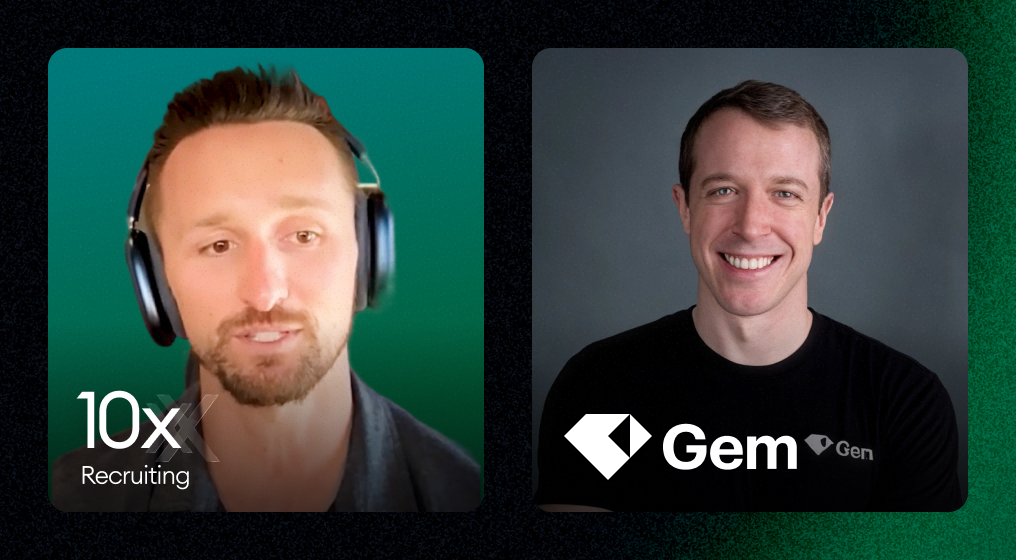
Most startups hire the wrong engineers. They go after the same infra-heavy bench that worked at the last company, and end up with a team that ships beautifully scalable systems nobody actually loves. The teams that win build for the customer first, then scale the tech. Steve Bartel learned this the hard way at Gem.
Steve Bartel (co-founder and CEO of Gem, the AI-first all-in-one recruiting platform) joined Nolan Church on 10x Recruiting (more episodes on the 10x Recruiting hub) to break down how Gem built a recruiting product with the highest G2 scores in the category. The conversation gets into why product-obsessed engineers beat infra-trained engineers in the early stages. It also covers how AI is now reshaping the way recruiting teams handle inbound, silver medalists, and outreach in a market drowning in templated AI spam.
This recap walks through the operating playbook: how to identify and assess product-obsessed engineers, and how to get the whole engineering team obsessed with the customer. It also gets into how AI lets a single recruiter punch above their weight when the application floodgates open.
Hire product-obsessed engineers, not infra engineers.
Steve spent five years at Dropbox watching the company import some of the best infra engineers in the world. The problem at Dropbox was file sync for hundreds of millions of users; the talent profile matched the problem. When he started Gem, he assumed the same template would work, and quickly realized it would not.
When I started Gem, I realized that exceptional technical talent alone wasn't enough. What we needed was more product and customer focused engineers.”

The right profile for an early-stage B2B SaaS product is the full-stack engineer who wants to spend time with customers. They want to put on a product hat and a design hat, and treat the engineering swim lane as a starting point rather than an endpoint. Gem hired specifically for that mindset and ended up with the highest G2 scores in the recruiting-platform category, a result Steve attributes more to the team's product instincts than to any technical headcount advantage.
The assessment move that worked best: short paid work trials. Two-to-three weeks where the candidate ships real features, sits in on customer calls, and gets a taste of what the early-stage startup actually feels like. The work trial gave both sides signal that no interview loop could match. Candidates self-selected into the company; Gem self-selected into hires who already proved they could ship.
Get engineers in front of customers, day one.
The hardest part of building product-obsessed engineers is not the hiring; it is keeping them obsessed once they are inside the building. Gem built a stack of practices to make customer contact unavoidable.
Every engineer had to shadow a target number of customer calls per month. The early team ran customer support directly from the engineering Slack. They started recording every customer call in GONG and built a fire-hose snippet feed that anyone in the company could browse. They created a feedback Slack channel that started as the founders posting call notes and grew into the most active channel at Gem.
Drew, one of our first engineers, was like, oh, I could fix that. And he just started coding in their office and shipped a feature within that hour long call. They were just blown away by the level of customer focus and obsession and became one of our largest early customers.”
Nolan called out the parallel to DoorDash, where every employee had to "dash" once a month. The principle is the same: the closer your team gets to the actual customer, the better the product gets. Customer empathy is not a feeling; it is a built habit that you wire into the operating model. Recruiters benefit from the same discipline, because the closer they get to the day-to-day work, the sharper their candidate calibration gets.
The application volume crisis.
Gem just published its most recent benchmark report, and the numbers are striking. Applications per role are up 3x compared to 2021-2022. More than 20% of Gem's customers now receive thousands of applicants for a single role. Recruiters are working 55% more reqs at the same time, time-to-fill is up eight days on average, and the number of interviews per hire has climbed 42%.
Applications are up 3x compared to where they were 2021, 2022. More than 20% of our customers get thousands of applicants for a single role.”
The combination is brutal. Volume is up, the team is smaller, every search takes more interviews to close, and the candidate-quality bar got higher because hiring managers can afford to be more selective. Manual inbound review at this volume is no longer humanly possible. The recruiting teams that try to keep up with the legacy process are leaking signal everywhere. For more on the application-volume thesis from the Metaview side, see the Application Review live demo write-up.
- Ship beautifully scalable systems against problems the customer never said they had.
- Treat customer calls as interruptions; the swim lane stays narrow.
- Optimize for technical elegance over time-to-customer-feel.
- The product wins on benchmarks. It loses on G2 scores.
- Ship features against problems customers actually named in last week's calls.
- Sit in on customer calls voluntarily; the swim lane includes design and support.
- Optimize for the moment the customer says "this is the thing I needed."
- The product wins on G2 scores. Gem's highest-rated category position is the proof.
Stack-rank inbound, then mine the silver medalists.
The operational move is to feed the job description and the intake-doc criteria into an AI ranking layer that scores every applicant, every CRM contact, and every silver medalist against the same 5-10 criteria. Steve described the Gem version of this; the same shape exists at every serious AI-recruiting platform.
The silver-medalist stat is the one that should rewire every recruiting leader's priorities. For Gem's mid-market customers, 30-50% of the people they hire were already in their CRM or ATS. For enterprise customers, that number is 50-70%.
At a company like Google or Facebook, it's probably 95% of people that you care about are already in your system. And that data is just locked up and impossible to search across. Those are your hand raisers and the previous context and relationship touch points that you've had with them, that's your superpower.”
The cost of not mining your existing database is high. A manual "silver medalist Google sheet" surfaces maybe 10% of the qualified pool. The AI version surfaces the full set, ranked, with the relationship context attached so the recruiter can re-engage on something other than a cold cold-email. The candidates you already paid to source are the candidates you should be re-engaging first, every time.
What world-class outreach looks like in the AI-spam era.
Outreach is where the AI moment splits into winners and losers. The base mechanics still matter: a 4-stage email sequence roughly doubles response rate vs InMail, three follow-ups deliver a 68% lift in positive response, and personal-email reach beats InMail because most senior talent has InMail notifications turned off.
What is new: the floor dropped, and so did the bar to compete. Volume-based AI outreach is already burning sender reputation, and the AI candidate outreach platform market is converging on a wave of templated, low-effort sequences candidates spam-filter on sight.
AI is just going to make it easy to spam the entire market, which I think is actually a miss for teams that are taking that approach because they're just going to burn their talent brand to the ground.”
The alpha goes to teams that use AI to personalize, not to spam. Pull in the candidate's resume, their relationship history with the company, the event they attended 15 months ago, the role they got close on last year. Gem customers using AI personalization see another 50-60% lift in response rate on top of the basics. The recruiter who can write a crafted, context-aware message has more competitive alpha in 2026 than at any point in the last decade.
The other tactic Steve mentioned is the "connector" play: open the outreach by naming a mutual contact (with permission). When the candidate sees a name they trust, the response rate jumps because they can validate the company through a person before they commit to a conversation. Used carefully, it converts cold reach into warm reach.
Where AI gives recruiting teams use.
Steve and Nolan agree on the throughline: AI reallocates recruiter time toward the work that compounds: candidate relationships, intake calibration, decision quality, and post-hire follow-through. It takes the high-volume, low-signal work off the recruiter's plate. The infrastructure to do this exists today.
Ranks profiles against intake criteria across external pools AND internal silver medalists. The 30-70% of hires already in your CRM stop hiding behind boolean queries.
Handles the 3x inbound volume Gem's benchmark report names. Every applicant gets ranked with rationale; the recruiter starts at the top of the queue, not the pile.
Captures every interview verbatim so the hiring decision is backed by evidence, not recall. Product-obsessed engineers are easier to spot when the customer-call signal is preserved as text.
Closes the loop on which screening signals predicted the engineers who shipped customer-facing wins. The next search opens with sharper criteria than the last.
Metaview Notetaker captures every interview verbatim so the hiring decision is backed by evidence, not recall. Application Review handles the 3x inbound volume that legacy ATS workflows cannot keep up with. AI Sourcing ranks profiles against the intake-doc criteria across both external pools and internal silver medalists. AI Outreach personalizes sequences using the full relationship history instead of generic tokens. For the AI-augmented-recruiter angle on this shift, see Claude for recruiters.
Numbers from the 2026 AI & Hiring Alignment Report, surveying 505 recruiting leaders and hiring managers across North America and EMEA. The 3.8x relationship lift maps directly to Steve's product-obsessed-engineering thesis: when AI handles the volume layer, recruiters and hiring managers calibrate from the same proof instead of arguing from CV-pile memory.
The operating shift.
Three concrete moves from Steve's Gem playbook for any team trying to operate at modern application volume:
One: change who you hire on the engineering side first. Product-obsessed full-stack engineers ship customer-facing wins that compound. Infra-trained engineers ship beautiful systems that nobody loves. Match the talent profile to the actual problem.
Two: wire customer contact into the operating model from day one. Call shadowing, support rotations, GONG snippet feeds, a feedback Slack channel that everyone is in. The teams that maintain customer obsession at scale built the muscle early.
Three: stop manually reviewing inbound and start mining your silver medalists. The 30-70% of hires that were already in your database are the highest-ROI sourcing channel you have. The recruiters who lean into AI-ranked rediscovery outperform the recruiters who treat every search as a fresh greenfield problem.
The companies that internalize these three moves will out-hire the ones still running the 2022 playbook. That is the operating shift.
Bring Metaview into your hiring stack.
Live notes, structured scorecards, and ATS sync - set up in under 10 minutes.
Frequently asked questions.
What does "product-obsessed engineer" actually mean?
A full-stack engineer who wants to spend time talking to customers, who naturally puts on a product hat and a design hat alongside their engineering hat, and who treats their engineering swim lane as a starting point. Steve specifically hired for the founder-mindset profile: people who maybe wanted to start a company someday and were excited to learn how startups actually operate.
How do you assess for product-obsession in an interview?
Paid work trials, 2-3 weeks, with the candidate shipping real features and sitting in on real customer calls. The work trial gives both sides signal no interview loop can replicate. Not every candidate can take the time, but the ones who can are the ones who will thrive once they start.
What is driving the 3x application-volume surge?
Three forces stacked: AI-assisted resume creation and mass-application tools, smaller recruiting teams handling 55% more reqs per recruiter, and hiring managers raising the quality bar in a candidate-rich market. The net effect: thousands of applicants per role at 20%+ of growth-stage and enterprise teams, with traditional inbound workflows breaking down.
How big is the silver-medalist opportunity in practice?
For Gem's mid-market customers, 30-50% of hires were already in the CRM or ATS. For enterprise customers, 50-70%. At Google or Facebook scale, the number can approach 95%. The candidates you already paid to source and engage are the highest-ROI re-engagement pool in the business.
What separates good AI outreach from bad?
Personalization that uses the full relationship history (resume, prior touchpoints, event attendance, past application history), not just first-name and company-name tokens. Gem customers using AI personalization see a 50-60% lift in response rate on top of the basics (4-stage email sequence, three follow-ups, personal email over InMail). Volume-without-personalization burns your talent brand fast.
