
The hiring playbook that worked in 2024 stops working in 2026.
Volume sourcing, generic outreach, and gut feel in place of interview evidence have been losing ground for two years, and in 2026 the gap shows up as speed. In Metaview's 2026 AI & Hiring Alignment Report, 67% of teams lose qualified candidates to competitors who move faster every month.
The report surveyed 505 recruiting leaders and hiring managers across North America and EMEA. Set alongside the 5.5 million conversations captured on Metaview, the survey shows where hiring has already moved.
Here are the 10 trends defining talent acquisition in 2026.
All 10 trends at a glance.
| # | Trend | What's actually changing |
|---|---|---|
| 1 | Sourcing pivots from quantity to fit | Shorter pipelines, higher reply rates, faster offers |
| 2 | Sourcing agents run while you sleep | Continuous sourcing replaces the Monday-morning search |
| 3 | Talent communities replace one-off sourcing | Pre-engaged talent pools cut time-to-fill significantly |
| 4 | Interview intelligence becomes table stakes | Every conversation captured, structured, and scored |
| 5 | Skills-first hiring overtakes resume gatekeeping | Competency clusters replace rigid title requirements |
| 6 | Outreach gets personalized at scale | AI handles the per-candidate detail recruiters never had time for |
| 7 | Recruiters become strategic advisors | Workforce planning becomes a recruiter-led conversation |
| 8 | DEI moves from program to dashboard | Representation tracked across every pipeline stage |
| 9 | Recruiting workflows go fully integrated | ATS, sourcing, capture, and reporting in a single feed |
| 10 | Predictive hiring replaces reactive hiring | Pipelines built six months before the req opens |
1. Sourcing pivots from quantity to fit.
Volume sourcing peaked in 2023.
The model assumed enough candidates at the top of the funnel would compensate for poor fit further down. By 2025 it was visibly broken: reply rates collapsing, hiring manager satisfaction falling, candidate experience trashed by mass outreach that landed in the wrong inboxes.
The 2026 model is the inverse. Smaller pipelines of better-matched candidates. AI does the filtering up front so the recruiter spends time on five strong fits, not 50 maybes.
What it means for recruiters: measure a search by how many candidates match the brief, and report that number to the hiring manager instead of how many you contacted.
2. Sourcing agents run while you sleep.
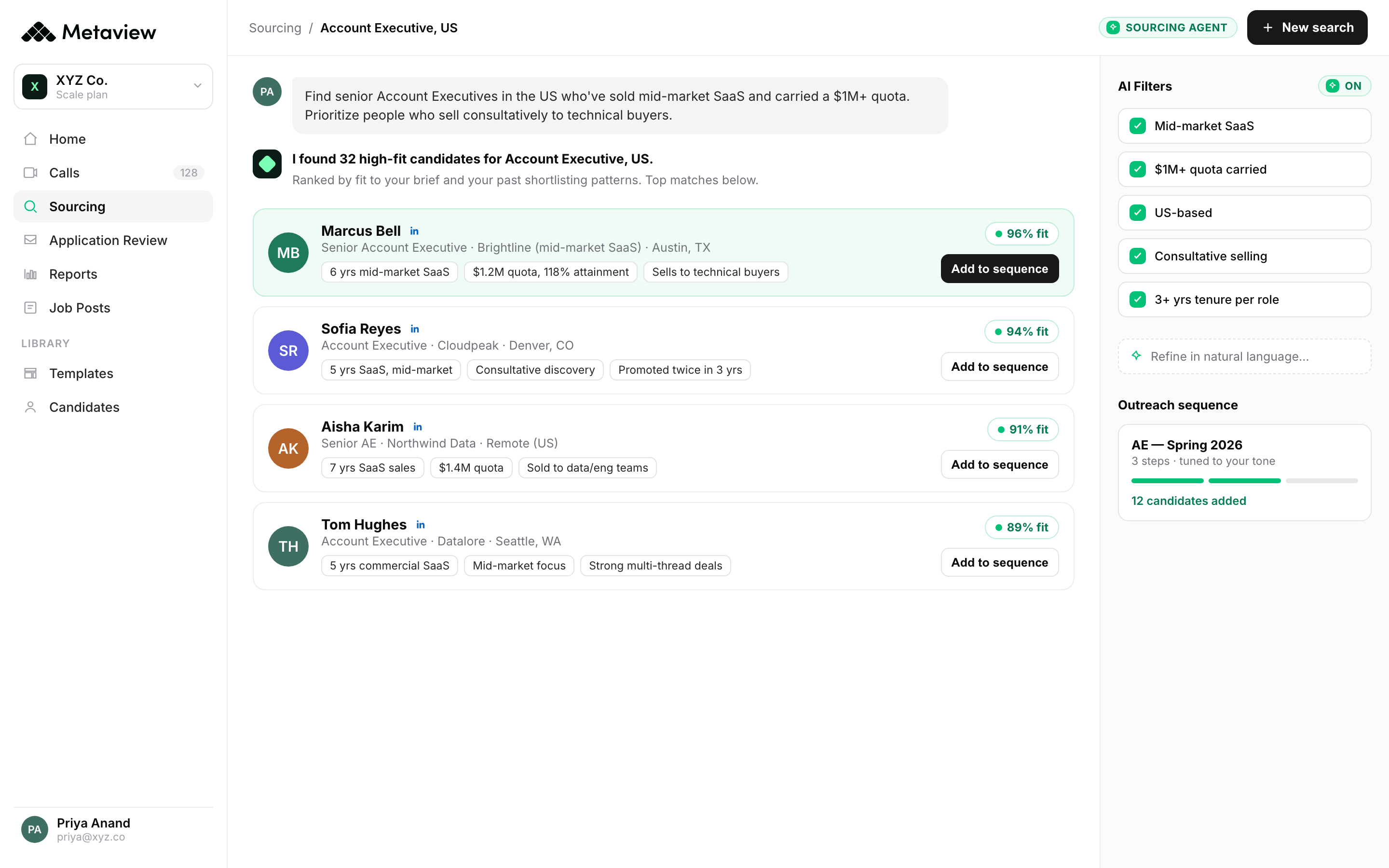
Manual sourcing is going the way of manual notetaking: a job the AI does better and faster.
The shift in 2026 is from "I'll run a search Monday morning" to "the search ran overnight, here are 12 ranked candidates with reasons." Agents read the JD, weight your past hires, and surface matches across LinkedIn, GitHub, and niche networks continuously.
The recruiter's work shifts to refining the brief and approving the shortlist, then writing the one message a candidate answers.
What it means for recruiters: the hours formerly burned on Boolean strings get redirected to candidate engagement and hiring manager partnership.
3. Talent communities replace one-off sourcing.
The cheapest hire is a candidate who already knows you.
Talent communities (past applicants, referrals, alumni, and warm passive candidates) became the answer for teams trying to scale hiring without scaling headcount. A nurtured community already knows the company, so the first message is a conversation rather than a pitch, and the recruiter starts from candidates who chose to stay in touch.
The AI layer that makes this work in 2026 is content personalization at the community level: segmented newsletters, role-specific event invites, and behavioral signals that flag who is suddenly job-curious.
What it means for recruiters: the calendar shifts. Sourcing time drops; nurture time rises. The output is a pipeline that's already half-warm before the req opens.
4. Interview intelligence becomes table stakes.
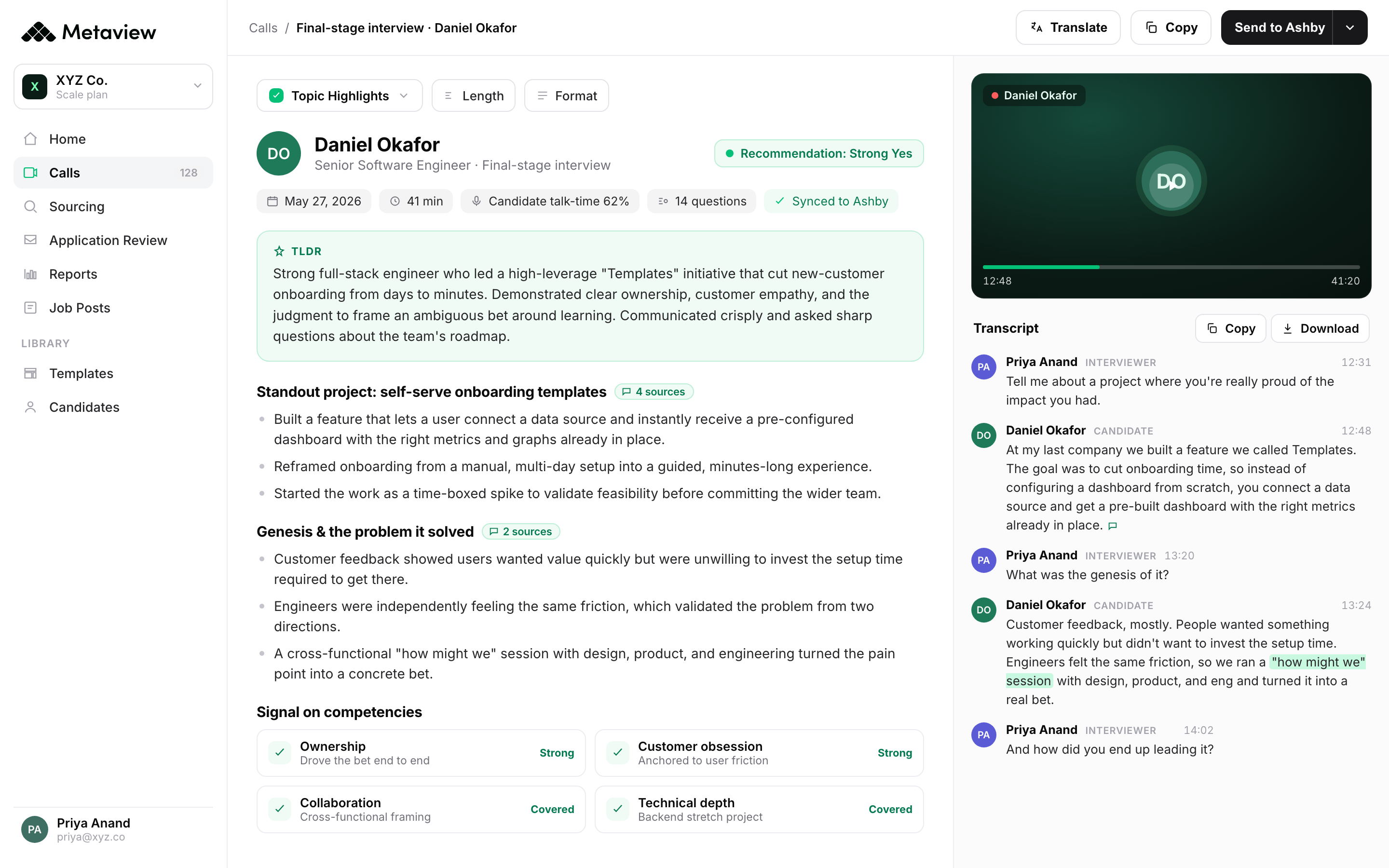
The interview is the highest-signal moment in the entire hiring funnel. In 2026, teams that don't capture it structurally are competing against teams that do, and losing.
Structured capture means every answer maps to a competency, every interviewer scores against the same rubric, and the scorecard exists the moment the call ends. No recruiter memory required.
The benefit builds over months. Once every interview is scored the same way, a team can see where two interviewers split on the same candidate and how long scorecards sit unsubmitted, read off the record instead of reconstructed from memory.
My notes are far more accurate, and I can really focus on the conversation with the candidate. I have this partner in every interview who can understand nuance and capture all the little bits.”
What it means for recruiters: the structured-capture layer is the single highest-leverage investment a 2026 recruiting team can make.
5. Skills-first hiring overtakes resume gatekeeping.
"10 years of experience in X" was always a lazy proxy.
In 2026, the proxy gets replaced. Job descriptions move from rigid title requirements to flexible competency clusters. Screening shifts from resume keyword matching to portfolio review, structured work samples, and competency-mapped interviews.
The bonus is reach: removing the title gate opens the pool to candidates who can do the work but never had the resume that conventionally qualified them.
What it means for recruiters: the rewrite of the JD is the easy part. The rewrite of the interview kit is where skills-first either delivers or collapses.
6. Outreach gets personalized at scale, finally.
"First name and company merge tag" was personalization in 2018. In 2026 it's a reply-rate killer.
Real personalization pulls a specific candidate detail (a recent project, a public talk, a posted thread) into the first sentence and uses it to make the ask relevant. AI now does this at volume without the recruiter rewriting every message.
The catch: the AI needs your data to be good. Templated outreach trained on poor examples produces poor outreach at scale.
What it means for recruiters: the prompt and the template library are now part of the recruiter's craft, alongside the conversation itself.
7. Recruiters become strategic advisors.
In 2024 much of a recruiter's week went on sourcing, scheduling, and scorecard reminders. In 2026 more of it goes on hiring manager conversations and workforce planning, because a sourcing agent runs the searches and the Notetaker drafts the scorecards.
Automation absorbed the rest.
The recruiters who lean into the shift become indispensable. The ones who don't get reorganized into the parts of the workflow the automation hasn't reached yet.
What it means for recruiters: the skill that matters most in 2026 is translating hiring data into business strategy. Tool fluency is the floor, not the ceiling.
8. DEI moves from program to dashboard.
The DEI conversation in 2026 is quieter than it was in 2022. The measurement is sharper.
Teams now track representation as a continuous metric across sourcing channels, candidate pipelines, and interview panels, the same way they track time-to-fill. The dashboard makes drift visible the week it happens, not the quarter after.
The deeper win is interview-stage bias detection. Structured capture surfaces patterns (which interviewers ask different questions of different candidates, which feedback shows tone drift) that a manual debrief would never catch.
What it means for recruiters: the work is less program management, more data hygiene. Representation as a number you watch, not a campaign you run.
9. Recruiting workflows go fully integrated.
Disconnected stacks were the single biggest source of recruiter overhead in 2024.
The 2026 default is end-to-end integration: sourcing writes to ATS, interview capture writes to ATS, reporting reads from ATS, and the recruiter never re-enters the same data twice.
Metaview integrates with 114 applicant tracking systems, including Greenhouse, Ashby, Lever, Workday, SAP SuccessFactors, Bullhorn, and JazzHR. Writeback is per vendor: a scorecard the interviewer submits in Metaview lands directly in Ashby and Lever, and the browser extension autofills the objective fields of Ashby and Greenhouse scorecards.
The teams winning at this aren't running more tools. They're running fewer, better-connected tools.
What it means for recruiters: the audit worth doing this quarter is "where does data have to be re-entered?" Every re-entry point is a candidate-experience and recruiter-productivity cost.
10. Predictive hiring replaces reactive hiring.
The reactive model: a manager opens a req, the recruiter starts sourcing. Time-to-hire begins ticking from zero.
The predictive model: a dashboard flags that a specific role family is likely to need hiring within six months based on attrition signals, growth plans, and historical patterns. The recruiter starts building the pipeline before the req opens.
This is the easiest trend to underestimate. The saving comes from starting earlier: when a req opens against a pipeline that already exists, the sourcing weeks are finished before time-to-hire starts counting.
What it means for recruiters: the conversation with finance and people ops shifts from "can I hire?" to "here is the pipeline I'm building for the role you'll need in Q3."
How Metaview shapes each trend.
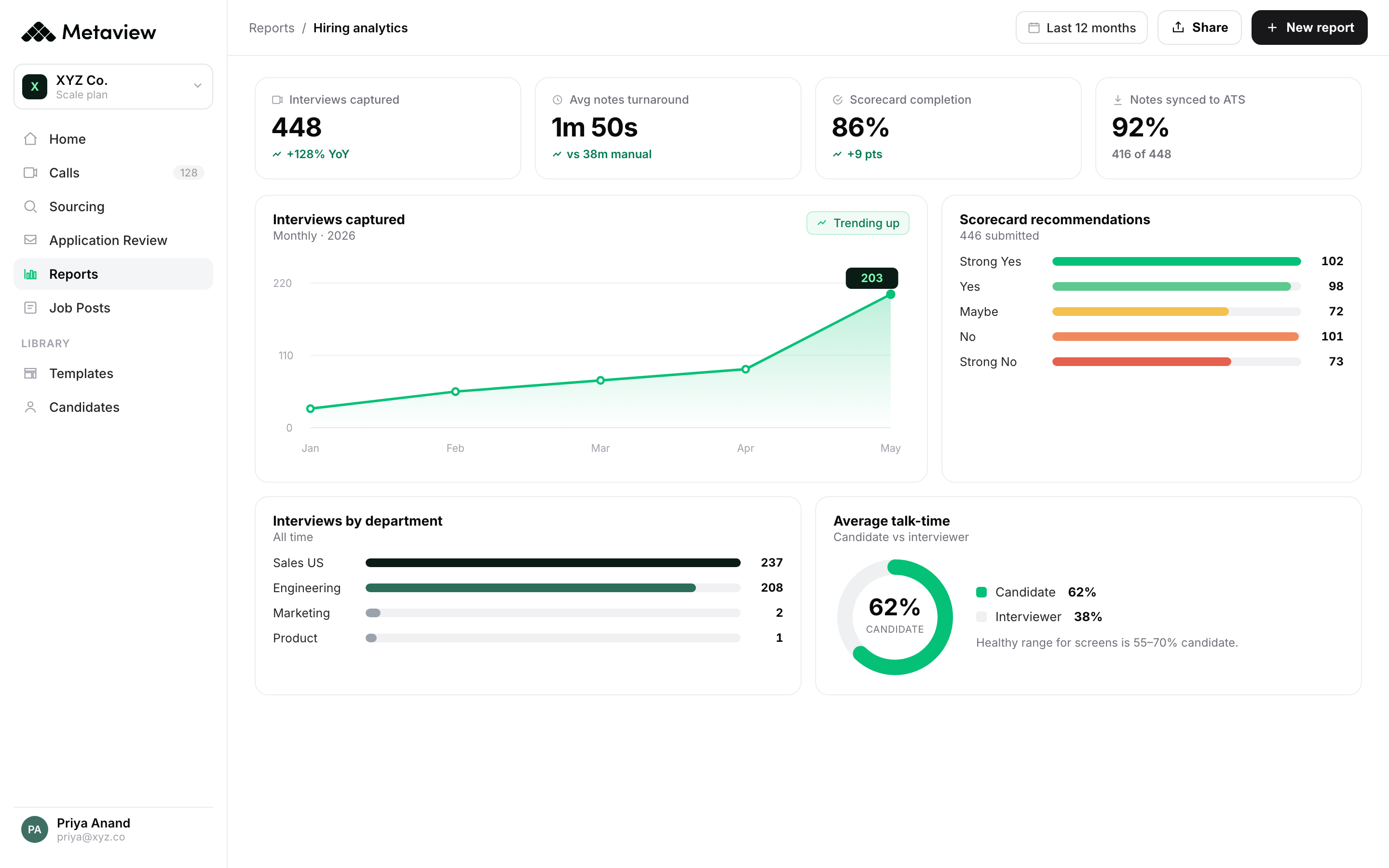
Most of the trends on this page are downstream of a single shift: recruiting teams treating their own interview and pipeline data as a first-class asset.
Metaview is built to make that data usable.
- AI Sourcing. Searches the web, your connected ATS, and your past Metaview conversations from one plain-language brief, and returns a shortlist with the reasoning behind each candidate.
- Outreach. Runs automated email sequences from that shortlist, personalizes each message to the candidate, follows up on its own, and finds verified emails and phone numbers without a list upload.
- Notetaker. Joins the interview as a visible participant and captures every spoken word across Zoom, Google Meet, Microsoft Teams, Webex, and phone. It then drafts the scorecard, which the interviewer reviews and submits.
- Application Review. Reads every application against the role's ideal candidate profile and sorts candidates into fit buckets, with the reasoning shown. A recruiter makes every accept and reject call.
- Reports. Reporting on your own interview data, queryable in the product or through the Metaview MCP (Model Context Protocol), with no per-report charge.
Recruiting teams at 4,000+ organizations use Metaview, including Brex, Catawiki, Cleo, Quora, Robinhood, and Perk.
Bring Metaview into your hiring stack.
Live notes, structured scorecards, and ATS sync, set up in under 10 minutes.
Frequently asked.
What is the biggest recruiting trend in 2026?
The biggest trend is the pivot from volume sourcing to precision sourcing. Smaller, better-matched pipelines beat large, partially-matched ones on every metric: reply rate, time-to-hire, offer acceptance, and hiring manager satisfaction.
Will AI replace recruiters in 2026?
No. AI absorbs the repetitive parts of the workflow: sourcing, scheduling, capture, and reporting. The strategic work (workforce planning, hiring manager partnership, candidate relationships) moves to the center of the recruiter's job.
What is interview intelligence?
Interview intelligence is the AI-driven layer that captures, transcribes, and structures every candidate interview against a competency rubric. The output is a consistent scorecard per candidate, faster feedback loops, and pattern data across thousands of conversations.
How should smaller recruiting teams approach these trends?
Start with one trend that compounds: interview intelligence. Capture every interview structurally, get your scorecards consistent, and the rest (better reports, fewer mis-hires, faster feedback) follows. Tackling 10 trends at once stalls; one trend done well moves the team.
What does skills-first hiring actually require?
It requires two changes, not one. Rewriting the JD as competency clusters is the easy half. Rewriting the interview kit to assess those clusters is the half that determines whether skills-first delivers or quietly reverts to resume gatekeeping.
How do I get my hiring managers bought in?
Show them the data they don't have today. A structured scorecard, a panel-consistency view, and a time-to-feedback metric tend to move hiring managers faster than any deck. Most ambivalence about recruiting tools is really ambivalence about the data they currently lack.
