
Most recruiting teams confuse interviewer training with interviewer coaching. They build a great onboarding session, run it once a quarter, and assume the interviewer is calibrated for life. Training is the front door. Coaching is the work that actually decides hiring quality.
The teams that hold the bar at scale do both, in sequence, on purpose. Training installs the structure. Coaching keeps the structure load-bearing every quarter as interviewers drift, calibration slips, and the bar erodes one judgement call at a time.
This piece breaks down the difference, why most teams under-invest in coaching, what a real coaching loop looks like, and how AI finally makes coaching tractable across hundreds of interviewers without a manager-of-managers cost structure.
What separates training from coaching
Training is what you do once. You sit a new interviewer down, walk them through the rubric, the scorecard, the bar-raising playbook, the do-nots. They leave with a handout. Coaching is what you do every week after that, in the flow of real interviews, when the gap between what was trained and what is happening shows up in the data.
The two are often labelled identically in TA org charts. They are not the same job. Training is structural and one-off. Coaching is behavioural and continuous. The team that has training but not coaching ends up with interviewers who know the rules and still vote with their gut because nobody is closing the loop on whether the rules were followed.
Training without coaching is a one-time event. Coaching without training is theatre. You need both, in sequence, or the bar drifts down within a quarter.”

- One-off session. Rubric, scorecard, do-nots, leave with a handout. Marked complete in the LMS.
- No feedback on what the interviewer actually did. Calibration drift is invisible until the post-hire data lands.
- Easy to budget for, easy to schedule. The org gravitates here because it can be planned.
- Interviewer drifts back to gut-feel within 90 days. Training cannot detect or correct the drift.
- Continuous loop. Every quarter, every interviewer, specific feedback against their last 10-20 loops.
- Coach reviews captured evidence, surfaces leading-question frequency, calibration drift, missed signals.
- Harder to schedule, but the only thing that holds the bar at scale. AI capture compresses the per-loop cost.
- Interviewer calibrates at 18 months as well as at 18 days. The bar holds across every loop, not just the manager's favourites.
Training is table stakes
A good interviewer training installs four things: the company's specific competency rubric, the structure of the loop (who asks what, in which order), the scorecard format and how to fill it, and the do-nots (leading questions, dual interviews, off-script bias-prone digressions). It is table stakes. Skipping it produces interviewers who do not even know what good looks like.
But training is not where hire quality is made. Training is where consistency starts. The interviewer who completed training in January and runs 30 interviews by April has drifted, almost certainly, because nothing in the training program told them how they actually performed against the bar in those 30 interviews.
The reason training is over-invested in: it is easy to budget for, easy to schedule, easy to mark complete. Coaching has none of those properties. The org gravitates to what it can plan for. Hire quality gravitates to what it cannot.
Coaching is the moat
Coaching is the continuous feedback loop between what the interviewer just did and what good looks like. It happens in the days after the interview, not in the training room. The loop closes when the interviewer can point at a specific moment in a recent interview and say "I should have done it differently."
For most teams the coaching loop breaks down for one of three reasons. The hiring manager does not have time to listen to interview tape. The recruiter does not have the standing to coach senior engineers on questioning technique. The interviewer never gets specific feedback on their last 10 loops, so they default back to gut-feel. Good-interviewer-bad-interviewer covers the specific behavioural patterns coaching should reinforce.
Coaching is the moat because it compounds. An interviewer coached every quarter for two years is a different person than one trained once and left to drift. The team that runs the coaching loop has hire quality that the team that runs only training cannot match, regardless of how thorough the training was.
You cannot train an interviewer to calibrate to a bar they have not seen. You can only coach them against a bar they just experienced. That is why hire quality lives in the coaching loop, not the training session.”
The training-to-coaching handoff
Most teams blow the handoff. The interviewer finishes training, gets added to the loop pool, and disappears into the workflow. There is no checkpoint at five interviews, no review at 15, no calibration at 25. The interviewer's first 30 loops are exactly the moment coaching matters most, and exactly when most teams provide none.
The fix is procedural. After training, every new interviewer is paired with a specific coach (usually the hiring manager or a senior interviewer on the same job family). The coach reviews the first three loops within 48 hours and gives written feedback against the rubric. The pair runs a 30-minute calibration at the 10-loop mark. The interviewer is not considered "trained" until they have shipped 15-25 calibrated loops with active coaching.
This is more work than the standard onboarding flow. It is also the work that produces interviewers who hold the bar 18 months in. The teams that skip the handoff end up with two-tier interviewer corps: the original trainers who still calibrate well, and everyone trained after the team scaled, who do not.
Why coaching finally scales
Until recently, coaching at scale was an unsolvable problem. Reviewing interview tape took the manager 30 to 60 minutes per loop. At 200 interviews a month, no manager-of-managers structure can absorb that load. The compromise was always to coach the worst performers and hope the rest stayed calibrated. The hope is usually misplaced.
AI changes the math. The interview is captured and structured automatically. The scorecard is filled with verbatim evidence, not recall. The coach receives a 90-second summary of where the interviewer asked leading questions, where they let calibration drift, where the candidate gave a signal that was missed. The 30-to-60-minute review compresses to 5 minutes of high-leverage coaching.
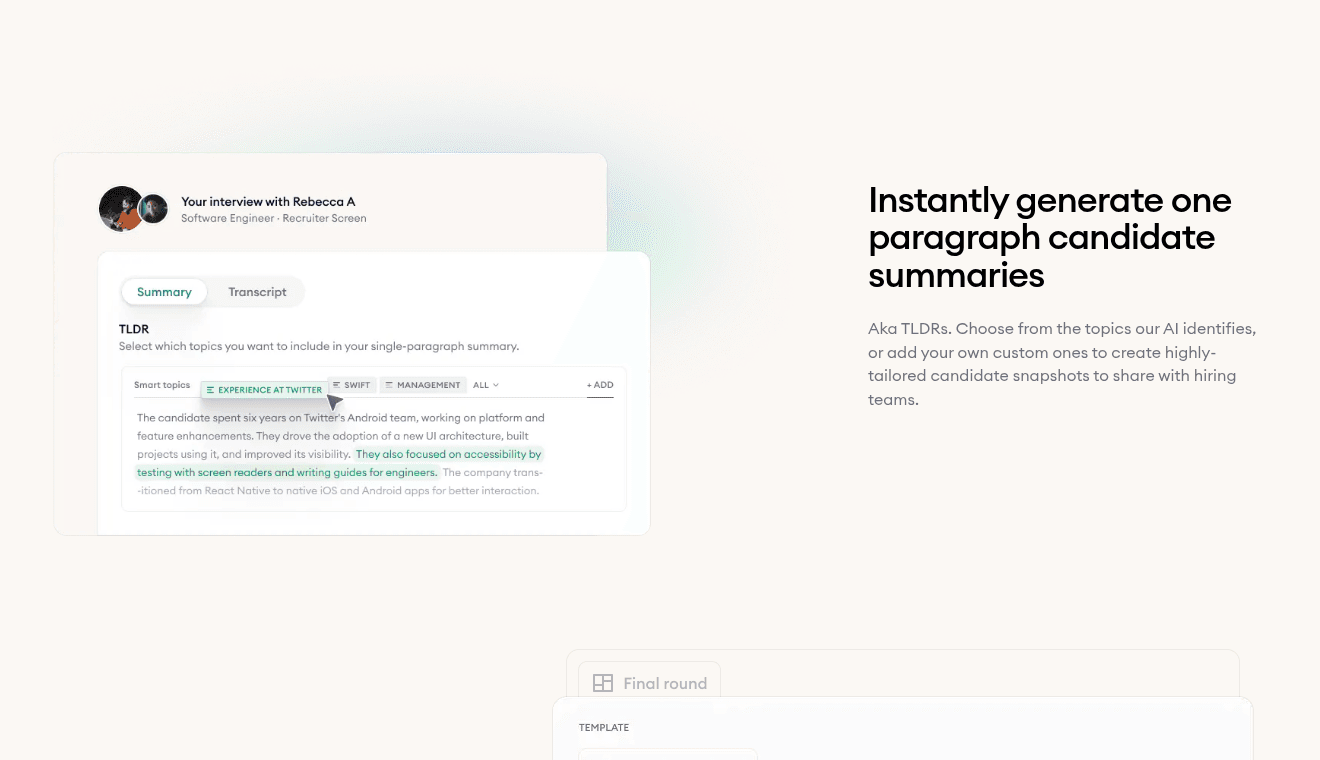
- 1Every interview lands here with candidate, role, and round on the header. The coach pulls up any specific loop in seconds, not after a tape hunt.
- 2The Q-and-A template makes leading questions, scorecard drift, and missed signals easy to spot. Coaching targets specific moments, not abstract feedback.
- 3A 90-second TLDR replaces the 30-to-60-minute tape review. The coach spends time on intervention, not reconstruction.
The implication is structural. Coaching can now run at the volume that training used to run at. Every interviewer, every quarter, with specific feedback against the rubric, without the team needing to hire 10 more interview ops people. For more on the AI-augmented-recruiter angle, see claude-for-recruiters.
Where AI gives recruiting teams leverage
Frees the recruiter from manual sourcing so the hours migrate to coaching the senior loops where the bar matters most.
Removes the CV-triage labor that used to absorb recruiter time, opening the calendar for actual interviewer coaching.
Captures every interview verbatim so the coach has structured evidence to coach on, not a hazy recollection. This is the layer that makes coaching tractable at scale.
Surfaces patterns across an interviewer's last 30 loops (leading-question frequency, time-to-score, calibration drift) so coaching targets the right behaviour.
The coaching ceiling broke when AI made interview evidence trivially accessible. The hiring teams that build the coaching loop on top of AI capture are the ones whose bar holds at scale.
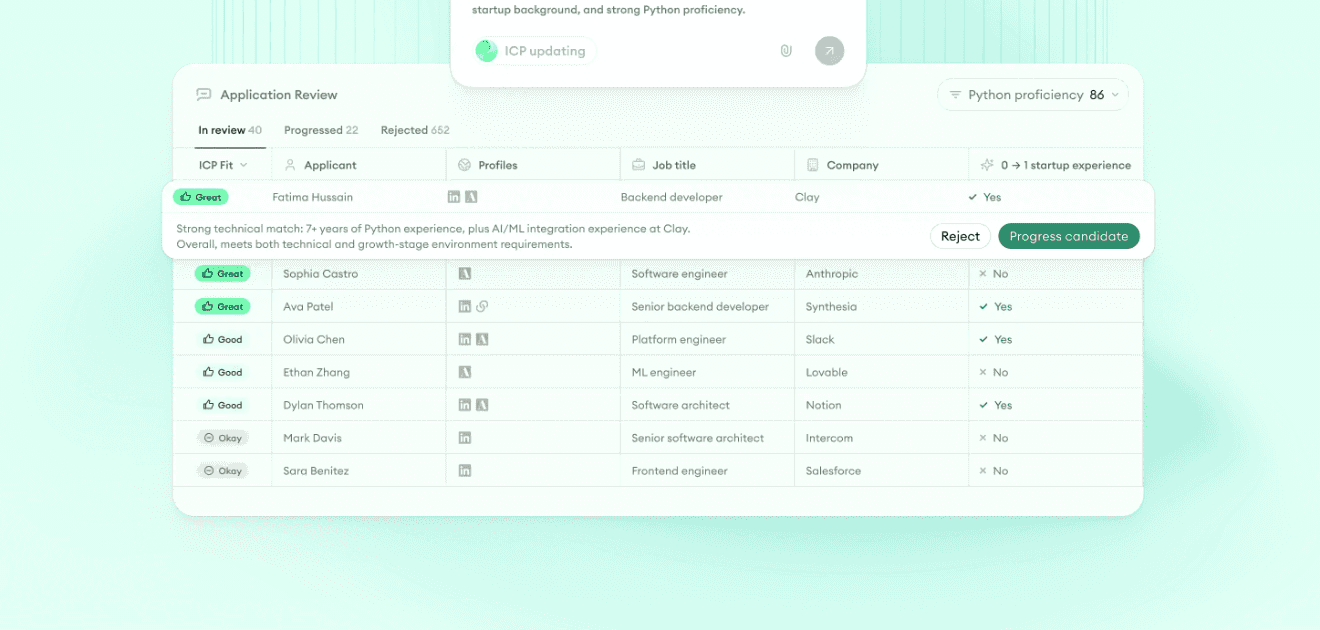
- 1CV triage was the labor that used to absorb senior recruiter hours. Ranking happens automatically; the recruiter starts at the top of the queue.
- 2Each row carries the one-sentence rationale, so the recruiter sanity-checks the verdict in seconds instead of re-reading every CV.
- 3The hours that come back from this view are the hours that pay for coaching. The math only works if the triage layer disappears first.
Metaview Notetaker captures every interview verbatim so the coach has the evidence to coach on, not a hazy recollection. Reports surfaces patterns across an interviewer's last 30 loops (leading-question frequency, time-to-score, calibration drift) so coaching targets the right behaviour. Application Review frees the senior recruiter time that gets reallocated to coaching. AI Sourcing means the recruiter's hours go to where coaching has the biggest impact: the senior loops.
Numbers from the 2026 AI & Hiring Alignment Report, surveying 505 recruiting leaders and hiring managers across North America and EMEA. The 3.8x relationship lift is the one that closes the training-vs-coaching loop: when AI captures the evidence and coaching runs at scale, the recruiter and hiring manager calibrate from the same proof instead of arguing from memory.
The operating shift
Three concrete moves for any TA leader trying to install a real coaching loop on top of an existing training program:
One: count coaching loops per quarter, not training sessions per year. If the only metric you track is training-completion percentage, you are measuring the wrong thing. Coaching frequency is the upstream driver of hire quality. Make it visible on the same dashboard.
Two: build the explicit training-to-coaching handoff. Every new interviewer gets a named coach for their first 30 loops. The first three loops get reviewed within 48 hours. The 10-loop calibration is on the calendar before training ends. The interviewer is not "trained" until they have shipped calibrated loops with active coaching.
Three: cut the per-loop coaching cost with AI capture. Stop asking managers to listen to entire interviews. Use captured interview evidence + automated pattern surfacing to deliver 5-minute coaching sessions that target the specific behaviour drift. The 30-to-60-minute manager review is the bottleneck; AI removes it.
The teams that install these three moves get interviewers who calibrate at 18 months as well as they did at 18 days. The teams that do not get bar drift that is invisible until the post-hire data shows up. That is the operating shift.
Bring Metaview into your hiring stack.
Live notes, structured scorecards, and ATS sync - set up in under 10 minutes.
Frequently asked questions
What is the difference between interviewer training and coaching?
Training is the one-off structural install: rubric, scorecard format, loop structure, do-nots. Coaching is the continuous behavioural loop after training: feedback on actual interviews, calibration against the bar, specific intervention on drift. Training is table stakes; coaching is where hire quality is made.
How fast do interviewers drift without coaching?
Most interviewers drift back to gut-feel hiring within 90 days of training. Without specific feedback on actual loops, the rubric becomes background noise. The 30-loop window after training is exactly when coaching matters most, and exactly when most teams provide none.
Why does coaching break down at scale?
Because reviewing interview tape takes 30 to 60 minutes per loop. At 200 interviews a month, no manager-of-managers structure can absorb that load manually. The pre-AI compromise was to coach only the worst performers; everyone else drifted unnoticed. AI compresses the coach's review to 5 minutes by surfacing patterns from captured evidence.
What is the right coaching cadence?
Every interviewer, every quarter, against their last 10 to 20 loops. Within that, the first 30 loops after training get coached more aggressively (review within 48 hours of the first three loops, calibration at 10 loops). After the initial intensive window, quarterly coaching sustains calibration without overloading the coach.
How do you know if your coaching loop is working?
Track hire quality at the 12-18 month mark against the original recruiting scorecard, and segment by interviewer. The interviewers receiving active coaching should produce hires whose 12-month performance matches the pre-offer prediction. The interviewers not receiving coaching will show drift. The gap is your coaching ROI.
