
Jon Bischke has been in recruiting tech longer than most of the category exists. The pattern he keeps coming back to: the teams that win are the ones with the deepest pipeline and the cleanest signal, not the ones with the loudest software.
Jon Bischke (founder of Entelo, one of the earliest recruiting-tech startups, now leading the recruiting product at ZoomInfo) joined Nolan Church on 10x Recruiting (more episodes on the 10x Recruiting hub) to talk through every wave of industry change he has seen across 15 years building category-defining recruiting products. The conversation covers what actually works in 2026 hiring, what is changing fast, and why the elite hiring teams are doubling down on data and "proof of work" instead of guesswork.
This recap covers Jon's pipeline-cures-all thesis, why proof-of-work is replacing the LinkedIn profile as the dominant signal, what agent-to-agent recruiting actually looks like, and how the best teams are using real benchmarks to raise their hiring quality.
Pipeline cures all hiring pain.
Jon's most-quoted maxim in the recruiting industry is also his bluntest.
Pipeline cures all hiring pain.”
The diagnosis: when a recruiting team is unhappy, the loudest symptoms are usually time-to-fill creeping up, candidate quality complaints, offer-accept rates slipping, and hiring managers chasing the team for updates. The underlying cause is almost always the same: the pipeline is thin. Every problem downstream of "we do not have enough qualified candidates in conversation" gets fixed automatically the moment the pipeline gets fixed.
The teams that internalize this stop treating pipeline as the second-priority work that happens after the current search is staffed. Pipeline becomes the always-on first-priority work, and individual searches just pull from the bench that is already built. The compounding effect is large; the diagnosis cost when you skip it is larger.
Proof of work beats the LinkedIn profile.
The LinkedIn profile is a self-reported resume in slightly nicer packaging. It tells you what the candidate wants you to think; it does not tell you what the candidate actually built, shipped, or moved. Jon's framing: proof of work is replacing the LinkedIn profile as the dominant signal in hiring for any role where verifiable output exists.
Engineering hiring is the clearest case. GitHub commits, contribution graphs, open-source maintenance, published technical writing. None of it is the candidate's marketing material; all of it is the candidate's actual work. The same logic extends to designers (Dribbble, real product screenshots), founders (the companies they built and the metrics they hit), researchers (published papers and citations), and even sales leaders (publicly visible deals and team-build records).
The implication for the recruiting team: stop assessing candidates on the LinkedIn version and start assessing them on the proof-of-work version. The candidate who has nothing to show is the candidate who has been operating in environments that did not let them build a public footprint. That is its own signal, neither all-positive nor all-negative, but it is the signal you actually want to evaluate against.
The agent-to-agent recruiting future.
Jon's near-future bet: agent-to-agent recruiting becomes a normal mode in the next 18-24 months. The candidate has an agent that knows their preferences, availability, comp expectations, and growth interests. The company has an agent that knows the open reqs, the criteria, the comp band, and the cultural shape. The two agents do the first round of compatibility checking before either side spends a human minute.
The mechanic looks like: the candidate's agent receives an inbound outreach, evaluates it against the candidate's stated preferences, declines on the candidate's behalf if it is a poor fit, or surfaces it for human review if it passes the filter. On the company side, the recruiting agent runs the same compatibility check on inbound interest before queueing the conversation for a recruiter. The wasted at-bats on both sides collapse to near zero.
The implications are large. Outreach quality has to be much higher because the agent filter is more rigorous than the human inbox filter. Companies that publish detailed, honest information about culture and comp will win because the candidate agents can match more accurately. Companies that hide behind vague job descriptions will lose because the agents will not be able to model them. The signal-noise ratio for both sides goes up; the friction goes down. For more on the AI-augmented-recruiter angle, see claude-for-recruiters.
Raise the bar with real benchmarks.
Most recruiting teams benchmark their funnel against their own history. The trap: if you have always converted 4% of outreach to first conversations, that becomes your normal, and you optimize within a window that is already mediocre by industry standards. Real benchmarks against industry-wide data show you where the bar actually is, not where your past has trained you to expect.
Jon's framing leans heavily on this. The teams that subscribe to real benchmarking (whether through ZoomInfo, through industry research reports, or through peer-network sharing) see the gap between their numbers and the top quartile enough to act. The teams that benchmark only against themselves stay stuck on the trajectory they have been on for years.
The most elite companies are doubling down on data, not guesswork.”
The concrete move: pick three funnel metrics that matter most for your hiring profile (likely outreach-to-reply, reply-to-onsite, and onsite-to-offer), benchmark them against the public industry data, and set quarterly targets that close the gap rather than nudge the local baseline.
What 15 years of recruiting tech actually teaches you.
Jon has watched every wave: the early sourcing tools, the rise of CRM-style recruiting, the ATS consolidations, the predictive-matching era, and now the AI-agent moment. The pattern across all of them: the loud marketing rarely matches the actual signal, and the underlying recruiting fundamentals do not change.
Pipeline still matters most. Candidate experience still wins close rates. Hiring-manager partnership still decides which search makes it through the loop intact. The tools shift; the levers that move outcomes do not. The recruiting leaders who treat each new wave as a chance to learn while keeping the fundamentals in focus outperform the ones who chase the latest category headline.
The implication for tool selection: do not buy the tool that promises the most. Buy the tool that solves your highest-use bottleneck and integrates cleanly with your existing data foundation. Jon's experience as both a founder and now a category leader makes him deeply skeptical of any pitch that does not start with "what is the specific job you need this to do." See best-ai-recruiting-tools-2026 for a curated take on the current market.
Where AI gives recruiting teams use.
The throughline across Jon's playbook: AI is the use that makes the recruiting fundamentals (pipeline, proof of work, real benchmarks) actually tractable at modern scale.
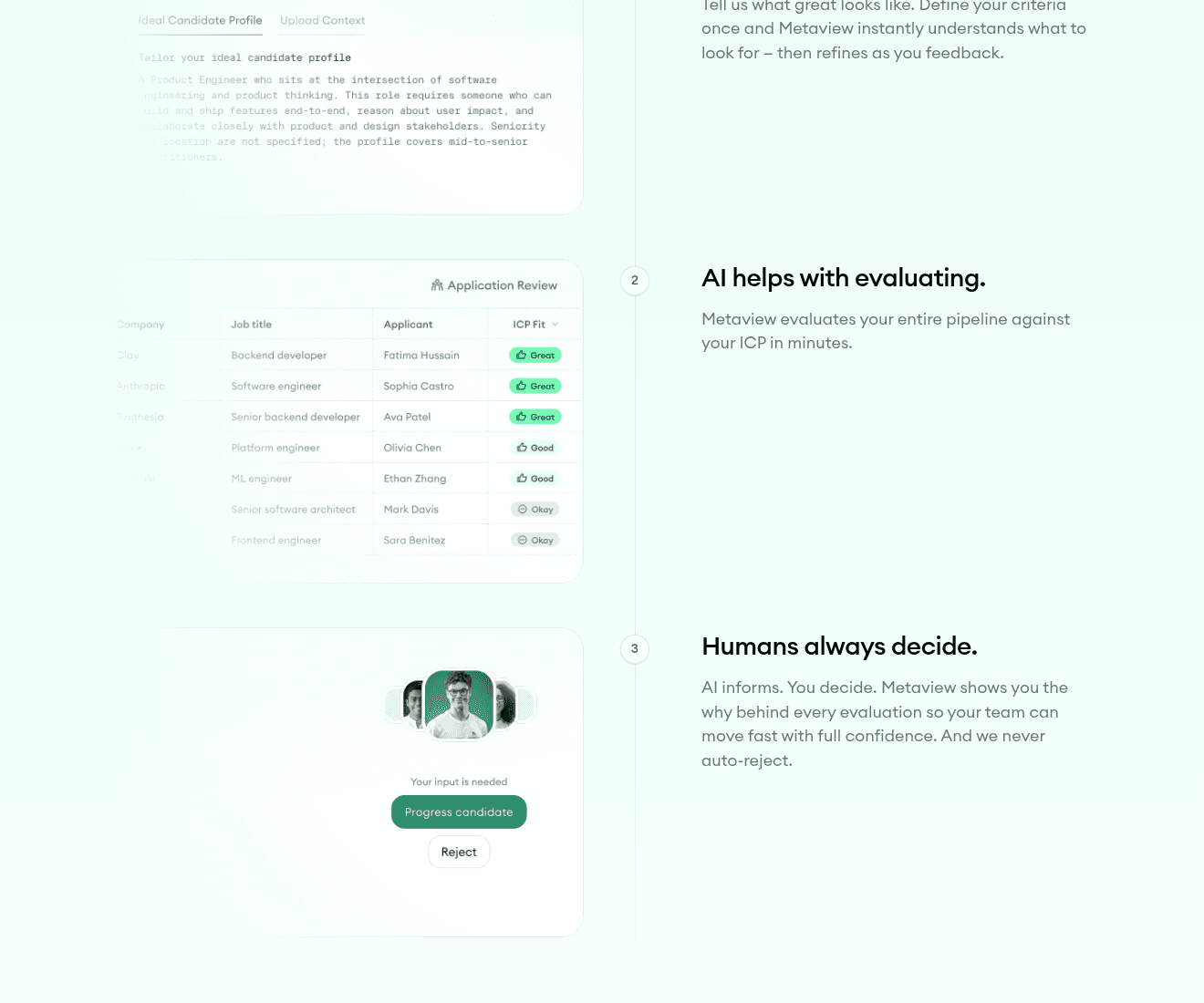
Metaview Notetaker captures every interview verbatim so the recruiting team has the data foundation to actually benchmark their funnel. AI Sourcing builds the deep pipeline that cures hiring pain, scanning for proof-of-work signals across GitHub, published writing, and verifiable output. Application Review handles the inbound volume so the senior recruiter time goes to the candidates who need real conversation. Reports closes the loop with the kind of cross-search benchmarking Jon believes the elite teams are doubling down on.
Numbers from the 2026 AI & Hiring Alignment Report, based on surveying 505 recruiting leaders and hiring managers across North America and EMEA. The 85% adoption stat tracks to Jon's prediction: the elite teams are not asking whether AI belongs in the funnel anymore; they are asking which agents to deploy where, and how to measure the result.
Heads up: The 79% business-outcomes figure applies to teams using AI across the full funnel - not just sourcing. Jon's benchmarking thesis applies here too: measuring AI impact only at the top of funnel normalizes you to a local baseline that under-counts the compounding use downstream at the offer stage.
The operating shift.
Three concrete moves from Jon's 15 years of recruiting tech for any team trying to win the 2026 talent market:
One: treat pipeline as always-on first-priority work. Stop letting it become the thing you neglect when individual searches get busy. The teams whose pipeline is healthy never have to talk about time-to-fill; the teams whose pipeline is thin talk about nothing else.
Two: shift evaluation from LinkedIn profile to proof of work. For every role where verifiable output exists, weight the public artifacts (commits, papers, products, deals, team builds) at least as heavily as the self-reported resume. The candidate who has 10 years of clean GitHub activity beats the candidate with 10 years of impressive titles every time.
Three: benchmark against industry data, not your own history. Pick three funnel metrics that matter, get external benchmarks, set quarterly targets that close the gap to the top quartile. The teams that benchmark internally stay stuck on local trajectories; the teams that benchmark externally find the levers that actually compound.
The recruiting leaders who internalize these three moves will outperform the ones still chasing category headlines. That is the operating shift.




Bring Metaview into your hiring stack.
Live notes, structured scorecards, and ATS sync - set up in under 10 minutes.
Frequently asked questions.
Why does Jon say pipeline cures all hiring pain?
Because every recurring recruiting pain (time-to-fill creeping up, candidate quality complaints, offer-accept rates slipping, hiring managers chasing the team) traces back to the same root cause: the pipeline is thin. Teams that treat pipeline as always-on first-priority work stop having most of those downstream conversations. Pipeline neglect is the highest-use problem most TA teams ignore.
What does "proof of work" mean in recruiting?
Verifiable artifacts of the candidate's actual output: GitHub commits and contributions for engineers, Dribbble and shipped product screenshots for designers, published writing or research for technical roles, companies built and metrics hit for founders, publicly visible deals and team-build records for sales leaders. Proof of work beats the LinkedIn profile because it is what the candidate actually did, not what they wrote about themselves.
What is agent-to-agent recruiting?
A future state where the candidate has an AI agent that knows their preferences, availability, comp expectations, and growth interests, and the company has a recruiting agent that knows the open reqs and criteria. The two agents do the first round of compatibility filtering before either side spends a human minute. Companies that publish honest, detailed information about culture and comp will win because the candidate agents can match more accurately.
Why does benchmarking internally fall short?
Because internal benchmarks normalize you to your own past. If you have always converted 4% of outreach to first conversations, that becomes your normal, and you optimize within a window that is already mediocre by industry standards. Industry-wide benchmarks show you where the bar actually is. The teams that close the gap to the top quartile rather than nudging their local baseline are the ones that compound.
What is the most important lesson from 15 years of recruiting tech?
The fundamentals do not change. Pipeline matters most. Candidate experience wins close rates. Hiring-manager partnership decides which search ships clean. The tools shift, the categories rebrand, but the levers that move hiring outcomes are stable. Pick the tool that solves your highest-use bottleneck and integrates with your existing data foundation. Skip the rest.
