
When hiring feels hard, most teams respond by interviewing more candidates. More conversations feel like more diligence. Most of the time, they signal the opposite: the team is using interviews to discover whether a candidate fits the role, instead of using interviews to validate a fit the screen already confirmed.
That is what a rising interview-to-offer ratio is actually telling you. Not that your interviewers are too picky. Not that the bar is too high. The ratio is a quality signal that points upstream: imprecise sourcing, weak screening, or unclear success criteria are pushing uncertainty into the most expensive stage of the funnel. The interviewers do the right job, which is filtering. The cost is that the filtering happens late, with the most senior people in the room.
This is a TA-leader guide to reading the interview-to-offer ratio as a diagnostic. The four upstream disciplines that move it. The interview-intelligence layer that makes the upstream lever visible instead of guessed at. And a 7-day audit to find your own lever and ship the fix.
What the interview-to-offer ratio actually measures.
The interview-to-offer ratio is the number of interviews your team runs for every offer it extends. If you run 40 interviews and extend 4 offers, the ratio is 10:1. Simple math, hard meaning. The number sits between time-to-hire (which measures recruiting speed) and offer-acceptance rate (which measures closing). It tells you how efficiently candidate conversations turn into hiring decisions.
What it does not tell you, on its own, is why. A high ratio could mean the screen is letting too many candidates through. It could mean the calibration brief drifted between intake and panel. It could mean the panel is testing for the wrong stakes. Read in isolation, the ratio is a temperature reading: it tells you something is off, but not what or where. Read with structured interview signal underneath it, the ratio becomes a diagnostic that points at the lever.
According to Metaview’s 2026 AI & Hiring Alignment Report - surveying 505 recruiting leaders and hiring managers across North America and EMEA - 67% of teams lose qualified candidates to competitors who move faster every month. A bloated interview-to-offer ratio is one of the most common ways that loss shows up on the inside. Every extra interview round adds days between the strong signal in round 1 and the offer call. By the time the offer lands, the candidate already accepted somewhere else.
I look at it as a three to one ratio always. If you have three candidates in pipeline, one person should move forward. If you’re not getting an offer expected from those metrics, something is wrong either in process, or in the candidates that you’re sourcing.”

Chris Adams on the 3:1 ratio (10x Recruiting #5).
Where high ratios actually come from.
Four upstream disciplines drive the ratio. Each one pushes uncertainty into a different part of the funnel when it is missing. Almost every high-ratio team is missing two or three. The trick is reading which two or three from the signal in the interviews themselves.
1. Sourcing precision.
Broad, keyword-driven sourcing brings in candidates who look acceptable on paper but fail the deeper evaluation interviews are meant to confirm. Every candidate who got pulled in because the keyword matched but the signal did not has to be filtered out by an interview. The cost of filtering in a 45-minute screen is low. The cost of filtering in a 4-hour onsite is high. Sourcing precision moves the filtering forward to the cheapest stage.
The fix is not lower volume. It is sharper targeting against the must-haves the team wrote in intake. AI Sourcing learns from every yes/no the recruiter and hiring manager give it. Over a search, the candidate slate gets more accurate. Over a quarter, the company-wide picture of what good looks like for each role gets sharper.
2. Screening that tests for what interviews will validate.
A screen that filters on availability and surface-level experience hands the interview stage every actual judgment call. The reason most screens look like this is that the team has not agreed on what the screen is actually for. When the screen tests for the same competency the panel will test for, deeper, the screen becomes a real filter instead of a logistics check. Application Review grades against the same rubric the panel uses, and the screen rejections feed back into the sourcing model.
3. Role-clarity that survives intake.
The most common failure mode is that the calibration brief never gets written down. The hiring manager has a strong gut sense. The recruiter writes a one-paragraph job spec from a 20-minute call. By interview five, the bar has drifted twice. The panel is calibrating against three different versions of the role, and every disagreement gets adjudicated in real time by whoever has the loudest voice. Capture the intake meeting, structure the must-haves and trade-offs and deal-breakers, and link the captured brief to every panel invite. The drift stops.
4. Scorecard signal that survives between rounds.
By round four, the panel has heard the candidate say different things to different people. The recruiter has the strongest context and the worst notes. The technical interviewer has the sharpest read on the technical bar and no view of cross-functional fit. Without a capture layer, the offer call runs on the senior interviewer’s best recollection plus whatever the panel remembered to write down. A high ratio in this state is a math artifact: the team is interviewing more candidates because each round is producing weaker signal than it should.
Notetaker captures every spoken word in the interview and writes the scorecard against the rubric the team set in intake. The signal stops evaporating between rounds. The team walks into round 4 already calibrated against rounds 1, 2, and 3, instead of reconstructing them under pressure.
How interview intelligence diagnoses the lever.
Most teams know their ratio is high. Almost none know why. The reason is that the data needed to diagnose it lives in scattered Slack threads, scorecard free-text fields, and recruiter memory. The funnel report shows the conversion drop. It does not show which competency failed at which stage. The team ends up arguing about whether interviewers are picky, when the actual answer is in the structured rejection reasons that nobody has structured.
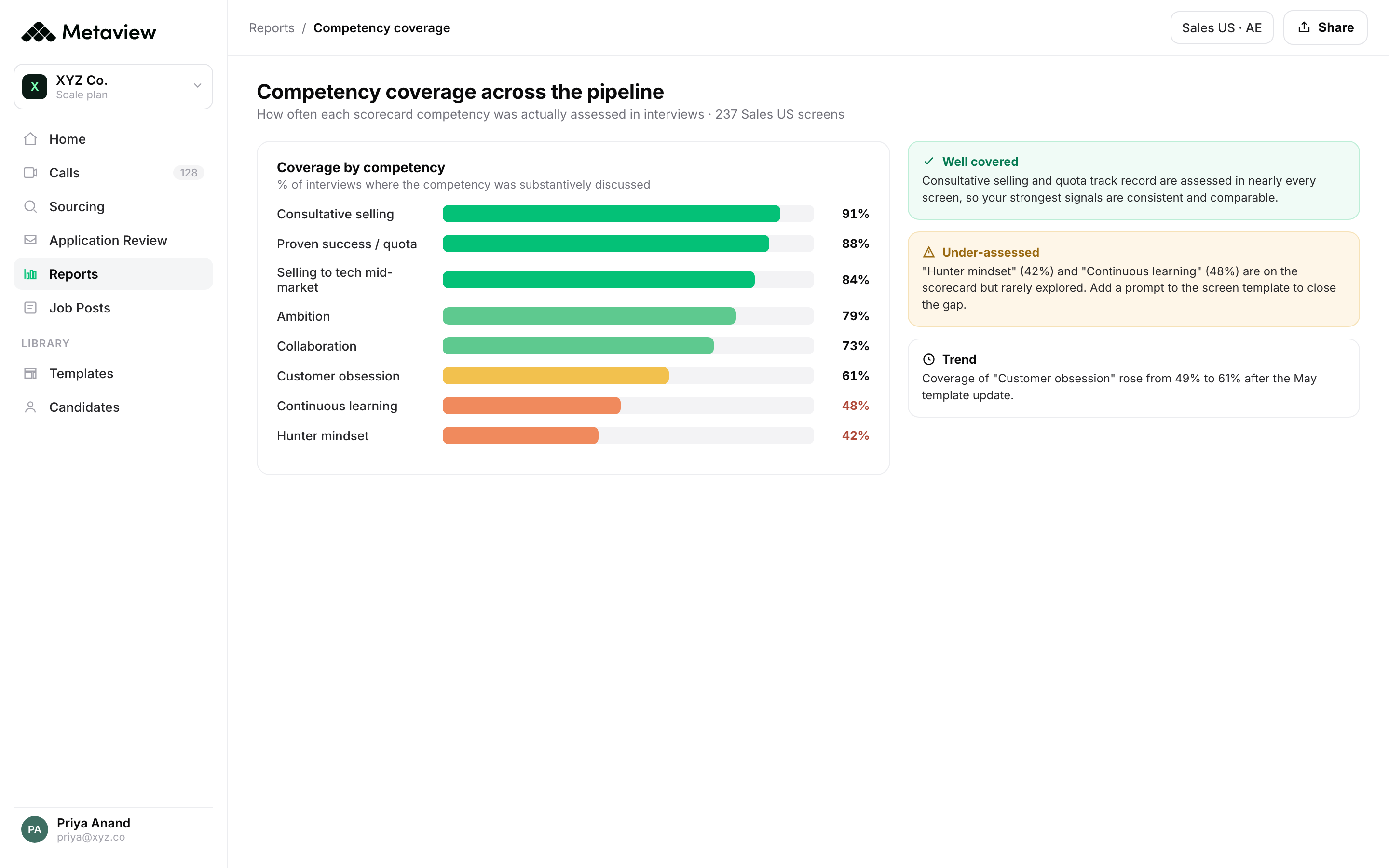
When interviews are captured and structured, every rejection becomes a tagged competency assessment. Pull every Staff Engineer rejected in round 2 and you can see whether they failed on system design (calibration brief problem), failed on coding fundamentals (screen problem), or failed because the role description was unclear in the screen (intake problem). The diagnosis lands in minutes, against the actual conversation data, instead of escalating to a quarter-long debate about whether the hiring manager is being too strict.
Without structured signal vs. with it.
The contrast is not Manual vs. AI. It is whether the interview signal lives as structured data or as scattered impressions. Same interviewers, same candidates, completely different ability to read the ratio as a diagnostic.
- Rejection reasons live in scattered Slack threads and unstructured scorecard fields.
- Funnel reports show conversion drops but not why candidates dropped at each stage.
- Recruiter and hiring manager argue about what “good” looks like one role at a time.
- A high ratio gets attributed to picky interviewers, and the upstream lever stays invisible.
- Every rejection reason is tagged to a competency, captured against the rubric, queryable across the corpus.
- Funnel reports show the exact competency that broke at each stage, segmented by source and recruiter.
- Calibration runs against captured signal, not against memory. The rubric the team agreed on in week one is still visible in week four.
- A high ratio gets traced to its actual cause: sourcing, screening, or calibration drift. The fix lands in days, not quarters.
What teams running this play are seeing.
The pattern is consistent: when the interview signal moves from notes to structured data, the ratio improves because the upstream lever gets fixed, not because the bar drops. Offer-acceptance climbs in parallel, because the offers go to candidates who got more rigorous signal earlier and waited less time between strong-yes and offer call.
At Brex, Danielle Harders rebuilt the interview process around structured signal captured from every panel. Offer-to-acceptance jumped from 25-30% to around 50%, a 20 percentage point swing. The lift did not come from a new sourcing channel. It came from the team having objective criteria to talk about instead of subjective debate about whether someone felt right for the role.

Quality of hire starts with quality of interview. If funnel conversions don’t make sense or aren’t where we want them to be, my next step is to look at Metaview and see what’s happening with these interviews to try to get to the root cause.”

 Metaview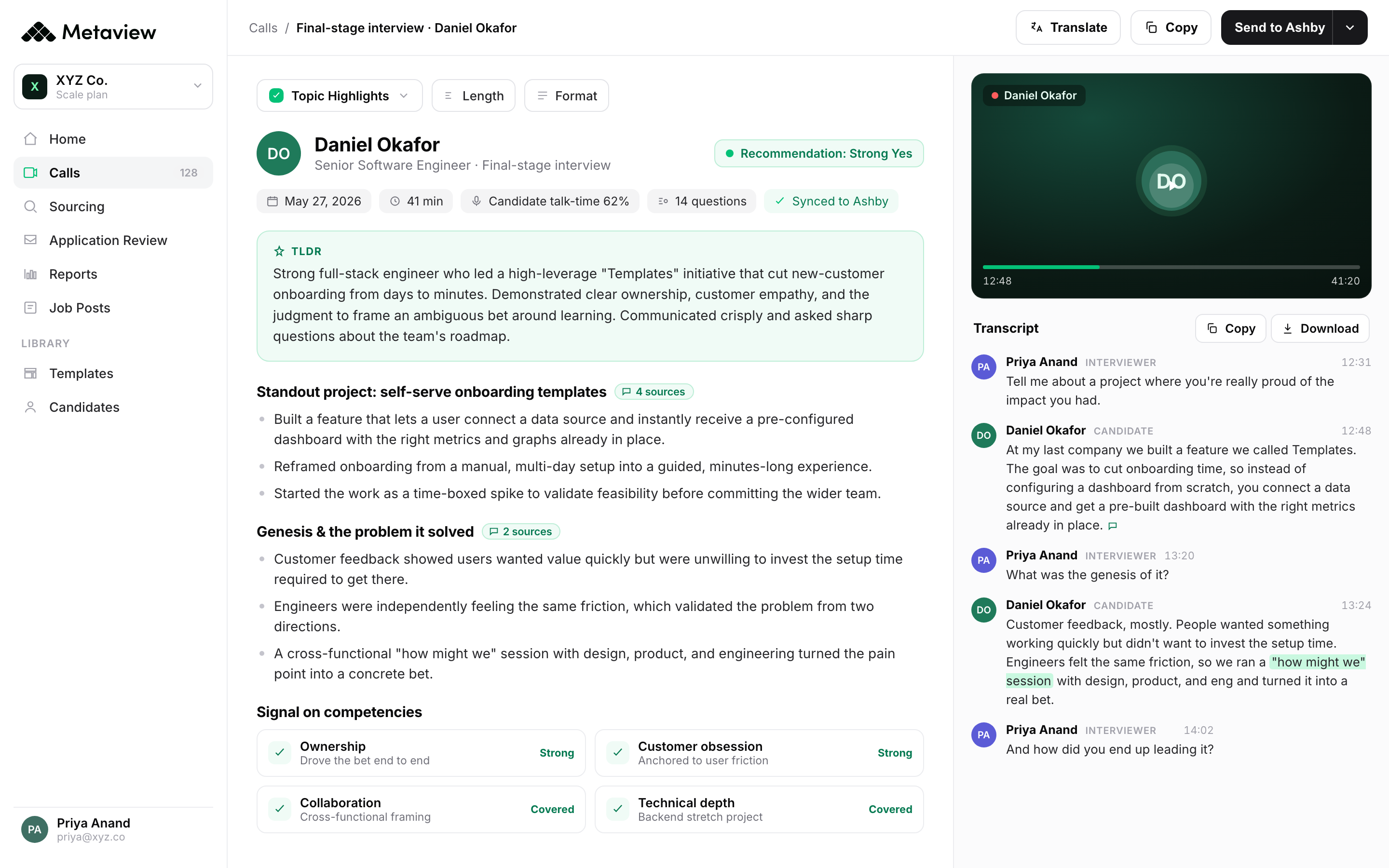
At 4,000+ organizations on the Metaview platform, the same pattern repeats. The number that moves first is the interview-to-offer ratio. Then offer-acceptance. Then time-to-hire. The capture layer turns each one from a board-meeting number into a workflow the team can operate on every week.
How to audit your own ratio in 7 days.
A practical sequence for a TA leader who wants to read their own ratio as a diagnostic before reacting to it. One week, one role at a time. The point is not to fix everything. The point is to find the upstream lever and ship the fix on the next open requisition.
- Day 1. Pull the ratio for the last 6 months by role family. Segment by sourcing channel and by recruiter. The cuts where the ratio is more than 2x the median for the same role family are the diagnostic targets. Pick one.
- Day 2. For that cut, list every rejection across every stage. If the rejections are concentrated in round 1, the screen is too loose. If concentrated in round 3 after consistent strong-yes reads, calibration drifted. If spread evenly, sourcing precision is the lever.
- Day 3. Pull the intake brief for the role. If there is no intake brief in writing, the calibration discipline is missing and that is the fix. Run the intake meeting with the hiring manager this week. Three must-haves, two trade-offs, one deal-breaker, written down.
- Day 4. Read the screen rubric. Does it test for the same competency the panel tests for, just earlier? If not, rewrite the screen rubric to mirror round 1 of the panel. The screen becomes a real filter, not a logistics check.
- Day 5. If the lever is sourcing, audit the candidates who reached round 1 from each source. The source where rejection reasons cluster around one missing competency is the source that is mis-targeted. Adjust the sourcing brief to test for that competency upstream.
- Day 6. Run one validation interview against the captured signal from a recent strong-yes hire who has been in role for 90 days. The competencies the team graded highly should be the ones that map to early performance. Mismatches are calibration debt.
- Day 7. Ship the fix on the next open requisition for that role. Re-baseline the ratio in 4 weeks. The first lift is usually visible inside the first 5 candidates through the new screen.
Bring Metaview into your hiring stack.
Live notes, structured scorecards, and ATS sync - set up in under 10 minutes.
Frequently asked.
Is there a “good” interview-to-offer ratio?
There is no universal benchmark. The right range depends on role seniority, source mix, market conditions, and how much risk your team is willing to absorb in the first 90 days. A 4:1 ratio for a generalist role with strong inbound is healthy. A 4:1 for a Staff Engineer search probably means the screen is letting too many through. The pattern that matters is whether the ratio trends down as your process matures, not the absolute number.
Should I always try to push the ratio lower?
No. The goal is the right number for the role, not the lowest possible number. An overly low ratio can mean under-interviewing, which raises hiring risk if it reflects weak signal rather than strong sourcing. Optimize for the ratio that ships the right hires consistently, not for the ratio that looks best in a board deck.
Why is the lever upstream and not in the interviews themselves?
A high ratio means the team is making more interview decisions than it needs to. Almost every time, the reason is that the upstream filter is letting candidates through who do not match the role’s actual signal. The interviewers are doing the right job: filtering. The cost is that the filtering is happening at the most expensive stage, with the most senior people, instead of in the screen.
How do I diagnose where in the funnel the ratio is breaking?
Segment your ratio by source and by stage. If candidates from source A convert at 8:1 and source B at 18:1, the lever is sourcing precision. If most rejections happen in round 1, the screen is too loose. If most happen in round 3 after consistent strong-yes reads in rounds 1 and 2, the calibration brief drifted between intake and panel. Structured interview signal makes all three cuts queryable instead of investigation projects.
What changes when interview signal is structured instead of noted?
Rejection reasons stop living in scattered notes. They live as tagged competency assessments against the rubric the team set in intake. That makes patterns visible: every Staff Engineer rejected in round 2 cited the same gap on system design. Every sales hire who reached round 4 and dropped flagged a comp mismatch in screen. The ratio stops being a single number and becomes a diagnostic that points at the lever.
How does this relate to offer-acceptance rate and time-to-hire?
All three move together when the upstream fix lands. A tighter interview-to-offer ratio means the team is making decisions on stronger signal, so offer-acceptance climbs (the candidates getting offers are better-fit and have been more thoroughly assessed). Fewer interviews per offer means time-to-hire compresses on the same headcount. Brex saw their offer-acceptance jump from 25-30% to around 50% after switching to structured interview signal. The ratio improvement was the leading indicator.
