
The ideal candidate profile sitting in your Notion doc gets opened twice. Once, when the recruiter writes it after a kickoff call. Once again, three weeks later, when the hiring manager asks why nobody in the pipeline matches. By candidate five, the criteria have already drifted, the recruiter is screening from memory, and the doc is a fossil.
Most ICP advice tells you to define harder. Better outcomes statements. Tighter must-haves. A behavioral signal column. The advice is not wrong, it is just aimed at the wrong layer. The ICP is not a definition problem. It is a capture problem. The version of "good" that actually decides hires lives in the hiring manager's verbatim language during intake, calibration, and debrief, not in a document anyone has time to maintain.
This guide rebuilds the ICP around capture. Why static profiles drift inside 30 days, the five jobs an ICP has to do (not one), how to capture it from the intake call instead of a template, and a 7-step framework for keeping it alive from intake to offer. The frame: the ICP that drives hiring is the one that shows up inside every screen, every interview, and every debrief, automatically, without anyone updating a doc.
Why static ICPs die in 30 days.
There is a predictable lifecycle for a written ideal candidate profile. Week 1, the recruiter and hiring manager run a kickoff. The recruiter takes notes, writes up a clean one-pager, and circulates it. Week 2, sourcing kicks off against the profile. Week 3, the first 5 candidates hit the recruiter screen. Two are obvious yeses, two are obvious nos, and one is the ambiguous middle the hiring manager has to decide on. They decide. That decision is the moment the static ICP starts to die, because nothing about the decision goes back into the doc.
By week 4, the hiring manager has reframed the role twice without telling anyone. Maybe the role was supposed to be a player-coach and they have decided it is really a senior IC. Maybe the must-have they listed as "customer support background" has quietly become "can build a help center from scratch." The recruiter is still screening against the original doc, and a third of the candidates getting through the screen are being rejected at the hiring manager step for reasons the doc never anticipated. That gap is the drift.
Drift is not a discipline problem. It is structural. A document captures the best version of what someone could articulate in a 45-minute meeting. The actual criteria live in pattern recognition the hiring manager develops while looking at real candidates, and that pattern keeps updating whether or not anyone is writing it down. The version of the ICP that decides hires is always the most recent one in the hiring manager's head. The version on paper is always 5 candidates behind.
The implication is uncomfortable for any team that has invested in better templates: a sharper template will not save you. A template is still a document. The fix has to move the ICP off the page and into the workflow.
What an ICP actually needs to do (5 jobs, not 1).
Most ICPs only do one job: they tell sourcing what to look for. That is why they fail. An ICP that only feeds sourcing is a search string, not a hiring operating system. According to Metaview's 2026 AI & Hiring Alignment Report - surveying 505 recruiting leaders and hiring managers across North America and EMEA - searches that begin with high recruiter and hiring-manager alignment finish hires faster, with better candidate quality, and far less panel rework. Alignment at kickoff requires the ICP to be live across the whole workflow, not just the sourcing tab.
A working ICP does five jobs at once. One: it tells sourcing what to search for, in both keyword and behavioral form. Two: it tells the recruiter what to score against on the screen, and at what weight. Three: it tells every interviewer what competency they are responsible for assessing and what "good" sounds like for it. Four: it tells the candidate what success in the role actually looks like, so they can self-select in or out instead of leaving you to do it. Five: it tells the offer-prep and debrief team what to calibrate against, and what to learn from when a hire works or does not.
Most teams write their ICP for job one and assume jobs two through five will happen by osmosis. They do not. The ICP that runs five jobs at once looks structurally different from the ICP that runs one: it is structured, rubric-aligned, score-able, and lives where the work happens, not where the documents live.
This ICP, the ideal candidate profile, is your primary work product as a recruiter now. Engineer the context such that the AI understands what you’re looking for just as well as you do, and then use that context in any part of the workflow where it makes sense.”

Capture the ICP from the intake call, not a template.
The intake call is the single highest-signal conversation in the entire hiring cycle. It is the only time the hiring manager is fully present, has not yet been worn down by candidate noise, and is talking about the role in their own language. Almost every team treats it like a meeting they will summarize later. The summary is where the ICP starts to die.
The right intake is structured around three prompts, not a template. One: describe the last great hire on the team, with names and specific behaviors. What did they do in the first 90 days that other people in the role did not do? Two: describe the last hire that did not work, with the same specificity. What did you see in week six that you wish you had seen in the interview? Three: describe the three concrete projects this person will own in their first six months. Not the role on paper, the work on the calendar.
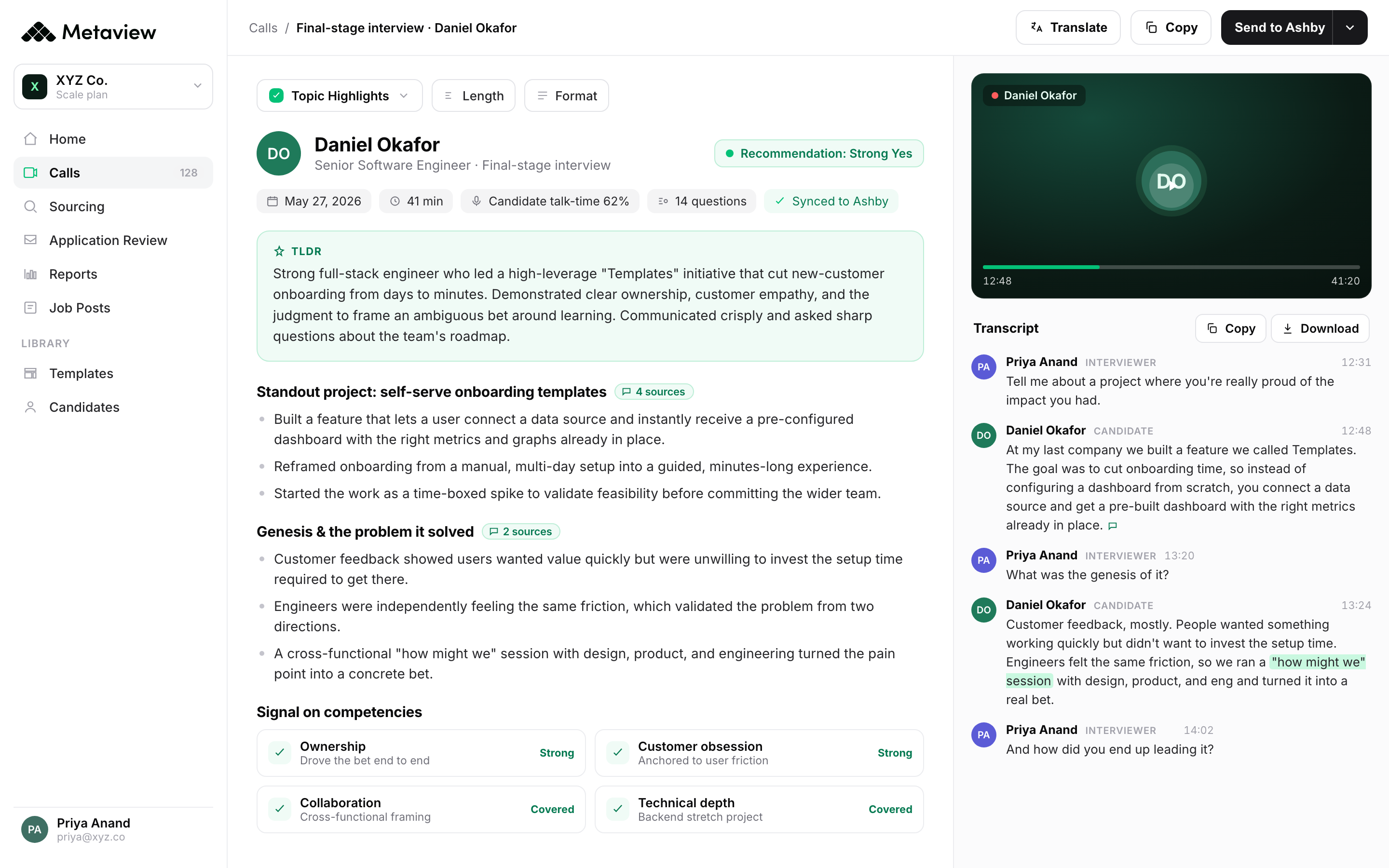
Those three prompts produce verbatim language. "They could de-escalate an angry director without escalating to me." "They kept saying they would scope it and never did." "They will own the migration from Zendesk to the internal stack by end of Q3." That language is the raw ICP. Run it through a transcript, extract the recurring competencies, and you have a profile that is anchored in real evidence, not abstractions like "strong communicator" or "self-starter."
The infrastructure to do this used to be a recruiter with very fast typing. It is now an interview-intelligence tool that captures the call, identifies the must-have language, and surfaces it inline. Whichever route you take, the work product is the same: a profile built from specific behaviors that the hiring manager actually named, not from a generic rubric.
Static doc vs Generic AI vs Living ICP: the side-by-side.
Three patterns dominate ICP work today. The static doc, the generic AI rubric, and the living ICP. They look similar on the surface (all three produce a one-pager), but they perform very differently across the five jobs above. Here is the side-by-side on dimensions teams actually feel.
| Dimension | Static doc (Notion / Google Doc) | Generic AI rubric (LLM-generated) | Living ICP (Metaview) |
|---|---|---|---|
| Source of language | Recruiter's reconstruction of the kickoff; abstract qualities. | LLM's prior on what a role like this needs; not your hiring manager's. | Verbatim hiring-manager language captured live during intake. |
| Where it lives | A document opened twice (write, archive). | A document with better starting prose, still archived. | Inside the workflow: sourcing query, screening rubric, interview prompts, debrief scorecard. |
| Drift response | None. The doc is unchanged at hire #5 and hire #15. | None. The rubric is static; the calibration data sits elsewhere. | Calibration feedback from every interview re-tunes the profile automatically. |
| Interviewer visibility | Each interviewer reads or skips the doc. | Same as static; the rubric does not appear in the interview. | Rubric questions surface in the interview UI before each panelist asks them. |
| Hiring-manager comfort | Recognizes maybe 40% of the language as their own. | Recognizes 10 to 20%; the rest sounds generic. | Recognizes 80%+ because the words are their own from intake. |
| Calibration loop | None. No structured feedback from hire to ICP. | None at the tool layer; feedback never reaches the rubric. | Every fit / no-fit decision feeds back into the ICP, sharpening it over time. |
The static-vs-living distinction is not about templates. Both static docs and generic AI rubrics produce documents. The living ICP produces signal that travels with the workflow, which is why it survives the drift that kills the other two by candidate five.
Surface the ICP inside every interview, not just the kickoff.
The single intervention that compresses ICP drift is structural: surface the criteria inside the interview itself, not in a doc the interviewer might or might not have read. That means rubric prompts visible to each interviewer before they ask their question, score-able dimensions inline as they listen, and a cross-panel summary that exposes inconsistency the moment it shows up. The interview stops being where the ICP gets ignored, and becomes where it gets enforced.
The same shift changes what a recruiter does at the network level. Instead of chasing scorecards, the recruiter watches a coverage dashboard: did every panelist actually assess the competencies the ICP says matter? Where are the consistent gaps? Which interviewer is over-indexing on one competency and under-indexing on three others? Those questions used to require listening back to recordings nobody had time to listen to. They are now a single view.
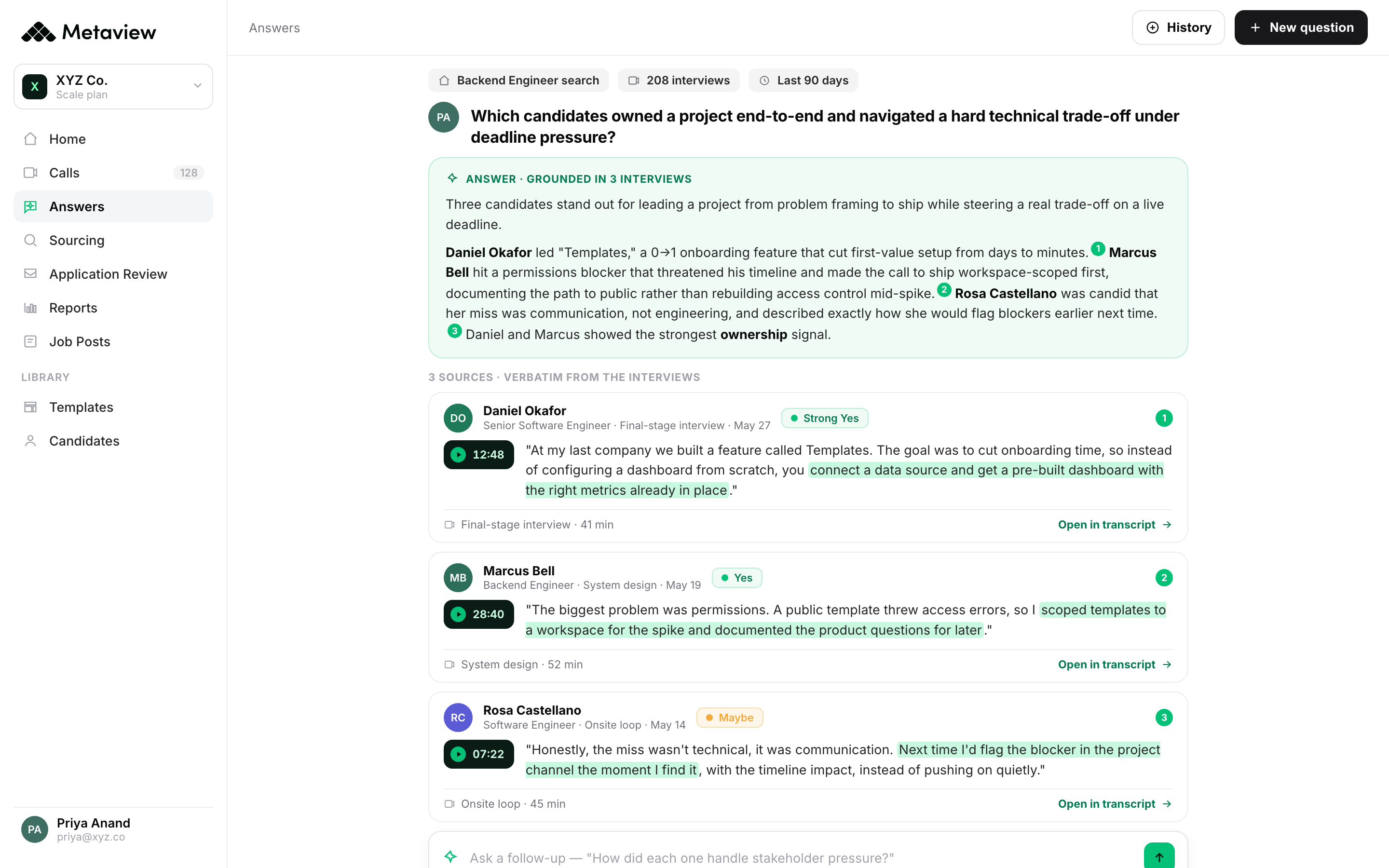
- 1ICP criteria become live queries. The recruiter can ask plain-language questions of every interview captured against the profile.
- 2Each ICP competency becomes a score-able dimension inline. Interviewers see what good sounds like before they ask, not after.
- 3Cross-panel consistency is visible the moment a panel finishes. Variance against the ICP shows up before the debrief, not three candidates later.
None of this requires interviewers to change their behavior. The structure of the workflow does the work, not the discipline of individual panelists. That is the only version of ICP enforcement that scales past one hiring manager.
The 7-step living ICP framework.
The framework below is the operational playbook for keeping an ICP alive from intake through offer. It assumes you have an interview-intelligence layer that captures calls and surfaces structure; if you do not, treat steps 1, 4, and 6 as manual and budget accordingly. Each step is the seam where drift either gets caught or gets locked in.
- Step 1. Run an outcomes-first intake call. Record it. Ask the three prompts from section 3 (last great hire, last failed hire, three concrete first-six-month projects). The deliverable is a transcript, not a doc.
- Step 2. Capture the hiring manager's verbatim language for "good." Pull every line where the hiring manager describes specific behaviors. Group by competency. This is the raw ICP.
- Step 3. Translate into 5 to 7 specific behaviors, not abstract qualities. "Communicates clearly" is useless. "De-escalates an angry director without escalating to me" is useful. The translation should preserve the hiring manager's words wherever possible.
- Step 4. Build the screening rubric from the captured language. Each behavior becomes a screening question and a 4-point score scale with what "good" sounds like at each level. The rubric is the ICP in interview form.
- Step 5. Pre-load every interviewer with the rubric before the call. Not in a doc to be read, in the interview UI itself, as the prompt for each panelist's competency. The interviewer cannot miss the rubric because the rubric is the workflow.
- Step 6. Score against the rubric at the end of every interview. Auto-fill from the structured capture where possible; require interviewer judgment for the rest. Every score becomes a calibration data point for the ICP itself.
- Step 7. Calibrate against the ICP at offer time; update the ICP at hire time. Before the offer, review the candidate against the rubric one more time as a panel. After the hire, run a 30 / 60 / 90 retro and feed what surprised you back into the ICP for the next role.
Calibration is the most important factor in terms of getting started. You go through the intricacies of the role, build a quick calibration of 20 candidates, go into a sync with that founder and really dial in on each profile, indicating why they're not a fit or why they are a fit.”

Scott Bianco frames taste as the recruiting moat: the hiring manager's taste, their verbatim language about what good looks like, IS the ICP. The job is to capture and operationalize it.
Common ways teams break the ICP (and how to spot it).
Most ICP failures are not theoretical. They follow a small set of recurring patterns, all of which are recoverable if you spot them inside the first 5 candidates.
Writing the ICP in recruiter-speak the hiring manager does not recognize.
If the hiring manager reads the ICP and says "yeah, looks good," it is either correct or, far more often, generic enough that they cannot disagree. Test by reading the ICP back as a list of specific behaviors and asking which two they would cut. If they cannot cut anything, the ICP is not yet discriminating. Sharpen until they push back.
Not re-capturing after the first 5 candidates expose drift.
By candidate 5, every hiring manager has reframed the role at least once based on what they saw in real candidates. If your ICP has not been touched since the kickoff, the drift is already 3 to 5 days old. Schedule the re-capture before candidate 5, not after.
Keeping the ICP separate from the interview itself.
An ICP in a Notion doc is theatrical compliance. An ICP that appears as the prompt for each panelist's competency, inside the interview tool, is operational. The first costs nothing to maintain and produces nothing. The second costs almost nothing to maintain and decides hires.
Leaving the ICP at intake, never feeding calibration data back.
Most teams stop updating the ICP the moment the recruiter sends the first search. The retro never happens. The next role re-runs the kickoff from scratch instead of refining what already exists. Compounding only starts when the calibration loop is closed.
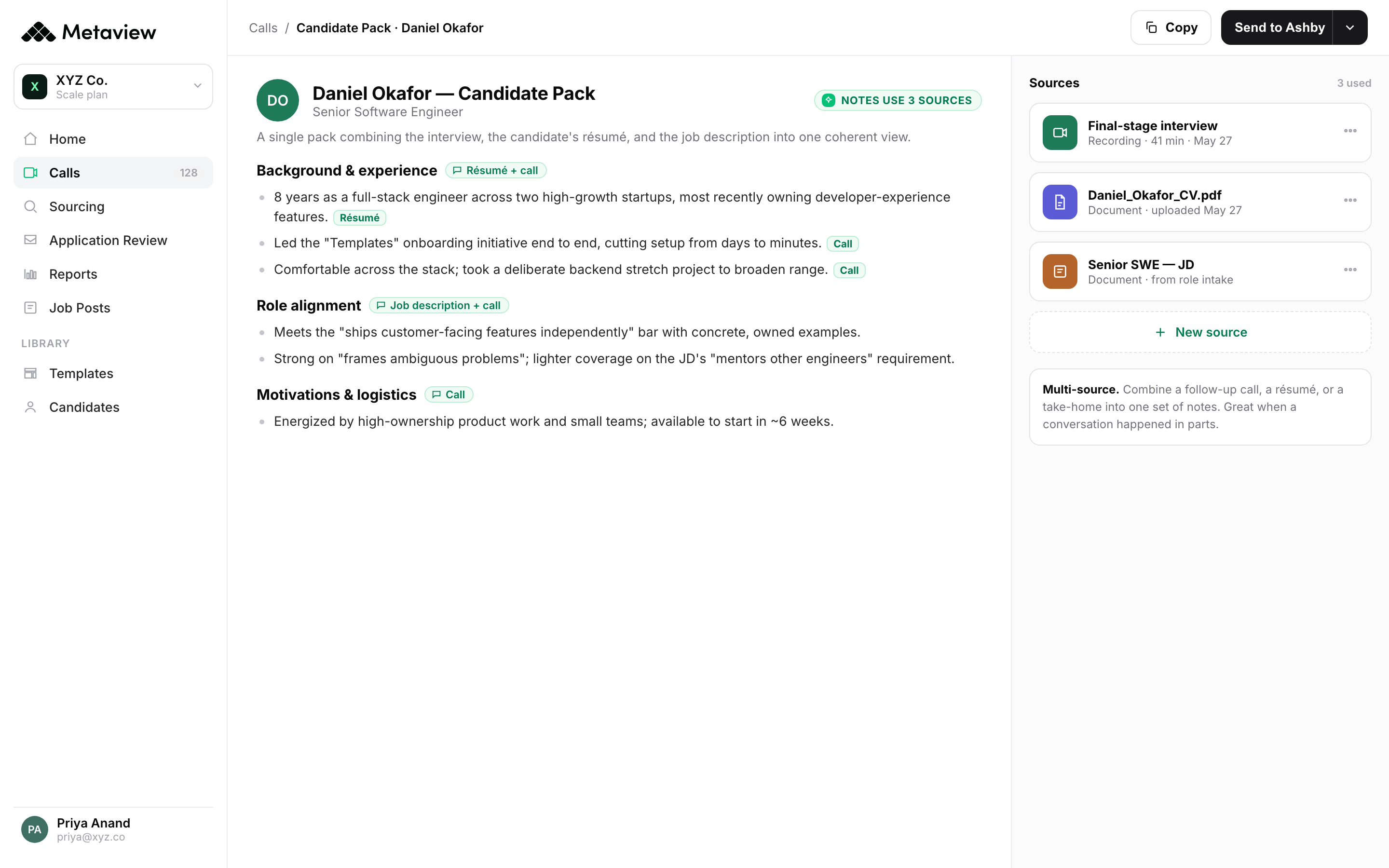
See how Metaview captures the hiring manager's language live, builds the rubric, and surfaces it inside every interview that follows.
Frequently asked questions.
How detailed should an ideal candidate profile be?
Detailed enough that you can run a screening rubric and an interview rubric from it without inventing new criteria, and short enough that every interviewer can read it in under 90 seconds before a call. Five to seven specific behaviors with a 4-point score scale per behavior is the working zone for most roles. If you cannot fit it on one screen, the ICP is doing too many jobs and needs to be split.
How often should you update an ideal candidate profile?
Re-capture after the first 5 candidates pass the recruiter screen, again at offer time, and once more at the 30 / 60 / 90 retro after the hire. Treat it like a product spec with versions, not a one-time deliverable. Most drift gets locked in because the second update never happens.
Should every role have a different ideal candidate profile?
Yes. The temptation to clone an ICP across two senior IC roles in the same team almost always introduces drift, because each role has different concrete projects in its first six months. Even when the job title is identical across two reqs, run the three intake prompts cleanly for each and only merge the ICPs if they survive 90% overlap on specific behaviors.
How do you know if your ideal candidate profile is working?
Three operational signals. First, fewer surprise rejections at the hiring-manager step (the recruiter screen catches most mismatches earlier). Second, panel scorecards converge instead of diverging (interviewers are assessing the same competencies). Third, the time between the recruiter screen and the offer compresses, because debrief is anchored in shared language instead of feelings.
Can an ideal candidate profile reduce bias in hiring?
Yes, when the ICP is built from specific behaviors and the interview scoring runs against the same rubric for every candidate. The mechanism is not the document itself, it is the structure: when every panelist sees the same rubric question and scores against the same 4-point scale, individual interviewer drift compresses. The ICP itself still has to be audited for bias in the criteria, but a behavior-based rubric scored consistently is the strongest tool any team has against pattern-matching.
