
Bad interviewers don't think they're bad. That's the whole problem.
The ten patterns below come from interviews captured on Metaview plus our own judgment; there's no frequency study behind the list, so the order is ours. Each one has a cost to the hire and a fix a recruiting team can apply per interviewer. Process mistakes the whole loop shares, like skipping the intake or the debrief, are in common hiring mistakes.
All 10 signs at a glance.
| # | Sign | Cost to hiring |
|---|---|---|
| 1 | Asks too few questions | Low signal, undertested candidates |
| 2 | Dominates the conversation | Candidate experience tanks; signal lost |
| 3 | Stacks questions | Candidate answers only the easiest one |
| 4 | Leans on yes/no questions | No behavioral evidence surfaced |
| 5 | Skips the follow-up | Stops at surface answers |
| 6 | Hasn't read the resume | Candidate sees no preparation |
| 7 | Improvises every interview | No comparability across candidates |
| 8 | Vague scorecards | Decisions stall in debrief |
| 9 | Late feedback | Candidate accepts elsewhere |
| 10 | Calls "gut feel" a signal | Bias slips in undetected |
1. Asks too few questions.
An interviewer who gets through a handful of questions in 45 minutes hasn't gathered enough evidence to rate anyone, however good the questions were. The scorecard that follows is a guess with a rating attached.
The fix: assign a minimum-question count per interview stage. Capture the conversation and audit periodically.
2. Dominates the conversation.
Across roughly 2,657 qualifying interviews with speaker-attributed audio captured on Metaview, the median interviewer share of talk time was 46.8%. That's the middle of the pack, so the interviewers to coach first sit well above it, where the candidate spends the interview listening to a job pitch and never gets the floor to show how they think.
The fix: pull interviewer talk share from the captured interviews and coach from the top of the list down, using a moment from the interviewer's own call where the candidate got cut off.
3. Stacks multiple questions at once.
"Tell me about a time you had a difficult report. How did you handle it? And how did you escalate it? And what did the manager say?" The candidate answers the easiest question and skips the rest.
The fix: one question at a time, then probe.
4. Leans on yes/no questions.
"Have you ever managed a team?" produces a yes. It doesn't surface anything.
The fix: replace closed questions with "tell me about a specific time when..." Probe for evidence in every answer.
5. Skips the follow-up.
The candidate gives a surface answer. A strong interviewer probes; a weak one moves on. The signal lives in the second and third follow-up.
The fix: the "and what would you do differently?" question after every behavioral answer.
6. Hasn't read the resume.
"So tell me about yourself" three rounds in tells the candidate nobody prepared. The interviewer pays for it in candidate withdrawal at offer.
The fix: 3-sentence interviewer brief sent 24 hours before the interview. Two minutes to write, prevents 20 minutes of frustration.
7. Improvises every interview.
Different candidates get different questions. Comparability disappears; "we just had a feeling" replaces evidence.
The fix: per-stage standardized question set tied to specific competencies. The interviewer can still probe, but the core questions stay consistent.
8. Writes vague scorecards.
"Liked them," "seemed solid," "fit our culture" doesn't decide anything in the debrief. The team relitigates the candidate from scratch.
The fix: structured scorecards with behavioral anchors. Rating per competency, one-sentence evidence note.
9. Files feedback late.
Across 811,298 scorecards on interviews captured on Metaview, the median scorecard was submitted within 2.3 hours of the interview ending, but the mean was 36.16 hours, dragged out by a long tail of late submissions. A scorecard written three days later comes from memory, and memory has already blurred which candidate said what.
The fix: let the Metaview Notetaker draft the scorecard from the captured interview, so the interviewer reviews and submits it while the conversation is fresh instead of writing it from memory days later.
10. Calls "gut feel" a hiring signal.
An interviewer who rates on gut feel is reporting their own reaction, and that reaction carries whatever bias they walked in with. A hunch is a fine reason to ask another question in the room, but it isn't evidence a hiring team can weigh in the debrief.
The fix: require evidence per scorecard rating. If "gut feel" can't be backed with a specific moment from the captured interview, it doesn't count.
How to fix the patterns.
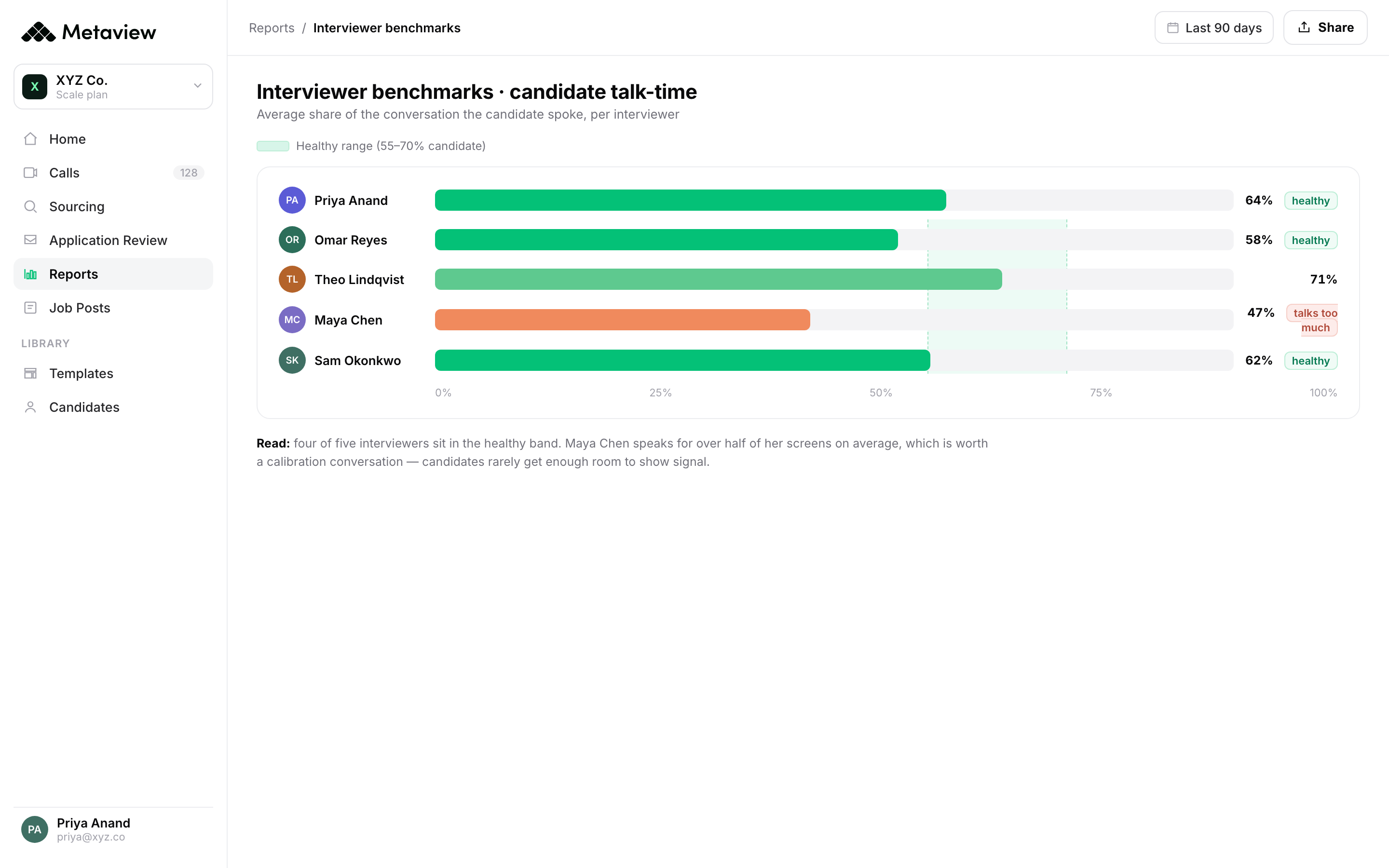
Generic interview training doesn't change behavior. Specific feedback tied to real interview moments does.
Capture every interview. Run an analysis across the corpus to identify which interviewers exhibit which patterns. Then coach each one with concrete examples from their own calls.
Metaview captures every spoken word of the interview and drafts the scorecard for the interviewer to review and submit. Metaview Reports then shows which interviewer has which pattern across the team's own captured interviews, in the product or through Claude. The submission gap in the card above (50.3% of AI-generated scorecards submitted, against 28.6% of the ones interviewers started by hand) is an association rather than proof, since teams that switch on drafting may already run tighter loops, but it's large enough to act on. Brex, Quora, Workleap, and Catawiki are among the 4,000+ organizations running hiring on Metaview.
Bring Metaview into your hiring stack.
Live notes, structured scorecards, and ATS sync, set up in under 10 minutes.
Frequently asked.
How do I know if my interviewers are weak?
Start with the scorecards they submit: ratings with no evidence note and feedback that arrives days late are the first tell. Then watch two or three of their captured interviews for talk share and follow-up, and if you run a candidate survey, ask whether the interviewer had read the candidate's background.
Can bad interviewers be fixed?
In most cases, yes, because most of the ten signs are habits an interviewer picked up when nobody showed them their own interview, and habits respond to specific feedback. The exception is the interviewer who rejects structure on principle, and that's a conversation for their manager rather than a coaching plan.
Should weak interviewers be removed from panels?
Only as a last resort, because removing an interviewer also removes a stakeholder from the hiring decision. Coaching from the interviewer's own calls fixes most cases, so pull someone from a panel only when they keep rating on gut feel after repeated specific feedback.
What does a good interviewer do differently?
They ask open questions tied to the competencies on the scorecard and follow up until they hear what the candidate personally did and what came of it. They let the candidate do most of the talking, and they submit a scorecard with a rating and an evidence note for each competency on the same day.
How do I roll out interviewer coaching at scale?
Start by capturing every interview. Then pick one pattern at a time, such as talk share, and show each interviewer their own number against the team median alongside one moment from their call. Begin with the hiring managers who interview most, since they set the tone for the rest of the panel, and repeat the review every quarter rather than running a one-off training.
How do I give an interviewer this feedback without it landing as criticism?
Lead with a specific moment from their own interview and tie it to the rating they couldn't back up in the debrief. Then agree on one change for the next interview. Skip the label: “you talk too much” starts an argument, while “you did most of the talking in the last call and the candidate never got to their example” starts a fix.
