

Most recruiting teams obsess over the wrong risk. The bad hire that slipped through gets the postmortem; the great hire that walked away never does. The false negative is the more expensive mistake, and it almost never shows up on a scorecard. Arthur Matuszewski built his career on the opposite habit.
Arthur Matuszewski, managing partner at Carrara and formerly a talent leader at Bridgewater and Better, joined Nolan Church on 10x Recruiting (more episodes on the 10x Recruiting hub) to unpack the hiring anti-portfolio: the candidates you passed on who went on to do extraordinary things. The lesson sits at the center of how he advises founders today.
This recap walks through the operating habits behind that philosophy: how to surface upside instead of optimizing for safety, why pedigree predicts less than output, and what intellectually honest talent systems actually look like in practice.
Hire for upside, not safety.
Most recruiting teams optimize the wrong axis. The pipeline gets engineered to avoid bad hires, which sounds responsible until you realize the same system is also filtering out the people who would have changed the trajectory of the business. Safety-first hiring is the most expensive kind of hiring there is, because the cost shows up in the work you never produced.
Arthur frames it as a portfolio problem. The downside of a wrong hire is bounded; you exit them in months. The downside of missing the right hire compounds for years. Recruiting systems that only count the first kind of error miss the larger one entirely.
We were more concerned about the false negatives than the false positives. We tried to study the cases where we didn't hire someone, or couldn't unlock their potential, and they went on to do amazing things.”
Track your hiring anti-portfolio.
The practice Bridgewater institutionalized is one any team can copy: keep a list of every candidate you rejected, and revisit it every twelve months to see what they did next. The findings change how you screen. If the same kind of profile keeps showing up on the anti-portfolio, the bar is not the problem; the filter is.
Most teams will not run this exercise because it produces uncomfortable answers. Arthur's view is that the discomfort is the point. "The only safety that you have is in being able to bet on yourself," he told Nolan. The same logic applies to recruiting teams: the only way to get better is to keep auditing your own decisions against the world's verdict.
The mechanics are simple. A quarterly review of the past year of rejections, with three columns: who they are now, what they shipped, and whether your reasons for passing still hold. Patterns surface fast.
Why individual brilliance often fails.
Bridgewater spent years hiring the smartest individual contributors available, then watched them struggle to compose into a working team. The sum of the whole was not greater than its parts, and often it was less. The mistake was treating talent as an input rather than a fit-to-work question.
Arthur's example is the company hiring Fulbright scholars as executive assistants. "When you're trying to schedule a meeting, you don't want people debating the nature of time. You want people to just schedule the meeting." Brilliance in the wrong seat produces nothing the business can use.
The corrective is to define the work first. What gets shipped if this seat is filled well, and what gets blocked if it is filled poorly. The answers usually point to a different candidate profile than the resume-led search would have surfaced.
Intellectual honesty as the real edge.
The Bridgewater operating manual was famous for radical transparency, real-time peer feedback, and obsessive measurement. Arthur is careful to separate the cultural theater from the actual edge. The edge was intellectual honesty: the willingness to update when the data said the strategy was wrong.
Experimentation without honesty is just expensive theater. Most companies will not pay for a research budget large enough to run controlled hiring experiments, which means the only viable substitute is the discipline of admitting when an assumption broke and changing course.
Arthur's bar: detach from sunk costs, ego, and identity. The hiring system gets better when the people running it stop defending decisions they made six months ago and start asking whether the decision they are about to make is right.
Output is the only credential.
The old hiring model rewarded pedigree as a proxy for performance. Brand-name companies on the resume, top schools, long tenure. The work was assumed to follow. Arthur's read on the current market is that the proxy has broken. You are increasingly only as good as the points you put on the board.
Two implications for how teams run searches. First, the screening question shifts from "where have they been" to "what did they ship in the last twelve months." Second, the interview should put the work in front of the candidate. A working session beats six rounds of behavioral interviews for predicting whether someone can actually do the job.
Arthur is direct about what this means for recruiters themselves. "What you're paid for is generating momentum for aligning direction." The same accountability applies in-seat: visible output, every week, mapped to a business outcome.
Where AI gives recruiting teams use.
The hardest part of running Arthur's playbook in-house is not the philosophy; it is the operational drag of capturing intake, syncing it across the hiring team, and tracking whether the bar you said you would hold actually held. Most teams lose the thread between the kickoff call and the offer because the brief drifts and nobody notices until the wrong shortlist lands.

Searches against the intake-captured definition of the work, not against keyword proxies. The candidate profile the resume-led search would have missed surfaces in the first pass.

Scores every applicant against the demand-side rubric. The false-negative rate falls because the filter stops over-weighting pedigree and starts reading actual output.

Captures every intake and interview verbatim so the brief stays alive across every conversation. The quarterly anti-portfolio review starts with real text, not memory.

Tracks whether the people you hired actually performed at the 30, 60, 90, and 12-month marks. Intellectual honesty becomes an artifact instead of an aspiration.
That drag is what Metaview Notetaker removes. Every intake and interview gets captured, structured, and surfaced back into the workflow so the brief stays alive across every conversation. The upstream version of the same problem (application volume, AI-generated noise, false negatives on early-stage screens) gets handled by Application Review. And the closing loop sits in Reports, which tracks whether the people you actually hired performed against the bar you set.
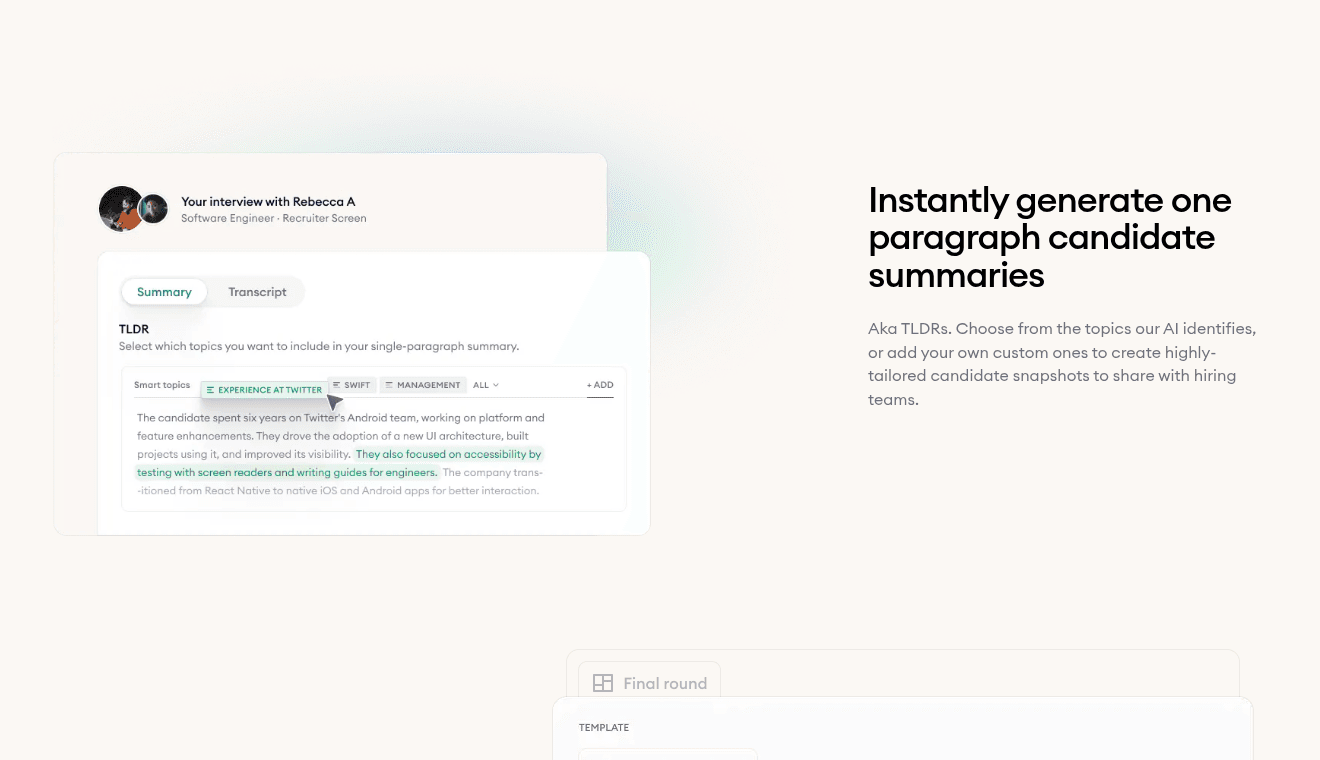
- 1The intake call lands here verbatim. The demand-side definition Arthur insists on (what gets shipped if this seat is filled well) is captured before the search opens.
- 2The structured Q&A template makes the rejection rationale auditable. The quarterly anti-portfolio review starts here, not in someone's memory.
- 3The TLDR is what the team revisits 12 months later when they ask whether the reasons for passing still hold. Intellectual honesty becomes a workflow, not a virtue.
Numbers from the 2026 AI & Hiring Alignment Report, surveying 505 recruiting leaders and hiring managers across North America and EMEA. The 3.8x relationship lift maps directly to Arthur's anti-portfolio thesis: when AI captures the screening signal, the recruiter and hiring manager calibrate from the same evidence and the false-negative rate falls.
The operating shift.
Three concrete moves from Arthur's playbook for any team that wants to stop optimizing for safety and start optimizing for upside:
One: run a quarterly anti-portfolio review. Pull the past twelve months of rejections, three columns: who they are now, what they shipped, and whether your reasons for passing still hold. Patterns surface within two reviews.
Two: replace the behavioral interview with a working session. Put the work in front of the candidate. One ninety-minute session that mirrors the actual job will tell you more than five rounds of competency questions.
Three: start every search with demand, not supply. Define what gets shipped if this seat is filled well, and what gets blocked if it is filled poorly. The answers usually rewrite the candidate profile you started with.
The teams that run these three moves stop hiring the safe-looking candidate and start hiring the right one. That is the entire game.
Bring Metaview into your hiring stack.
Live notes, structured scorecards, and ATS sync - set up in under 10 minutes.
Frequently asked questions.
What is a hiring anti-portfolio?
A running list of candidates you rejected and what they went on to do. Reviewed quarterly, it surfaces the patterns in your false negatives, the exceptional people your screen filtered out who later created outsize impact elsewhere. The practice forces a recruiting team to audit its own bar against the world's verdict.
Why is a false negative more expensive than a false positive?
A wrong hire is bounded; you exit them in months. The right hire you missed compounds for years through every outcome they would have driven and every teammate they would have raised. Recruiting systems that only count the first kind of error miss the larger one entirely.
How do you replace pedigree-based screening?
Shift the screening question from "where have they been" to "what did they ship in the last twelve months." Then put the work in front of the candidate in the interview itself. A single ninety-minute working session predicts on-the-job performance better than five rounds of behavioral interviews.
What does "start with demand, not supply" mean in practice?
Define what success in the seat looks like before you go shopping the candidate market. What gets shipped if this seat is filled well; what gets blocked if it is filled poorly. The answers usually rewrite the candidate profile you would have run with, and surface profiles a resume-first search would miss.
How does intellectual honesty differ from experimentation in hiring?
Experimentation requires a research budget most companies do not have. Intellectual honesty is the cheaper substitute: the discipline of admitting when an assumption broke and changing course. The point is not to be right; the point is to update fast when the data says you are wrong.
